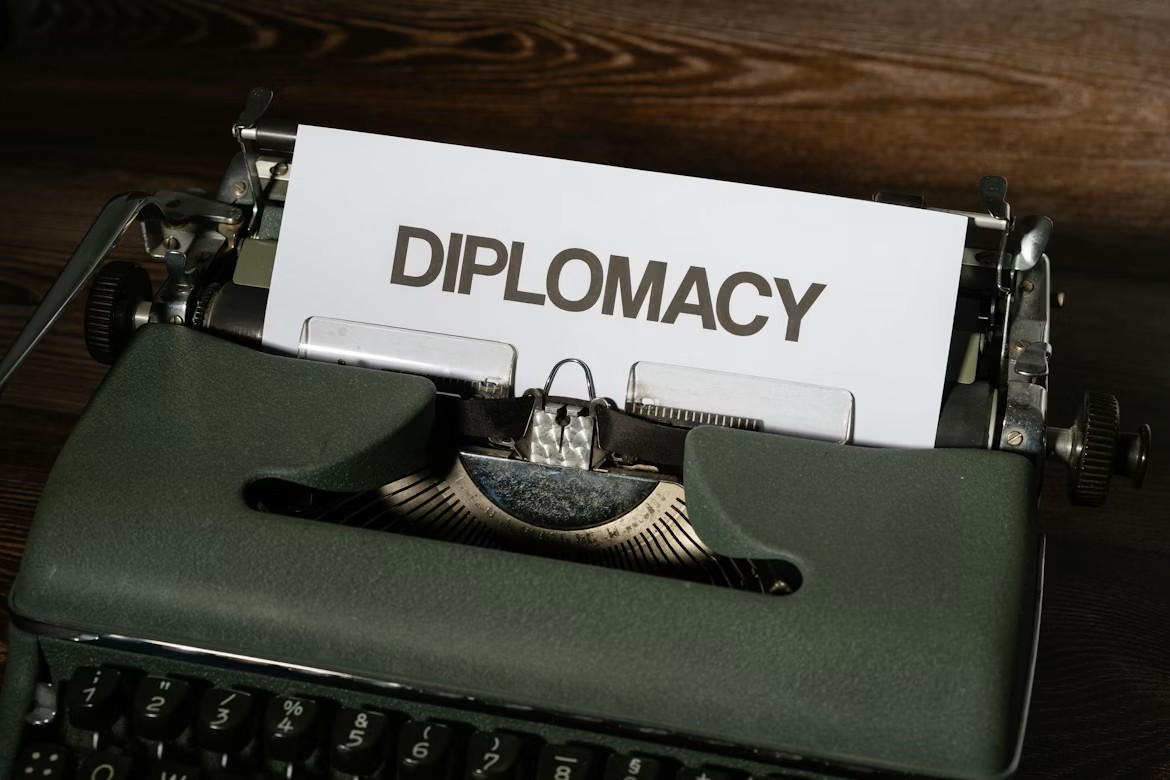
It is a foundational premise of international legal theory that law between states operates through consent, reciprocity, and the sustained practice of interaction that generates customary norms. Unlike domestic legal systems, international law is devoid of a centralised enforcement mechanism; its binding force is derived from the voluntary participation of states in an interconnected web of obligations, institutions, and expectations. Most people overlook how diplomacy holds the whole structure together. When talks stop, when embassies close, when treaties go unsigned, summits fade away, and civil servants halt their behind-the-scenes efforts, international rules do not just weaken, they lose meaning entirely. This is why the erosion of diplomatic culture is not merely an aesthetic or political concern for international lawyers, it is an existential threat to the discipline itself.
When the President of the United States of America, Donald Trump, returned to the White House on 20 January 2025, seasoned diplomats and international lawyers braced themselves with bated breath. What followed was, in the characterisation of one senior Washington analyst, a feeling of watching the same film but “with the safety mechanisms disabled.”
Within hours of inauguration, the White House had announced withdrawals from the World Health Organization and the Paris Agreement, not through measured diplomatic channels, but through executive orders signed before a cheering crowd at Capital One Arena, with Trump declaring he was “immediately withdrawing from the unfair, one-sided Paris climate accord rip-off.”
X, Truth Social, and the Grammar of Second-Term Statecraft
Classical diplomatic theory, from Nicolson to Berridge, posits that the medium of diplomatic communication is not separable from its content. To communicate through formal channels, i.e., the diplomatic note, the demarche, the communiqué, is to acknowledge that one is bound by what one says, that the interlocutor has standing to receive and respond, and that the exchange is embedded in a web of legal and institutional obligations. To communicate through a post on X is to repudiate each of these premises simultaneously. In his second term, Trump has made this repudiation more thoroughgoing than in his first.
Where the first term saw tweets that surprised and sometimes contradicted official State Department positions, the second term has effectively abolished the distinction: What appears online, stands as the official stance. Hedley Bull observed that international order depends upon a set of common institutions, diplomacy among them, through which states pursue their goals while sustaining the system that makes such pursuit possible. The consistent use of social media to issue ultimata, humiliate allied leaders, and announce treaty exits as accomplished facts corrodes precisely this institutional fabric.
Thank You for Your Attention to This Matter
Perhaps no rhetorical gesture better encapsulates the dissonance at the heart of this Trump-era digital diplomacy than the phrase “Thank you for your attention to this matter.” Borrowed from the boilerplate of corporate correspondence and consumer complaint letters, this formula, appended to tweets demanding action from foreign governments, threatening allies with tariffs, or announcing unilateral withdrawals from international agreements, operates as a form of aggressive mock-civility.
In the formal diplomatic tradition, expressions of courtesy are not mere pleasantries: they are legally and politically meaningful gestures that signal the speaker’s acknowledgment of the interlocutor’s sovereignty and dignity. To reproduce those gestures in the context of a public ultimatum is to strip them of their meaning while retaining their form – a kind of diplomatic forgery. What is communicated, in effect, is: “I have used the language of respect, and thus cannot be accused of rudeness, while having demonstrated that I regard your autonomy as entirely irrelevant.”
Withdrawal from 66 International Organisations
On 7 January 2026, the White House published a Presidential Memorandum (January 2026 Memorandum) directing the withdrawal of the United States from 66 international organisations “that no longer serve American interests.” The scale of this withdrawal is without precedent in the history of international institutional participation. It encompassed 35 non-UN organisations and 31 UN entities, including the UN Framework Convention on Climate Change (UNFCCC), making the United States the first and only nation ever to withdraw from that treaty.
The legal implications are severe and multi-dimensional. Under Article 56 (2) of the Vienna Convention on the Law of Treaties, withdrawal from treaty obligations requires notification and a transitional period during which the withdrawing state continues to be bound by its commitments. The January 2026 Memorandum made no provision for orderly transition; it instructed executive departments to “take immediate steps to effectuate the withdrawal as soon as possible.” The Secretary-General of the United Nations expressed “regret” and reported that the US withdrawal from UNFCCC had been communicated to UN officials not through formal diplomatic channels but through news reports and the White House’s social media feed. There had been, in his words, “no formal communication”.
Writing in the American Journal of International Law, Daugirdas and Mortenson have meticulously documented the ways in which the second Trump administration’s treaty exits contravene established international legal obligations, noting in particular the administration’s assertion that the Paris Agreement withdrawal ‘will be considered effective immediately,’ in defiance of Article 28 of the Agreement, which requires a one-year notification period. This is not merely procedural non-compliance. It is a statement of principle: that the United States regards itself as unbound by the processes of international law that bind all other states.
Secretary of State Marco Rubio’s characterisation of the affected organisations as “anti-American, useless, or wasteful” is itself diplomatically significant. To dismiss, in a single phrase, bodies as varied as the UNFCCC, the UNFPA, and the office of the Special Representative for Children in Armed Conflict is to signal that the United States no longer recognises the normative claims of the multilateral system as such; not that it disagrees with specific institutional decisions, but that it rejects the legitimacy of the framework itself. This is categorically different from the normal exercise of sovereign prerogative within a system of shared norms; It is the repudiation of that system.
The Legitimacy Deficit and the Cascading Cost
Thomas Franck’s foundational theory of international legal legitimacy posits that the compliance pull of international law depends on the perceived fairness and coherence of the normative system. When the world’s most powerful state systematically signals that it regards the rules of world order as inapplicable to itself, the calculus of compliance shifts for every other state in the system. Why observe treaty obligations that the hegemon treats as optional? Why invest in diplomatic institutions that the most powerful actor has labelled ‘useless’? Why constrain the use of force when the state that drafted the UN Charter launches wars of choice without Security Council authorisation?
It should be noted, however, that disregard for the prohibition on the use of force did not commence with this administration: the throughline runs at least from Iraq in 2003 through Ukraine in 2022. What distinguishes the present moment is the complete absence of coherent legal justification for the disregard, compounded by the conspicuous failure of most Global North states to mount any meaningful pushback – a silence that normalises impunity as much as the violations themselves. The ripple effects are already visible. By striking Iran in collusion with Israel, the United States has created multiple potential precedents which others may follow in different circumstances and that it will not be easily possible to oppose further Russian aggression or potential Chinese expansionism if there are no clear principles left to rely on. This is the cascading cost of diplomatic erosion: It is not simply that the United States has weakened itself, but that it has weakened the system that constrains all states.
The digital dimension of this erosion has its own cascading dynamic, identified in the scholarly literature on digital diplomacy by Manor and Bjola and Holmes. When foreign policy is conducted through social media, it is structurally addressed to domestic audiences, not foreign interlocutors. The international community becomes the backdrop for a domestic performance. But this inversion has international legal consequences: it means that commitments made in public posts are not made in good faith to a foreign state but for domestic consumption and can be retracted with equal speed and equal indifference to legal obligation.
Koskenniemi’s “From Apology to Utopia” offers a useful lens here: International law survives because states, even when they breach it, feel compelled to justify themselves in its language. That compulsion is itself a form of acknowledgement. An administration that offers no legal justification at all, substituting the same for a social media post, does something qualitatively different: it removes the argumentative scaffolding that holds the system together. A United States that treats a treaty-exit as a matter for social media, that characterises 66 multilateral organisations as contrary to its interests in a single Presidential Memorandum, and that conducts wars of choice while diplomats are mid-negotiation, is not a state behaving badly within a legal system, it is a state that has structurally ceased to treat international law as binding at all. The customary consequences of this, as Byers’ scholarship on state practice and opinio juris warns, may prove permanent.
A Legal Emergency
This piece has not engaged in speculation about possible futures. Everything described here has occurred: the unbridled withdrawal from international organisations, the bombing of Iran during diplomacy, the social media announcements that substituted formal diplomatic communication, the diplomatic resolution promised hours before the bombs fell. The record of the second Trump administration, in international legal terms, is one of systematic and accelerating dismantlement of the communicative and institutional infrastructure upon which international law depends.
The phrase that appears as a recurrent coda in Trump’s most diplomatically consequential posts, ‘Thank you for your attention to this matter’, is the emblem of this pathology in concentrated form. It is the performance of diplomatic courtesy stripped of its substance: a form that acknowledges the interlocutor while simultaneously demonstrating that their response is irrelevant, their sovereignty immaterial, and their legal standing under the international system a matter of indifference. It is, in the most precise sense, anti-diplomatic and it has been delivered, in variant forms, to allied governments, adversary states, and multilateral institutions with equal facility.
International law scholars are not bystanders. The task of the present moment is to document, with precision and without equivocation, what is being lost and to insist, against the normalisation that proximity to power always produces, that the erosion of diplomatic norms is not a stylistic eccentricity but a legal emergency. The bedrock of international law is diplomacy, conducted in good faith, between states that regard themselves as bound by what they say. When that bedrock is systematically removed, by executive order, by a social media post, by bombs dropped on negotiating partners, the structure it supports does not merely wobble, it risks collapse.

Ananyo Mitra is an Assistant Professor of Law at Manipal Law School, Manipal Academy of Higher Education, Bengaluru. His research areas include public international law, criminal law, and jurisprudence.