Wind of (Nuclear) Change
Germany’s Legal Latitude After the NPT Review Conference Failure
Under international law, Germany is not as irrevocably barred from acquiring nuclear weapons as is commonly assumed. In certain circumstances, Germany could be released from Article 3 of the Treaty on the Final Settlement with Respect to Germany (known as the Two Plus Four Agreement, or 2+4) and withdraw from the Non-Proliferation Treaty (NPT). This would allow Germany to pursue a nuclear weapons program without violating international law—or to trade that latitude for renewed, credible security guarantees. This understanding should be a prerequisite for any serious strategic debate.
A caveat: the argument is not that Germany needs nuclear weapons. Germany should impartially assess which options are available and what they cost. The question this commentary takes up is the legal one; the political one is separate, and it cannot be answered on a false legal premise.
The NPT Review Conference
The eleventh NPT Review Conference concluded on 22 May 2026. Like the conferences of 2015 and 2022, it reached no consensus. In the closing press conference, its President, Do Hung Viet, recalled warning that a third inconclusive conference “would be disastrous for this regime”—by his account, the NPT community had not produced a shared commitment in sixteen years.
Consensus on a final document failed amid what the Arms Control Association reports was a dispute over blame for the U.S.-Israel-Iran conflict—though not the only issue; a draft provision strengthening review and accountability was also dropped. This failure has precedent: in 2022, the primary obstacle was Russia’s objection to language on its occupation of the Zaporizhzhia plant; in 2015, the U.S. blocked a proposed conference on a Middle Eastern zone free of weapons of mass destruction.
This failure deepens the rift in the nuclear order—the structure governing relations between nuclear and non-nuclear states. The moment thus provides an opportunity to examine whether the order, as it stands, remains the least bad option, or whether it should give way to something that achieves better security. Central to this is an understanding of the ban on German nuclear weapons.
The NPT
According to the NPT, there are nuclear-weapon states (NWS)—the U.S., Russia, the U.K., France, and China—and non-nuclear-weapon states (NNWS). India, Pakistan, Israel, and North Korea—whose withdrawal status is disputed—are not parties to the NPT but possess nuclear weapons. Article I prohibits NWS from transferring nuclear weapons to NNWS, making nuclear sharing legally contested; the wording arguably allows for a “dual-key procedure.” Article II prohibits NNWS from developing nuclear weapons, though peaceful nuclear energy is guaranteed (Article IV). Article III governs inspections and verification. Article VI obligates parties to pursue disarmament “in good faith.”
Under Article X, any party may withdraw if it perceives “extraordinary events” as a threat to its “supreme interests.” It is therefore inaccurate to claim that the NPT permanently bars Germany from producing or possessing nuclear weapons. But since the NPT serves as the cornerstone of the nuclear order, publicly considering withdrawal could undermine that order.
The U.S.-Israel-Iran conflict shows it is not only a matter of rights but of geopolitics: Iran, still a party, has faced military strikes, while North Korea’s 2003 withdrawal brought only sanctions. Should Iran emerge without new treaty obligations and with the regime intact, it could follow North Korea—and further U.S.-driven confrontations could draw South Korea, Japan, or Saudi Arabia into a conversation about nuclear weapons.
The Two Plus Four Agreement
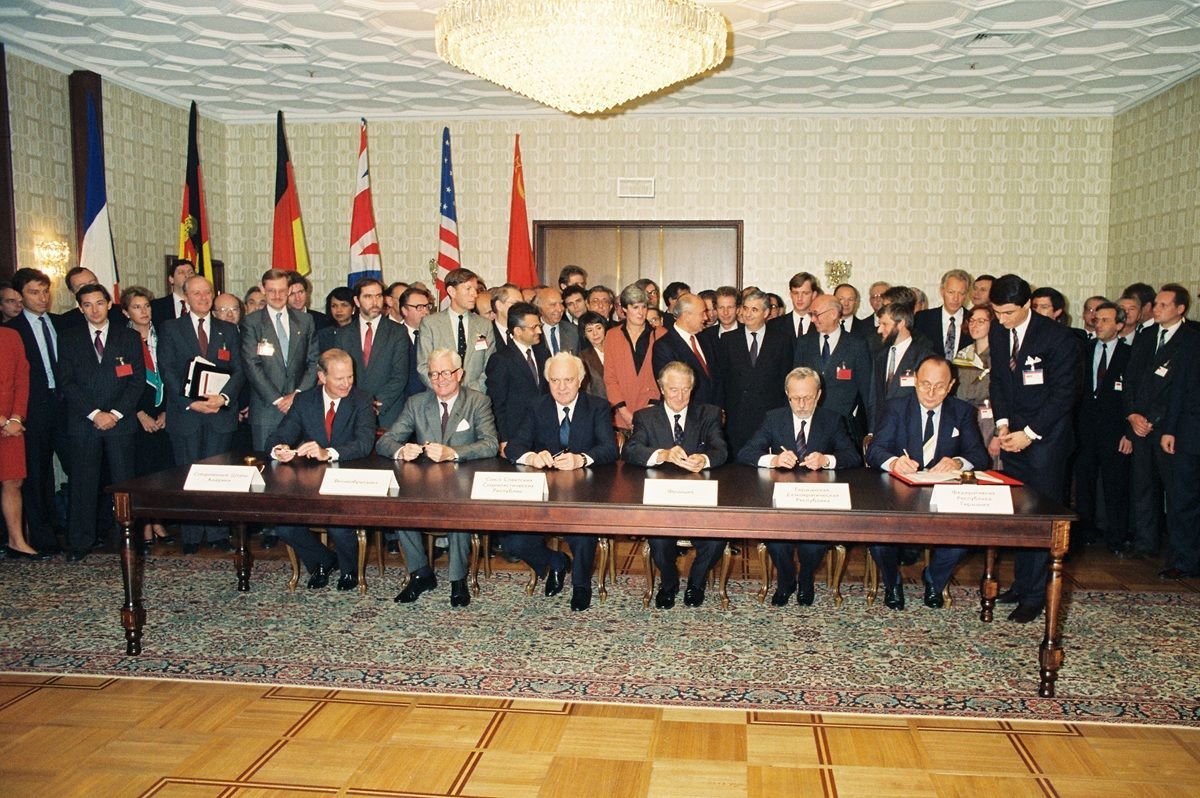
The NPT is linked to the 2+4, which made reunification possible, confirmed Germany’s borders as final, and restored its full sovereignty. The 2+4 does not contain an “opt-out clause” and can thus be viewed as stronger in international-law terms than the NPT. The European Nuclear Study Group’s (ENSG) “Mind the Deterrence Gap” report confirmed this, stating the 2+4 “forbids any form of German control over nuclear weapons,” though noting “some German commentators have recently questioned whether this provision should remain in force.”
Here, too, a closer look is necessary. Article 3(1) consists of three sentences:
“The Governments of the [FRG] and the [GDR] reaffirm their renunciation of the manufacture and possession of and control over nuclear, biological and chemical weapons. They declare that the united Germany, too, will abide by these commitments. In particular, rights and obligations arising from the [NPT] will continue to apply to the united Germany.”
On an initial reading, sentence 1 appears to be an explicit declaration imposing the renunciation as a new obligation. The Bundestag’s Research Service, however, reads it as doing the opposite: confirming that the 2+4 did not impose any new obligations on the united Germany (WD 2-3000-008/24). The affirmation, it argued, is merely “declaratory”—a reminder to adhere to existing obligations. The Service subsequently confirmed this (WD 2-3000-060/24).
The Service’s understanding is based on the NPT, not on Germany’s earlier commitments (Adenauer’s 1954 declaration, carried into the Paris Agreements); whether those older commitments retain independent force today—bound up with arrangements since superseded—is a separate question this commentary does not pursue. What a withdrawal from the NPT would leave standing is thus not fully settled; however, sentence 3 preserves the right to withdraw under Article X of the NPT.
Sentence 2 could be read as imposing new obligations on a united Germany—in line with the Four Powers’ demand for a renunciation of nuclear weapons in exchange for reunification. This maximalist interpretation would go beyond sentence 1 and could effectively nullify Article X as an option for Germany. One could also interpret sentence 2 as merely extending sentence 1 to a united Germany.
Germany’s Options
The ENSG’s report evaluates five options for Europe: (1) U.S. extended nuclear deterrence; (2) French/U.K.-based European nuclear deterrence; (3) a Eurodeterrent; (4) new, independent national nuclear deterrents; and (5) no nuclear deterrent. Its verdict: Europe faces no good options, only less bad ones. Each affects Germany differently and is worth considering.
Regarding option 2, in February 2026, German Chancellor Friedrich Merz said he did not want Germany to consider developing its own nuclear weapons, but that the standing French offer could not be left unexamined, and asked whether France and the U.K. might match the U.S. umbrella. On 2 March 2026, the German government confirmed that Germany and France had “established a high-ranking nuclear steering group” but would “continue to comply with their obligations under international law including the [NPT].” Yet, on the same day, President Macron ruled out any joint planning, execution, or final authorization of use—precisely what the U.S. “dual-key procedure” allows. Nevertheless, Germany could provide financial support for France’s nuclear weapons, as the NPT does not preclude this.
However, France will elect a new president by April 2027; should the far-right Rassemblement National win, any eventual arrangement could be overturned, and a victory of the political left also carries this risk. Even if such a Franco-German agreement survived the election, it would be far more politically sensitive than the Future Combat Air System, whose manned-fighter core—despite active involvement from France, Germany, and Spain—was abandoned on 8 June 2026 after nearly a decade.
The British situation is more complicated than the French, as the U.K. depends on the U.S.—which provides the Trident missiles. This brings us back to option 1: the U.S. itself is the source of much of Germany’s uncertainty. In early June 2026, reporting suggested the U.S. would cancel the planned sale of Tomahawk missiles to Germany, reportedly over fears Russia would see the sale as escalation (in July, however, Merz announced an agreement to acquire Tomahawks—a letter of intent signed at the Ankara NATO summit, with U.S. approval promised for August). This reporting emerged roughly a month after the U.S. announced, on 1 May 2026, the withdrawal of 5,000 troops from Germany—which followed Merz’s criticism of the U.S. strategy toward Iran.
If the U.S. invokes fears over Russian escalation to withhold conventional capabilities, this undermines the credibility of the U.S. extended nuclear deterrence for Germany. Meanwhile, a Eurodeterrent is politically all but impossible, lacks a plausible configuration, raises NPT-compliance questions, and carries a high risk of decision paralysis.
“Zweigleisigkeit”
Given these uncertainties, option 4 warrants attention. The ENSG report lists legal constraints among the feasibility limits that render some options unlikely; for Germany, that constraint is Article 3. In the 2+4 talks, Germany traded the option of nuclear weapons for reunification. The NPT Review Conference failure opens the possibility of securing a comparable bargain via Zweigleisigkeit, a strategy of holding two complementary negotiating positions: simultaneously seeking a credible legal route out of Article 3 of the 2+4 while offering to renegotiate the nuclear order.
On the one hand, Germany may not wish to alter the nuclear order but might be forced to consider clausula rebus sic stantibus—the doctrine that a fundamental change of circumstances can call the promises of 1990 into question. This clause forms the basis of Article 62 of the Vienna Convention on the Law of Treaties (VCLT).
During unification, as Robert Zoellick wrote in 2000, “America’s strategic aim was to promote peace and security […] by pressing for Germany’s unification within the European Community and NATO.” Zoellick noted that Gorbachev told Bush at Malta in December 1989 he wanted U.S. troops to stay in Europe; Bush replied they would remain only as part of NATO, so a continued U.S. presence depended on a healthy alliance. Should the U.S. now step back from defending Europe—as the developments above suggest—the calculus that underpinned the 2+4 would change.
But further complications arise: the VCLT might not be applicable to the 2+4 due to Article 4 VCLT limiting application to treaties concluded after the Convention’s entry into force with regard to the parties, since France and the U.S. never ratified the VCLT; but Article 62 VCLT binds as customary law regardless (see ICJ, Fisheries Jurisdiction, 1973 para. 36; Gabčíkovo-Nagymaros, 1997 paras. 46, 99-104). Moreover, the Service rejected Article 62 on two grounds: in February 2024 (WD 2-3000-008/24) it found no objective change in external circumstances—attitudes and new alliances, it held, do not qualify—and it inclined toward classifying the 2+4 as a border-establishing treaty under Article 62(2)(a) VCLT. The first finding predates the developments above, which are conduct rather than attitudes (a May 2026 brief, EU 6-3000-070/26, restates the 2024 analysis without engaging this conduct).
However, it would likely be consistent with the VCLT to distinguish between the border clause and other obligations under the 2+4, since Article 62(2)(a) VCLT protects the stability of the border demarcation itself, but does not entirely preclude Article 62(1) VCLT as a reason for terminating the treaty. Furthermore, the issue would not be to alter Germany’s borders—these are separately confirmed by treaty with Poland—but to recognize that the same “extraordinary events” justifying withdrawal under Article X of the NPT could also be relevant as a “fundamental change of circumstances” within the meaning of Article 62(1) VCLT.
Article 44(3) VCLT, or a comparable customary procedure, then provides for the separability of treaty provisions. Severance of Article 3 of the 2+4 would thus be feasible in principle. Most obligations were tied to unification and are, on the Service’s account, now obsolete; what continues (WD 2-3000-061/24) is Germany’s own renunciation under Article 3, alongside the Article 5(3) ban—which, too, binds the three Western powers—on stationing foreign forces or nuclear weapons in the former GDR.
Germany has reaffirmed its commitment repeatedly since reunification, but this does not change the analysis. Under international law, the possibility of invoking clausula rebus sic stantibus exists independently of political declarations—provided there is no breach of good faith. That invocation would be the “nuclear option”: Article 62 VCLT would then provide grounds for severing Article 3 of the 2+4 alone, while Article 44(3) VCLT would provide the mechanism.
On the other hand, the NWS could create a new nuclear balance and take Germany’s concerns—and those of other NNWS—seriously, so that Germany need not sever Article 3 of the 2+4. But the failed conference indicates that this is currently unlikely—unless a state like Germany exerts pressure, as this Zweigleisigkeit would allow.
Consequences
In January 2026, Merz invoked the 2+4 and the NPT, concluding that the question of nuclear weapons lies outside Germany’s discretion. He held to that position in February. The political conclusion thus rests on a legal premise—and that premise is less firm than it appears. Germany has options. But to make use of them, Germany must understand the international legal position precisely and acknowledge that its obligations are not as immovable as some assume.
The author is grateful to Professor Oliver Dörr for his help in understanding Article 3 of the Two Plus Four Agreement and Articles 44 and 62 VCLT, and for his critical reading of an earlier draft, which saved the piece from errors of substance and emphasis alike. He also thanks the anonymous reviewer and the Völkerrechtsblog editorial team. The argument and any errors that remain are the author’s alone.

Gabriel H. Heyl is a doctoral researcher at the Centre for Security, Diplomacy and Strategy, Brussels School of Governance (VUB). His research examines the nuclear-deterrence strategic cultures of France, Germany, and the United Kingdom—in particular the longer-term patterns of thought underlying them, of which international law is one structuring factor.
One question the piece deliberately leaves open is whether the same facts could satisfy the requirements of both Articles 62(1)(a) and 44(3)(b) VCLT.