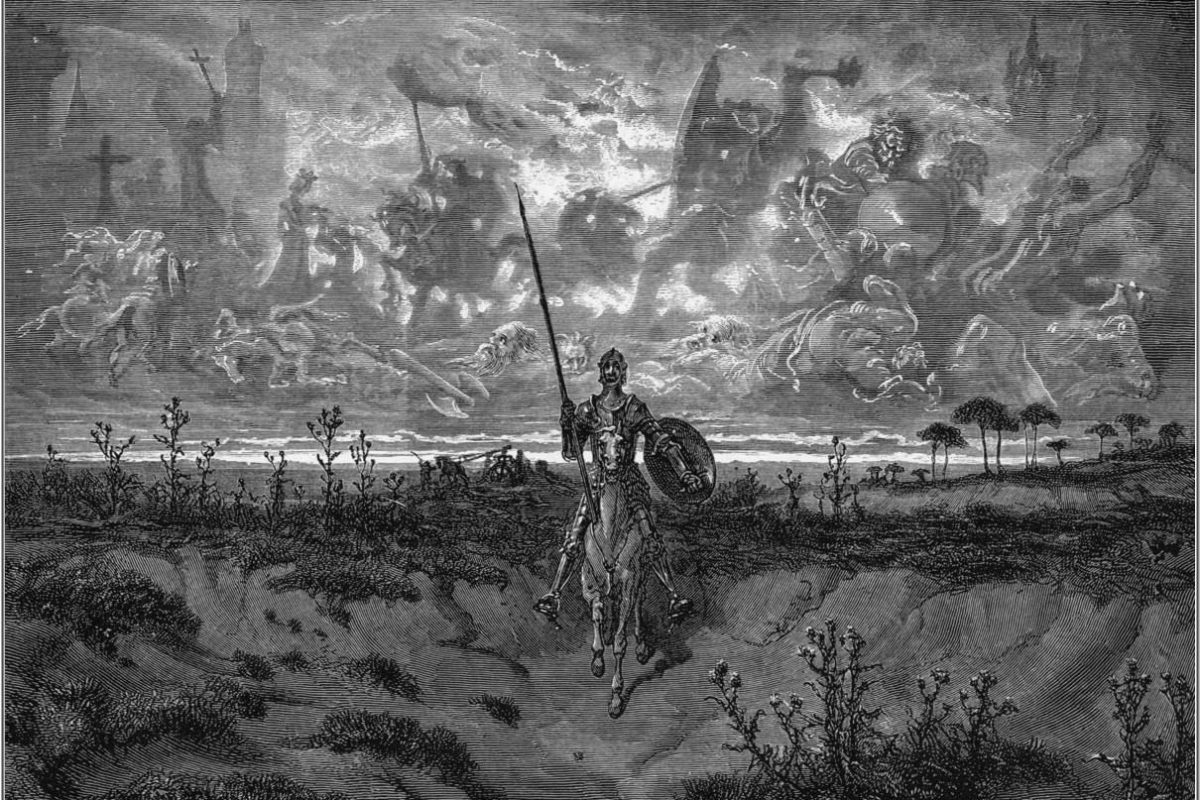

The Last Knight of International Law
Don Quixote and the Persistence of Legal Worlds
Don Quixote‘s first mistake is not to attack a windmill. It is to believe that the world still speaks the language of the books from which he learned how a knight should act. He rides into La Mancha carrying an elaborate normative order: duties towards the distressed, rules of honour and combat, distinctions between knights and commoners, procedures for acquiring knightly status, and a vocabulary through which injustice can be identified and corrected. His problem is therefore not the absence of rules, but the persistence of a normative world after the social world to which those rules are applied no longer resembles the one described in his books. Does international law face its own version of that problem?
This post argues that Don Quixote by Miguel de Cervantes offers a way of thinking about a recurrent problem in international law: the persistence of legal categories beyond the historical and institutional conditions in which they acquired their authority. International law encounters the world through abstractions such as sovereignty, equality, territory, personality and jurisdiction. The difficulty is not that these categories are fictions; law cannot operate without its own classification. The harder question is what happens when a category retains its coherence while the relations it is meant to organise change. Cervantes’s knight therefore raises a more demanding question than whether international lawyers sometimes mistake windmills for giants: how does a legal order know when the world around its categories has changed?
That question is especially pressing now, at a moment when international law is being asked to govern relations transformed by technological change, planetary environmental risks, and institutions whose practical functions do not always fit comfortably within inherited legal forms. The pressure is not simply for new rules. It is also a question of whether the categories through which international law allocates authority and responsibility still correspond sufficiently to the relations they are meant to organise.
When an Inn Becomes a Castle
Before Don Quixote can begin righting wrongs, he encounters a problem of status. He has not been dubbed a knight and worries that, under the law of chivalry he has adopted, he cannot lawfully engage in knightly adventures. The first inn he reaches becomes, in his eyes, a castle. Its landlord becomes a castellan. Don Quixote asks him to perform the necessary ceremony to be knighted. The landlord, recognising the delusion and eventually wishing to move his troublesome guest along, obliges: an account book serves as a ceremonial text, ordinary participants acquire roles within the imagined order, and Quixote leaves satisfied that his defective status has been cured.
The episode is a useful instance because Quixote’s world is organised through classification. In his eyes, the inn does not merely look like a castle. Once classified as one, it generates consequences: the landlord acquires authority; the women at the inn become ladies; gestures become ceremony; and Quixote’s own legal position changes. A category does not merely name the encounter. It structures it.
International law, of course, is not a private fantasy. Its categories are produced and maintained through recognised legal processes, institutional practice and legal argument. Yet classification remains constitutive of how the legal order encounters social reality. To characterise an actor as a State or an international organisation, to recognise it as an international legal person, to identify an individual as a national, or to delimit a place as territory is to attach legal consequences to that status. These categories make certain relationships legally intelligible while determining the vocabulary through which they can be addressed.
Sovereign equality illustrates both the necessity and the limit of abstraction. Article 2(1) of the United Nations Charter establishes the sovereign equality of all Members. The proposition is juridical, not sociological: it does not assert equality of territory, wealth, military capacity or political influence. Yet the Charter itself institutionalises differentiation. Article 27 gives the permanent members a distinctive position in Security Council voting on non-procedural matters. Equality and differentiation therefore coexist within the same legal architecture.
This does not make sovereign equality unreal. Nor does material inequality negate its normative function. The difficulty begins elsewhere: when a juridical abstraction is treated as a sufficient account of the relations it regulates. A category that makes legal relations possible may also obscure the distribution of power that conditions how those relations operate. The inn does not become a castle merely because the category renders the encounter coherent.
The distinction also matters in practice. Formally equal States do not participate in international institutions, negotiations or dispute settlement with equal capacity. Such disparities can shape which claims can be sustained, which obligations can be effectively implemented and which interests acquire institutional influence. The point is not that sovereign equality is fictitious, but that formal equality may coexist with unequal capacity to make use of the legal order that equality makes possible.
The Wrong That Was Righted
The episode of Andrés presents a different problem. Don Quixote encounters a young servant tied to a tree and being beaten by his master, Juan Haldudo. Here the knight does not misunderstand the basic injustice. He sees the violence, hears the dispute over unpaid wages and intervenes. He calculates what Andrés is owed, orders Haldudo to pay, and obtains a promise that payment will be made. Andrés warns him that once the knight leaves, his position may become worse. Don Quixote nevertheless departs convinced that the wrong has been righted.
It has not. Once Quixote is out of sight, Haldudo ties Andrés to the tree again, beats him severely and leaves him for dead.
This is, in some respects, a more legally interesting failure than the windmills. Quixote identifies the wrong and articulates what ought to happen. His error lies in assuming that declaration, obligation and compliance form a continuous sequence. Having stated the rule and obtained a promise, he behaves as though the material relationship between the parties has already been transformed.
International law should not be reduced to this problem. It possesses courts and tribunals, international organisations, domestic implementation mechanisms, monitoring procedures and different accountability and enforcement structures. Their availability and effectiveness vary considerably across ‘regimes’. The more limited point exposed by Andrés is nevertheless familiar: the question of what law requires is not identical to the question of what makes that requirement effective.
Legal validity does not depend on perfect enforcement. Conversely, the existence of an obligation does not establish that the conduct or relationship it addresses has been effectively governed. Formal commitment, institutional capacity, supervision, implementation and consequences for non-compliance are related, but they are not interchangeable. Quixote’s satisfaction after leaving Andrés reveals a particular temptation of legal formalism: to mistake the successful articulation of a rule for the successful governance of the relationship to which it applies.
The irony is that his intervention is motivated by justice. The normative demand is not necessarily the problem. The weakness lies in the institutional form through which he expects that demand to become effective.
The Windmills Are Still There
The windmills introduce a third problem. Sancho tells Don Quixote what stands before him. They are windmills, not giants. Quixote attacks anyway. The material world then supplies unusually direct evidence: a moving sail shatters his lance and throws horse and rider to the ground. Even then, he does not revise the category. The sage Friston, Quixote concludes, has transformed the giants into mills to deprive him of the glory of defeating them.
The interpretive move is more important than the initial mistake. Evidence that should place pressure upon the category is absorbed into an explanation that protects it. The contradiction no longer tests the framework; the framework explains the contradiction away.
International law is not structurally condemned to this form of closure. Its concepts can be reinterpreted, its rules can develop, and its institutions can confront situations for which inherited categories are insufficient. The 1949 Reparation for Injuries Advisory Opinion offers a particularly useful counter-example. Asked whether the United Nations could bring an international claim, the International Court of Justice did not treat the Organisation as if it were a State. It reasoned that the functions and rights attributed to the United Nations could be explained only if the Organisation possessed a measure of international personality and a capacity to operate on the international plane.
The Court’s broader formulation remains significant. The subjects of a legal system need not be identical in their nature or in the extent of their rights; their nature depends upon the “needs of the community”. The point should not be overstated. Reparation did not displace the central position of States or create an unlimited doctrine of international legal personality. It demonstrated something narrower: the legal order could recognise that an actor need not fit an inherited form to possess the capacities required by the institutional reality in which it operated.
That capacity for revision is as important to law as stability. International law cannot reinvent its basic vocabulary each time political, economic or technological conditions change. The persistence of concepts such as sovereignty, equality, jurisdiction and personality coordinate expectations precisely because they persist. But persistence is not the same as immunity from reconsideration. The difficulty arises when contrary practice, institutional change or altered relations of power can only be classified as exceptions, while the conception generating those exceptions is placed beyond revision.
At that point, the category begins to resemble Quixote’s giants. The evidence changes, but the explanation has acquired a mechanism for surviving the evidence.
After Chivalry
For international law, Don Quixote’s most interesting error is therefore not idealism. His commitment to justice is often more attractive than the world he encounters. Nor is the lesson that inherited legal concepts should be discarded because they are old. The greater difficulty lies in his inability to distinguish fidelity to a principle from fidelity to the inherited form through which he has learned to express it.
International law requires a comparable discipline. It needs abstractions because no legal order can operate without them. Sovereign equality need not describe material equality to perform a legal function. International personality need not be identical across all legal subjects. The demand is therefore not for a law without categories, but for categories that remain open to the world they organise.
Cervantes’s knight survives almost any contradiction by translating it back into the language of chivalry: the inn remains a castle; the windmills were giants until an enchanter altered them; Haldudo’s promise allows Don Quixote to leave Andrés behind believing justice has been done. The system retains its coherence because the world is rarely permitted to correct it.
That is the more serious Quixotic temptation for international law. The danger begins when the persistence of a category becomes evidence of its adequacy, and when every mismatch between legal form and institutional reality is treated as an anomaly rather than as a reason to ask whether the form itself requires reconsideration.
That problem is not confined to moments of doctrinal crisis. It arises whenever inherited legal forms remain formally intact while the actors, technologies or material relationships organised through them have changed. The discipline required of international lawyers is therefore neither to celebrate continuity nor to pursue novelty for its own sake. It is to test legal categories against the institutional realities they claim to organise, and to ask whether fidelity to the category still preserves the principle that once gave it authority.
International law does not need to abandon its inherited vocabulary each time the world changes. It must, however, preserve the capacity to recognise when that vocabulary no longer explains enough. The windmills may remain. The task is to know when calling them giants no longer clarifies the world, but protects the category from it. The last knight of international law is, therefore, not international law itself, but the jurist who can no longer distinguish continuity from correspondence.

Gustavo Leite Neves da Luz holds a PhD in Law from the University of Hamburg. Specialized in international procedural law, international environmental law, and the law of the sea.