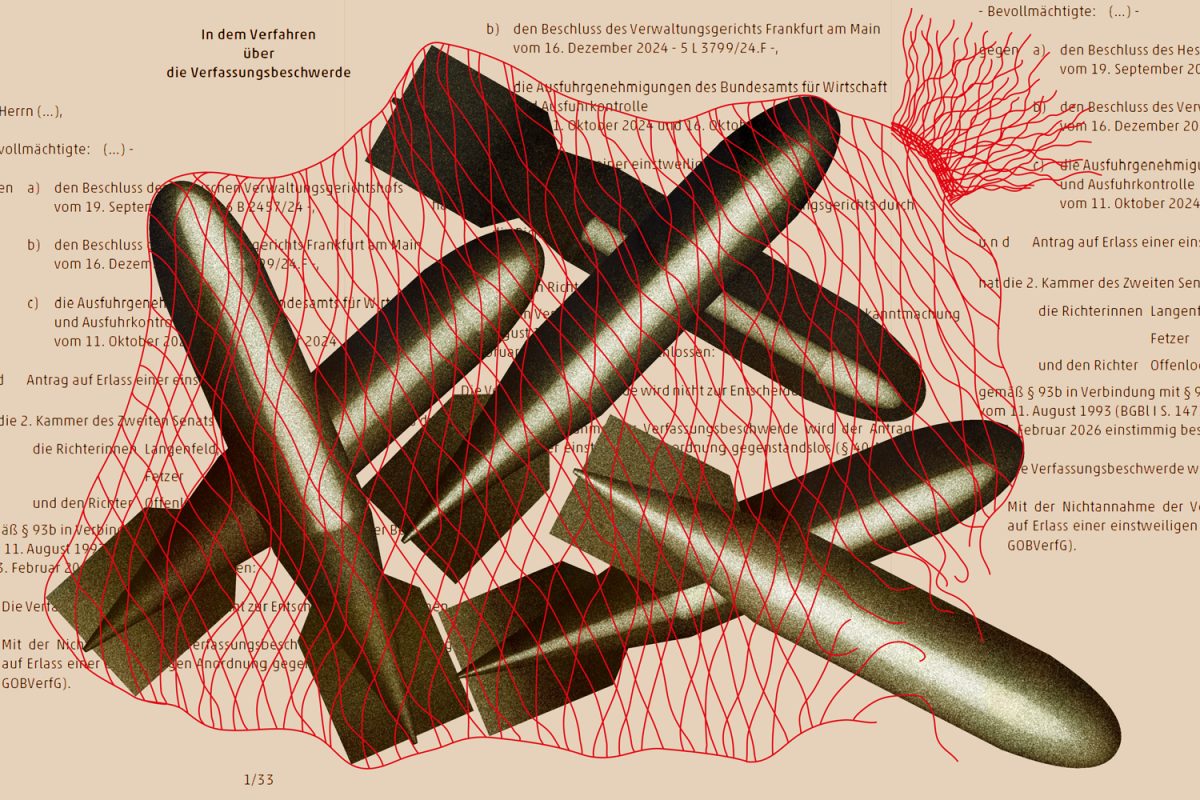
The Illusion of Compliance
The German Constitutional Court Endorses the Restriction of Individual Legal Protection in Arms Export Cases
Prior to 2024, litigation against arms export licenses constituted an infrequent legal remedy in Germany. This was caused by interconnected determinants, comprising the complex dual structure of the German arms export laws and insufficient transparency in arms export decisions. Simultaneously, Germany has been the second-ranked exporter of arms to Israel over the past ten years, behind the US. The volume experienced a preliminary increase following the Hamas attack against Israel on 7 October 2023. After German arms had been directly associated with violations of international humanitarian law (IHL) by the Israel Defense Forces (IDF), and proceedings were initiated by Nicaragua before the International Court of Justice against Germany and by the Prosecutor of the International Criminal Court against Israeli officials, the transfers nevertheless persisted.
This provided impetus for strategic litigation by several NGOs and lawyers before the Administrative Courts in Berlin and Frankfurt beginning in 2024. In 2025, the Ramstein judgment established a prospective framework for reviewing the German state’s obligations regarding violations of international law by other states. This blog post will engage with the German Federal Constitutional Court’s (GFCC) recent decision of 3 February 2026 on arms transfers, its positioning within pertinent case law, and its interaction with the Ramstein judgment to assess its impact on the relationship between domestic and international law.
Strategic Litigation Against Arms Export Licenses since 2024
The increasing use of strategic litigation before German courts in the fields of foreign and defense policy has opened new pathways for contesting state behavior and policy decisions, resulting most prominently in the aforementioned Ramstein judgment. Strategic litigation can be classified as a legal challenge to state behavior through courts by organizations or individuals using specific approaches in seeking to achieve large-scale legal, political, social, or other impact beyond a particular case. While general access to German courts requires a possible violation of one’s own individual rights, the GFCC has established that German fundamental rights are also applicable to foreign citizens abroad who are subject to German executive force and may bind German executive acts (Federal Intelligence Service judgment). This has been confirmed by the GFCC in its Ramstein judgment. The GFCC further established a general mandate of the German state to protect (Schutzauftrag) and the possibility of an extraterritorial duty to protect (Schutzpflicht) against violations of IHL (in particular the principle of distinction and the prohibition of excessive collateral damage, both protecting civilians in armed conflict) even if committed by third parties. According to the court, the general mandate to protect can give rise to an extraterritorial duty to protect if (1) there is a sufficient nexus to German state authority and (2) there is a serious risk of systematic violation of applicable international law.
In early 2024, the cases against arms exports to Israel began with requests for interim legal relief before the Administrative Courts in Frankfurt and Berlin. While in Frankfurt, the export of “other military equipment” (e.g., target designation devices, components for howitzer ammunition) was challenged, the Berlin cases concerned the export of “weapons of war”. The main proceedings were held after the Ramstein decision. These cases present a new phenomenon before German courts: simultaneous, partially synchronized strategic arms export litigation. It is particularly intriguing, given that judicial proceedings continue to represent an important legal review mechanism, with the capacity to preemptively influence policies concerning arms exports – intensifying pressure on the government.
Notably, the cases adhere to a consistent reasoning pattern, arguing that the plaintiffs’ fundamental rights have been violated by German licensing decisions enabling acts of a third party which contravene IHL and other international legal obligations. Accordingly, the plaintiffs contended that Germany bears a duty to protect fundamental rights requiring the state, inter alia, to deny or revoke arms export licenses. However, in the context of licensing decisions, the lower Courts did not permit judicial access for civilians abroad.
Cases Before the Frankfurt Administrative Court and Higher Administrative Court
Palestinian plaintiffs submitted an interim legal relief request to the Administrative Court Frankfurt against export licenses for “other military equipment” to Israel. One of the plaintiffs later submitted another (second) request for interim legal relief before the same Court, demanding the annulment of certain gearbox licenses for Merkava tanks destined for Israel.
In both requests, the plaintiffs argued that export licenses impacted their right to life and bodily integrity and violated rules of international law, inter alia, IHL, the EU Common Position on the control of exports of military equipment (EUCP), the Arms Trade Treaty (ATT), and § 4(1) Foreign Trade and Payment Act (FTPA). However, the Court dismissed all requests as inadmissible on the grounds of a lack of standing, finding that the applicable provision of § 4 FTPA does not grant protection to individuals. The Court also denied an extraterritorial dimension of the duty to protect following the Federal Administrative Court’s Ramstein decision. Furthermore, the court granted the state significant deference in foreign policy.
In September 2025, after the export, the Higher Administrative Court Hesse rejected the plaintiff’s appeal, even after applying the Ramstein criteria. Nevertheless, the Higher Administrative Court found no adequate risk to the plaintiff’s right to life from the Merkava tank gearboxes. It classified such licenses as “normatively neutral”, stressing that the German government does not influence the later usage of such weapons. It thus declined from determining whether a risk of IHL violations existed, triggering a duty to protect, which could have resulted in an obligation to deny the license.
Constitutional Complaint Regarding Arms Export Licenses
The plaintiff of the second case submitted a constitutional complaint before the GFCC against both court decisions and the issued export licenses. He argued that the Courts fundamentally misinterpreted the scope of Art. 2(2) sentence 2 German Basic Law (GG), the duty to protect the right to life and bodily integrity, and its connection to obligations under international law, thus leading to a denial of judicial protection that was incompatible with Art. 19(4) sentence 1 German Basic Law. In his view, the general mandate to protect human rights and IHL has given rise to a duty to protect his right to life in the present case. He further argued that the authorized export of tank transmission components establishes a sufficient nexus to the state authority of Germany, given that the delivery of essential military equipment contributes to the Israeli military offensive. In his opinion, the pertinent provisions of the FTPA must be interpreted in accordance with the German Basic Law, thereby conferring a protective effect for individuals. Additionally, he argued that the scope of discretion was exceptionally limited to the revocation of the issued licenses.
By contrast, the German government claimed that the plaintiff had no standing due to the nonexistence of a duty to protect in the case and no protective effect of the FTPA provisions. In its view, there was no sufficient link between the arms exports and the claimed violations of international law. The contested license addressed, in its view, only insignificant components of tank transmissions for which it was not adequately proven that they were used in Gaza. It also invoked its broad discretion regarding foreign policy.
Decision of the GFCC in the Arms Export Case
The GFCC, disappointingly, declined to accept the constitutional complaint in February 2026 due to its inadmissibility for lack of substantiation. The Court recognized Germany’s obligations under domestic and international law; however, it also held that these obligations do not necessarily give rise to an enforceable claim for a specific action by the state. According to the Court, the complainant did not sufficiently demonstrate that both Courts had unreasonably dismissed standing for individuals to challenge export licenses by misinterpreting or arbitrarily denying the meaning and scope of a duty to protect. The GFCC largely concurred with the reasoning of the previous Courts that the relevant provisions of the FTPA do not have a protective effect for individuals. However, it did not engage in an evaluation of the merits under the Ramstein criteria, since in its view, the case did not hinge on the question of a specific duty to protect the right to life.
The GFCC held that a purely objective export regime without enforceable rights for affected individuals sufficiently fulfilled the general mandate to protect, since the regime and the government’s measures effectively ensured compliance with IHL and human rights. The Court based this on policy changes in export decisions the government had undertaken in the face of Israel’s military offensive and the catastrophic situation in Gaza, as well as on assurances by the Israeli government to comply with IHL. Similarly, it held that the plaintiff had not sufficiently substantiated that he had an exceptional claim to specifically demand the denial of licenses. The Court emphasized that the German Basic Law grants broad discretion to the government, generally not allowing individuals to demand specific measures. It thus left open whether a duty to protect had materialized in the case.
The GFCC thus somewhat naively trusted that the present mechanisms sufficiently meet the standards of international law, in particular IHL. This is unfathomable against the backdrop of numerous reports of UN and European bodies confirming that the IDF’s modus operandi in Gaza violates IHL in a systematic manner – a fact that the GFCC itself acknowledged, citing numerous sources. In light of this, it can be assumed that the tank transmission components in question are also installed in tanks used in hostilities in Gaza. The plaintiff brought forward that, apart from Germany, apparently no other country supplies the components required for the tanks, and that the IDF employed tanks in violation of IHL in Gaza. Accordingly, UN reports document violations linked to Israeli tanks. It is questionable how the plaintiff can further substantiate an extraterritorial duty to protect without having access to confidential information from the Israeli military. Consequently, this renders it impossible for the plaintiff to furnish adequate substantiation. Otherwise, it is unrealistic to prove that the exact same components are used in Gaza to establish the required nexus to German state authority.
Conclusion
While the Ramstein judgment marked a significant advancement in the responsibility of domestic courts to enforce international law, the GFCC’s decision largely reinforces and consolidates existing case law regarding arms exports. The GFCC’s demand for even further substantiation of a violation of a duty to protect imposes an insurmountable threshold on victims. The reasoning closely mirrors that of previous Courts, hindering individual access and barring effective enforcement of compliance with international law. The decision approves of the lower Courts’ reluctance to interpret and apply domestic law to effectively safeguard individuals affected by violations of international law committed with weapons associated with German arms exports.
The decision follows the pertinent practice of German courts rather than acting as necessary enforcers of international law, yielding to the government’s discretion without adequately reviewing standards of fundamental rights interconnected with international law and IHL. It moves the review of the implementation of international obligations under IHL, the EUCP, and ATT from the legal domain to a purely political sphere. This severely undermines effective legal protection by effectively precluding both preventive and retrospective review of licenses. The GFCC’s decision reinforces the observation that German arms export decisions are practically insulated from effective judicial review under the present arms export framework, underlining the legal and policy changes necessary to align the framework with Germany’s international obligations.
The decision, de facto, terminates future pathways to justice before German courts for civilians abroad affected by German arms exports. This should, nevertheless, not discourage actors from attempting to establish standing with emerging evidence and refined lines of argumentation, motivated by the hope that German courts will eventually and comprehensively assume their vital responsibility as enforcers of international law.
This blog post is partially based on the soon-to-be-published article in the German Yearbook of International Law (Vol. 68, 2025) titled “Arms Export Litigation before German Courts: Picking up Momentum or Reaching a Dead End?”.

Dr. Vera Strobel is a Post-Doc Researcher at the Chair of Public Law and International Law at Justus-Liebig-University Gießen in Germany. Her PhD focused on strategic litigation, international humanitarian law, fundamental rights and arms export control law.

Sabrina Ohm is an early-stage researcher specializing in international humanitarian law and international law.