
As we write this post, we reiterate our firm condemnation of the commission of war crimes, crimes against humanity and genocide – such as in Gaza, the Middle East, South Sudan, and the Democratic Republic of Congo.
Domestic criminal trials under universal jurisdiction have been expanding significantly in recent years. Notably, Eurojust reports that more than 4000 cases are ongoing within EU Member States. Domestic trials under universal jurisdiction have become an integral part of international criminal justice’s ecosystem and are frequently encouraged by NGOs, international organisations, and scholars alike. This evolution contrasts with the ongoing backlash against, and waning support for, the International Criminal Court.
Universal jurisdiction is praised as an alternative and less costly avenue for international criminal justice, enhancing accountability worldwide. The practice’s ability to escape the recurring critiques levelled against the ICC, however, is far from certain (see here and here). This blogpost offers a socio-legal examination of existing tendencies in universal jurisdiction proceedings in Belgium, France, and Switzerland through the prism of those implementing it daily. Based on observations and qualitative interviews with legal professionals, it delves into their aspirations and the contrasting realities of universal jurisdiction in action. Far from immune to the criticisms formulated against the ICC, its practice is constrained by material impediments and procedural contingencies.
Methodological Clarifications
The results presented are part of a larger socio-legal research project on universal jurisdiction in law, action, and context in Belgium, France and Switzerland. These states provide a useful framework to analyse the law and practice of universal jurisdiction. First, they are particularly active in this field and have seen several trials completed within their respective jurisdiction. Second, the similarity of their legal and procedural frameworks allows for both a macro-comparison (of key overarching themes) and a micro-comparison of specific rules presenting differences in law or jurisprudential interpretation (such as the definition of the residence/presence of the perpetrator, the procedural rights of the accused or of victims, among others). This blogpost relies on findings drawn from 28 interviews conducted between September 2024 and March 2026 with investigators (2), prosecutors (5), investigative judges (3), chamber judges (3), defence (7) and civil parties’ lawyers (8) in the three states. The data is complemented by two trial observations (Emmanuel Nkunduwimye trial, Brussels; Dabbagh trial, Paris), the participant observation of a training at the French School of Magistrature (December 2024), and the analysis of all completed trials in these states as of April 2026. While the first round of qualitative analysis has been conducted and is presented here, the comprehensive and systematic coding of the data through Nvivo is ongoing. Additionally, the authors are currently interviewing civil parties and convicted persons and, as such, these interviews do not form part of the corpus analysed here.
Aspirations of Universal Jurisdiction Professionals
The qualitative interviews shed light on how legal professionals perceive their role within the universal jurisdiction enterprise. One of the main rationales articulated by interviewees is contributing to the fight against impunity. This goal translates into two different ways. Some of the professionals express a sense of belonging to a broader, global effort to combat impunity – what is referred to as the ‘Global Enforcer’ model. A victims’ lawyer, for example, explained:
“Today, today the fight is that impunity is not 100%. […] I mean impunity is everywhere. So, we’re keeping [universal jurisdiction] proceedings alive…”.
Others articulate a more ‘localised vision’ of this fight, which includes the duty to ensure that fleeing perpetrators cannot live in impunity. This requires that the host state hold them criminally accountable– echoing Langer’s notion of ‘No Safe Haven’. A defence lawyer stated:
“I think that, obviously, universal jurisdiction trials are extremely important to avoid creating a sense of impunity among the… the people prosecuted, the people who are perpetrating such atrocities”.
The second main rationale is the duty to provide justice to victims. For the professionals, this duty includes recognising victims’ status, giving them a voice in proceedings, treating them with respect, and ensuring the prosecution of their case. While several interviewees articulated this duty in relation to victims in abstract terms, for others it is grounded in personal experiences shared by real victims. A prosecutor, for example, emphasised the driver of his work:
“It’s the opportunity to change people’s lives. Of course, the defendant’s, but especially the victims. So, when they come to tell you that you have changed their lives, that they have finally been able to speak out and that they then thank you, it’s worth everything”.
A minority of respondents fundamentally rejected the concept of universal jurisdiction and its exercise by the Belgian, French, and Swiss judicial authorities. Notably, one defence lawyer criticised the political use of universal jurisdiction trials, noting:
“In the Rwanda Papers we realise that there is corruption in Rwanda, we realise that, in reality, these Rwanda trials are a way… politically, to justify the ruling power. […] The prosecution of the perpetrators of genocide in collaboration with [the prosecuting State] is political propaganda”.
These interviewees aside, values of justice, universality and shared humanity appear to lie at the centre of the professionals’ aspirations. They are primarily motivated by the belief that their work contributes to a larger cause – international justice – and to provide justice for victims of international crimes. But are these values and aspirations reflective of the actual practice of universal jurisdiction?
Realities of Universal Jurisdiction in Belgian, French and Swiss Practice
Understanding universal jurisdiction – as it actually is – requires an empirical examination of its practice. Focusing on nuances of universality, this post analyses the Belgian, French, and Swiss trials for international core crimes completed to date through the prism of three questions: 1) Which crimes and who is prosecuted? 2) On which basis? and 3) By whom?
As of April 2026, nine domestic trials for international crimes have been completed in Belgium, twelve in France, and four in Switzerland. For each of them, Figure 1 illustrates the Situation States, i.e. the States in which the crimes were committed. Figure 2 shows the jurisdictional basis of the cases in each State.
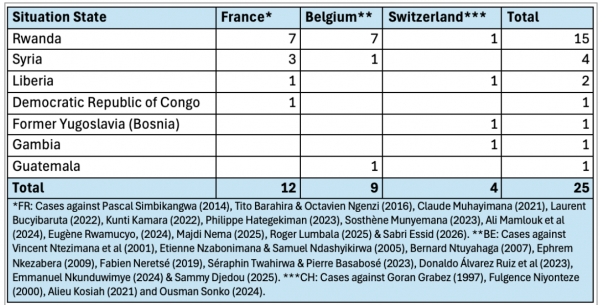
Figure 1 Situation State by Prosecuting State
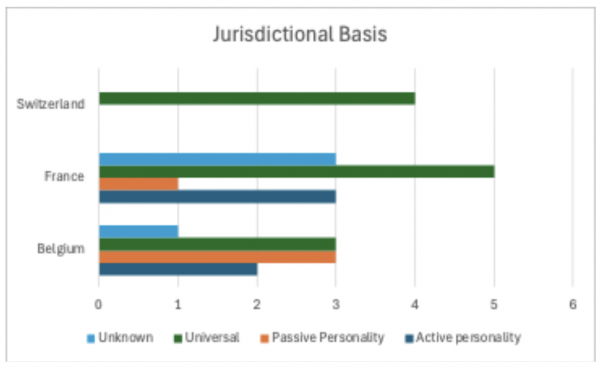
Figure 2 Jurisdictional Basis by Prosecuting State
Two main empirical observations emerge from the data. First, there is a discrepancy between universal jurisdiction as a legal principle and universal jurisdiction as a legal phenomenon. In law, this principle refers to States’ ability to exercise jurisdiction over core international crimes based solely on their nature and regardless of an absence of territorial or personal connections of the State to the crimes. With the exception of French prosecutorial authorities, most legal actors interviewed described these cases as universal jurisdiction proceedings. In reality, however, a significant part of these cases is based on extraterritorial jurisdiction instead of genuine universal jurisdiction. Particularly, the multiple proceedings based on active/passive personability in Belgium and France suggest that the practice of universal jurisdiction is more localised than at first glance.
Second, the data clearly demonstrates that the practice of universal jurisdiction tends to reproduce the dynamics observed in international criminal justice, namely “an ostensibly universal regime [that] seems to apply only to countries in the Third World – and those countries that are expeditiously categorized in this way” (see Anghie). The Belgian, French and Swiss practice focuses solely on crimes committed in the Global South. Moreover, as visible in Figure 3, the majority of the accused are nationals – or were nationals at the time of the crimes – of Global South states, with a primary geographical focus on Africa. In both Belgium and France, there is a noticeable tendency to prosecute perpetrators originating from former colonies.
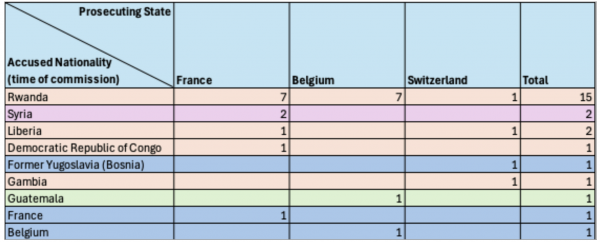
Figure 3 Nationality of the Accused
This pattern closely mirrors longstanding critiques of the ICC’s practice and reflect a global trend in relation to the prosecution of international crimes: only one part of the world is subject to both international and national criminal justice systems. Considering the colonial and postcolonial role of the prosecuting states in the territories concerned, prominent for Belgium and France – but also existent in Switzerland – this is perhaps unsurprising. Taken together, the empirical findings evoke an uncomfortable sense of colonial déjà vu, in which “the North provides justice and order for the violent and unruly South” (see Anghie, see also here and here). Some interviewees were conscious and critical of these (post)colonial continuities and called for broader accountability in prosecutorial selection, as well as the exercise of universal jurisdiction by Global South states.
Causes of Disjuncture
The gap between the aspirations of professionals and the practice of universal jurisdiction derives from a combination of legal, political, and social factors. The first obstacle to a genuinely universal exercise of jurisdiction lies in the procedural limitations embedded in the legislative framework, i.e. the requirement of an element of local connection to the prosecuting State. Belgian, French and Swiss criminal law all require either the presence or residence of the alleged perpetrator on the territory (arts. 8, 13 CPPB; art. 689-11 CPF; art. 264m CPS). Additionally, restrictions apply to victims’ procedural rights, notably the right to initiate criminal proceedings, while prosecutorial discretion and administrative authorities’ powers are more expansive (art. 13 CPPB; art. 689-11 CPF; art. L121-10 French Asylum Law allowing referrals by asylum bodies to criminal authorities). These legal conditions severely restrict the type of cases and perpetrators that may face justice in Belgium, France and – to a lesser extent – Switzerland.
Second, the limited financial and human resources allocated to universal jurisdiction proceedings by political authorities impact prosecutorial policy. Interviewees underscored several factors that enable jurisdictions to operate at relatively low cost, thereby projecting the image of acting ‘at minimal expense’. These factors include the prioritisation of cases involving domestic victims, genocide (in Belgium) as well as the existence of judicial cooperation with situation states and access to the crime scenes. Rwanda, for example, has proven highly cooperative in prosecutions of alleged perpetrators of the 1994 genocide – in part explaining its high representation in completed trials to date.
Finally, this discrepancy can also be explained by the migration routes taken by victims of international crimes, which “typically espouse postcolonial trajectories”. One of the driving forces behind universal jurisdiction proceedings – particularly in Belgium and France – is the presence of victims within the prosecuting state. The predominance of Rwandan trials reflects not only patterns of judicial cooperation, but also the composition of the political communities of these states. Belgium hosts one of the largest Rwandan diasporas in the world, and a significant Rwandan community is also present in France. By initiating proceedings under universal jurisdiction, Global South victims act as agents of international criminal justice, asserting their right to access to justice and remedies. While the (post)colonial dynamics identified above are crucial to understanding the structural contours of universal jurisdiction practice, this mechanism retains an emancipatory potential, particularly for Global South victims when pathways to domestic or international criminal institutions are blocked.
Concluding Remarks
These preliminary findings suggest that universal jurisdiction is a legal concept rather than a legal reality in Belgian, French and Swiss practice. Financial, material, and procedural contingencies significantly constrain its operation, leaving limited possibilities for the prosecution of international crimes. Legal professionals, for their part, are driven by a commitment to defending universal values which underpin their daily work. Yet this noble engagement appears contradicted by the realities of practice: some professionals fail to perceive this contradiction, while others openly acknowledge and regret it. Taken together with the fact that what is labelled as universal jurisdiction in practice encompasses both a truly universal jurisdiction and an expanded form of extraterritorial jurisdiction, these findings invite a rethinking of the notion of universal jurisdiction itself, situated somewhere between belief, emotion, and legal reality.
Dr. Marie Wilmet is a Postdoctoral Researcher at the Université libre de Bruxelles. Her research focuses on international criminal justice, universal jurisdiction, gender justice and victims’ rights.

Damien Scalia is a professor of criminal law and international criminal law at the Université libre de Bruxelles and director of the Maison des sciences humaines. Working at the intersection of criminal law, international justice, sociology, and the history of mass violence, he has spent the past twenty years studying the perpetrators’ experience of justice.