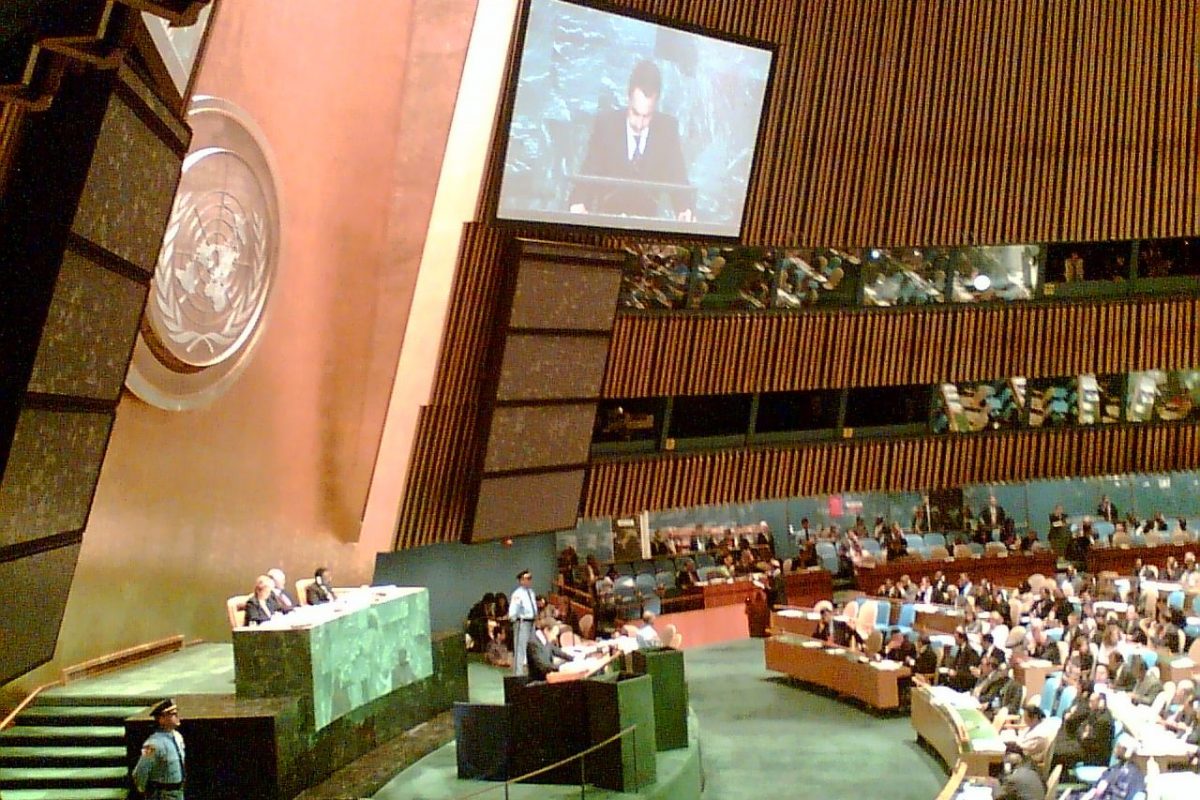

Selecting Silence? – The 2026 Secretary-General Election and Moral Authority
Competing Sites of Moral Authority in Global Governance
“The UN is not just a product of do-gooders. It is harshly real. The day will come when men will see the UN and what it means clearly. Everything will be all right — you know when? When people, just people, stop thinking of the United Nations as a weird Picasso abstraction, and see it as a drawing they made themselves.”
-Dag Hammarskjöld
The upcoming 2026 election of the United Nations Secretary-General will take place in an increasingly fragmented normative landscape. The UN’s claim to universal moral authority—grounded in the Charter’s language of peace, human rights, and collective security—now coexists with alternative governance platforms that privilege sovereignty, regime stability, or transactional geopolitics. In 1955, SG Dag Hammarskjöld claimed that the UN was neither naïve idealism nor abstract art. It was something built – collectively drawn – by states and peoples who believed that global order required more than power politics. And yet, as the Organization approaches the 2026 election of a new Secretary-General, it is difficult to avoid the sense that the “drawing” is not just redrawn but painted over.
The Secretary-General’s office most clearly embodies this claim to universal moral authority, making the selection of that officeholder a moment of particular institutional significance. The politics behind past selections underscores how much of that choice happens away from sunlight. In the 2006 and 2016 contests for Ban Ki-moon and António Guterres, respectively, the formal speeches and public debates belied intense bargaining and deadlocks among the five permanent members of the Security Council. Even efforts to open the process in 2016—televised candidate dialogues and public straw polls, encouraged by sustained civil society advocacy for transparency—were widely understood as only partially transformative. While these innovations created an appearance of procedural openness and allowed several women candidates to articulate visions of the office, the decisive phase remained insulated: private consultations among permanent members continued to shape the outcome, often converging on a candidate acceptable to all but fully anticipated by none. In that sense, the process reflects a persistent tension between calls for visibility and accountability, and a selection practice that still accommodates last-minute consensus emerging from diplomatic negotiation.
The Architecture of Moral Authority
Formally, the process remains unchanged. Article 97 of the Charter provides that the Secretary-General is appointed by the General Assembly upon the recommendation of the Security Council. Yet since 1946 the process has been shaped by closed-door deliberations, secret ballots, and the longstanding practice – traceable to General Assembly Resolution 11(I) (4.d) – of forwarding only a single candidate for approval. The record also reveals structural exclusions: in nearly eight decades, all appointed Secretaries-General have been men, notwithstanding Article 8’s commitment to gender equality and in spite of qualified candidates. In 2025, General Assembly Resolution 79/327 further formalized elements of transparency introduced in 2016—public nominations, candidate dialogues, and disclosure practices. However, while these developments enhance the visibility of the process, they leave intact its constitutional core: the decisive role of the Security Council, operating through private deliberation and veto-based consensus. Even on questions of representation, the Assembly’s language remains exhortatory (ie “recalls” and “reaffirms” in Resolution 79/327, para. 41), encouraging rather than requiring the nomination of women. This process appears increasingly open in form while leaving decision-making power unchanged. In practice, the Organization’s highest office is shaped by diplomatic compromise and concentrated power rather than an open process—raising questions not only about transparency, but about how moral authority is filtered at the very top.
Constitutionally, the Secretary-General has never been merely an administrator or a diplomat. The office has come to embody a particular claim—rooted in the Charter’s allocation of administrative and agenda-setting authority under Articles 97 to 99, and developed through the practice of successive Secretaries-General—that there exists a focal site of universal moral authority in global governance: a place from which peace, human rights, and collective responsibility can be articulated as more than geopolitical preference (see e.g. Kille, The UN Secretary-General and Moral Authority: Ethics and Religion in International Leadership, 2007)). This claim is not purely symbolic. Under Article 99 of the Charter, the Secretary-General may bring to the attention of the Security Council any matter which in his or her opinion may threaten international peace and security – a rare agenda-setting power within the UN architecture. Beyond its formal invocation under Article 99, this agenda-setting role has also been exercised more informally, as Secretaries-General have brought situations to the Council’s attention through reports, briefings, and public statements that frame emerging crises as threats to international peace and security. Hammarskjöld famously invoked Article 99 during the 1960 Congo crisis, insisting that the deterioration of the situation warranted urgent Council engagement. In doing so, he did not merely transmit information; he exercised independent constitutional judgment about what constituted a threat to peace. More recently, Guterres invoked the provision in 2023 in relation to Gaza—its first explicit use in over three decades—illustrating the continued expectation that the Secretary-General may speak as a moral voice, even where institutional follow-through remains uncertain, as demonstrated by the Security Council’s inability to adopt binding measures following that invocation. Articles 97 and 98 further position the office as chief administrative officer and representative of the Organization as a whole. The Secretary-General thus speaks not as a state, but on behalf of an institutional order that purports to transcend state preference.
Collective Security and Institutional Paralysis
Security Council deadlocks in the face of major conflicts have exposed the limits of collective security when veto politics hardens into structural blockage. The Council’s inability to adopt binding measures in response to the war in Ukraine, sustained paralysis over Gaza, and recurring divisions regarding Syria illustrate how the veto – designed as a mechanism of great-power accommodation – immobilizes the Security Council. In such moments, the Charter’s promise of collective security does not disappear; it is suspended by political arithmetic. The language of peace remains, but enforcement fractures.
The risk is not simply operational failure. It is normative erosion. When foundational commitments – prohibition of the use of force, civilian protection, peaceful settlement – are repeatedly articulated without institutional consequence, their authority shifts from enforceable principle to rhetorical aspiration.
When Institutions Hollow Out
The trajectory of the World Trade Organization offers a cautionary parallel. The WTO was constructed on the premise that rules would discipline power, transforming what had been a largely diplomatic and power-driven system under the GATT into a more legalized and rule-oriented order (see e.g. Goldstein et al., “Legalization and World Politics” (2000) 54 International Organization 385). Yet in an era of trade wars, unilateral tariffs, and strategic economic coercion, sustained political obstruction has rendered the institution widely paralyzed. In particular, the erosion of the dispute settlement system and the increasing resort to unilateral tariffs outside WTO disciplines have undermined the Organization’s ability to ensure that trade relations remain governed by agreed rules rather than power-based retaliation. The lesson is stark: when the political will sustaining an organization’s core ideals erodes, procedural structures alone cannot preserve authority. Institutions do not collapse overnight; they persist while becoming detached from the normative force that once anchored them. The United Nations is not the WTO—its mandate is broader, its symbolic weight deeper—but the comparison illustrates a structural point.
Competing Sites of Moral Authority
At the same time, alternative multilateral formations – from the Shanghai Cooperation Organization’s sovereignty-centered security framework to ad hoc “peace boards” and informal diplomatic coalitions – advance models of order that do not rely on universalist language at all. Stability, regime security, and geopolitical balancing are presented as sufficient sources of legitimacy. These frameworks typically operate through alignment among participating states and are shaped by strategic, economic, or regime-security interests, rather than by claims to universal applicability, making them structurally indifferent—if not resistant—to normative frameworks that require justification beyond those interests.
This is not simply a fragmentation of institutions. It is a fragmentation of moral authority. What is at stake is not the multiplication of forums, but the erosion of a shared normative reference point – for example, where the definition of “war” in Iran is no longer framed or contested within a single institutional forum, but invoked differently across competing platforms with no common mechanism for validation, Authority is no longer contested within a common framework, but dispersed across parallel systems that generate and sustain their own standards of legitimacy—often without reference to universalist claims at all.
The United Nations once functioned, however imperfectly, as the central arena in which universal claims – relating to the use of force, the protection of civilians, or the meaning of self-determination – were articulated and contested (see e.g. Widdows, Global Ethics: An Introduction, 2011). Today, it is one site among several competing normative orders, despite remaining the only institution with both global membership and a universal mandate. In such an environment, the incentives surrounding the Secretary-General’s selection shift subtly but decisively. Moral speech is scrubbed of any stance that might be interpreted as criticism. In a veto-driven recommendation system, the safest candidate is often the least disruptive one. This dynamic interacts with the structural constraints of the veto system, as the concentration of decision-making power within the Security Council both contributes to institutional paralysis and creates space for alternative frameworks that operate outside its normative and procedural constraints.
The phrase “competing sites of moral authority” here does not refer to mere institutional overlap. Global governance has always been plural. What appears to be shifting is the distribution of normative centrality. The post-1945 order rested on an assumption – however contested – that the United Nations constituted the primary arena in which universal claims were articulated and legitimated. Alternative institutions might have resisted or reinterpreted those claims, but they did not claim equivalent moral standing.
That hierarchy now appears less secure. Sovereignty-centered security platforms, transactional trade coalitions, and informal diplomatic groupings do not simply contest UN authority; they bypass it (see e.g. Hale/Held, Gridlock: Why Global Cooperation Is Failing When We Need It Most, 2013). Their legitimacy rests on regime security and geopolitical coordination (see e.g. Clark, Legitimacy in International Society, 2005). Informal “peace boards” or ad hoc diplomatic coalitions similarly operate through strategic alignment rather than constitutional aspiration. They are not weakened by silence; they are structured around it. In such a setting, the Secretary-General’s office no longer mediates a common normative grammar but navigates among rival ones.
Selecting Silence
Global constitutionalism presupposed a focal site of universal moral authority. If that focal point dissolves into competitive legitimacy arenas, the UN’s claim to speak for “the international community” becomes structurally fragile. The 2026 Secretary-General election may reveal whether universalist moral authority remains politically sustainable – or whether neutrality has become indistinguishable from strategic quietude. The question is not whether the United Nations will endure, but rather whether it will continue to function as a site where universal claims can be voiced with institutional backing – or whether its authority will depend increasingly on careful avoidance of normative fracture.
The 2026 election may not resolve that tension. But it will reveal how the Organization calibrates voice and survival in a world where moral authority is no longer singular. If the UN is a drawing made by “just people,” as Hammarskjöld suggested, the question is no longer only who holds the pen. It is whether there is still shared confidence in what has been drawn – or whether the Organization risks resembling the emperor in Andersen’s tale: sustained by collective insistence rather than a visible tapestry of consensus.
Diliana Stoyanova is a postdoctoral researcher in international law at the University of Basel. Her scholarship examines the constitutional structure of international organizations, moral authority in global governance, and the relationship between institutional culture and internal law in the United Nations system.