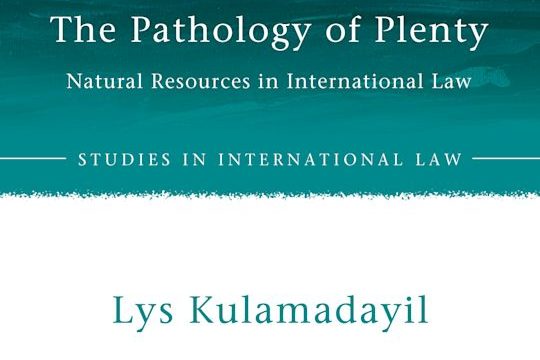
Pathology of Plenty
The Bigger They Are, the Harder They Fall
In the opening months of the Gaza Genocide, and more specifically in November 2023, the Bloomberg New Economy Forum convened. An annual conference linking world economics to contemporary issues, crises, and wars, the purpose of the Bloomberg New Economy Forum is to inform researchers and stakeholders of the priorities of different countries vis-à-vis the thematic subjects tackled annually. Then-Minister of Investment in Saudi Arabia, Khalid al-Falih, was asked whether Saudi Arabia was considering utilizing oil sanctions in order to exert pressure for an end to the Gaza genocide. The Saudi Arabian Minister laughed – whether it was a ridiculing laugh or a nervous one remains up to debate – stating that ‘Saudi Arabia is trying to find peace through peaceful discussions.’
I start my book review of Lys Kulamadayi’s The Pathology of Plenty: Natural Resources in International Law with this incident in mind: the possibility of exerting a cost onto the world in order to stop the genocide in Gaza that was foreclosed in that specific moment by the inexplicable laughter of the Saudi minister. This response is striking not only for its tone, but for what it reveals about the limits of translating resource power into political action. Saudi Arabia controls 17 percent of the world’s petroleum reserves, while being the largest crude oil exporter in the Organization for Petroleum Exporting Countries. As such, the country yields a considerable amount of political, diplomatic, and economic leverage that could have paved the way for a swifter ceasefire and potentially even an end to the genocide in Gaza. That it was not deployed in this way underscores a broader disjuncture between the possession of resource power and its strategic use in moments of acute crisis.
There are three important points to emphasize: (1) my review will strictly concern itself with the political economy of imperialism and its ties to international law; (2) my positionality on international law as a Palestinian living in the West Bank which necessarily informs a critical engagement with international law; (3) that the post-Gaza world is unfolding as we speak with Israel and the U.S. killing or kidnapping heads of states with impunity, starve entire populations, bomb critical infrastructure, and unleash unforeseen torrents of pain and upon entire populations.
The aim of this blog post is to show how the ‘pathology of plenty’, as termed by the author of the book, manifests in our region through its entanglement with U.S. militarization and neoliberal processes.
Rather than beginning with abstract definitions, it is useful to approach the book through the conceptual framework it develops. The paradox of plenty is described by the author as ‘kleptocratic public institutions and significant income disparities among the peoples of resource-wealthy countries.’ The title of the book, Pathology of Plenty, refers to ‘the problems that particularly post-colonial countries that are wealthy in mineral resources face […] [and how they are] [are] structured entirely by human relations with nature, and among humans.’ In effect, the author defines the problems of the post-colonial resource rich nation-state as an issue of an international division of labour and as an issue of ecology. Debates with scholars on the nitty-gritty details of the paradox of plenty aside, the author is trying to make the case that international law has failed to account for the adverse effects of the pathology of plenty. The numerous examples, from the golden age of state-led central planning in Algeria and the fiery debates at the UN surrounding economic self-determination, all the way to the present-day, international law has simply failed to redistribute the wealth of a country to the lowest rungs of society. At the same time, the book appears to gesture toward the possibility of redeeming international law through proactive intervention. That is the primary contradiction point at hand. How can international law be redeemed, and fixed to address these structural inequalities, particularly in light of the case studies presented? While the analysis powerfully illustrates how the pathology of plenty has operated across different historical moments, it leaves largely open the question of how these dynamics might be meaningfully transformed. In this sense, the book provides a critical diagnosis, while leaving future scholars to add on to her contribution in the form of solutions.
At the heyday of revolutionary anti-colonial thought in the mid twentieth century, international law was a contested site, as the author shows in her book. Interpretations of international laws and reinterpretations, alongside the emergence of consortiums, forums, and cartels of resource-exporting countries fuelled hopes for a more equitable world. As the author shows, this was particularly evident during the age of decolonization and the early formation of the postcolonial nation-state, when key concepts such as “self-determination,” “permanent sovereignty over natural resources” were actively negotiated at the United Nations. These debates traced deep North-South disagreements, rooted in fundamentally opposed economic and political interests, over how such principles should be defined and implemented. In this context, resolutions advocating for the nationalization of resources emerged as alternatives to colonial concessions and unequal resource-sharing agreements, reflecting broader efforts to restructure the global economic order. Heterodox economic theorists, such as Raul Prebisch, Hans Singer, Paul Baran, Arghiri Emmanuel, and Samir Amin were beginning to discover how the international division of labour regulated certain countries to realities of unequal exchange. While they differ in their theoretical explanations and underpinnings of such an unequal exchange relationship, they nonetheless have identified a power balance driving the Third World towards dependency for manufactured goods on the First World, along with the severe per capita wealth disparity and unequal trade relationships. The author has briefly touched upon the dependency theory school and the Prebisch-Singer hypothesis but never went further to analyze the extent to how much this economic thinking is tied to the reality of so-called ‘underdevelopment’ of the Third World and the discussions surrounding it in academic and policymaking circles in post-colonial states at the time.
In addition, the author does not account for how much of the Cold War dynamics were conducive to discussions surrounding economic sovereignty, self-determination, and the view of nationalization of resources. A multipolar world, by design, grants smaller state actors more leeway to choose their destinies in contrast to the unipolar world we live in, despite the strides taken by China to provide an alternative developmentalist paradigm via its economic initiatives. As such, the transition between past and present is stark even in legalistic discussions surrounding international law. The end of the age of decolonization, the fall of the U.S.S.R, the rise of the neoliberalism and cementing of the U.S. as the greatest and sole imperialist power with all of its implications on the world system we live in have pushed international law into the field of weaponization for imperialism, with little to show for the prosperity of the peoples of the Third World. The author, unfortunately, perhaps for brevity of the book, does not make these necessary connections in her analysis. The transition from a period where international law and resource rights were discussed in vivid detail in international fora to a reality where the U.S. can enforce oil governance in Iraq and Israel can expropriate resources located in the Gaza Strip, West Bank, and the Sinai Peninsula.
One underdiscussed aspect of the petro-state, and its conceptualization, is how it morphs its surplus into high-capital investment projects and I say this with the Gulf Cooperation Council (GCC) countries in mind. The war on Iran and the closure of the Strait of Hormuz, for example, demonstrate an implicit old Marxist axiom: the more interconnected a world system is, the more devastating the crash would be when it eventually comes. In other words: the bigger they are, the harder they fall. The Arab oil embargo of 1973, and the subsequent oil boom of 1978, created massive financial surpluses that were invested into building the soft and hard power of the Arab Gulf countries, which was invested in buying real estate assets abroad and expanding financial capitalist infrastructure – both in the West and in nearby Arab countries while the inauguration of the petrodollar in the same period, i.e. selling oil in U.S. dollars, heavily strengthened the reliance on the dollar for international trade. As Adam Hanieh notes in Capitalism and Class in the Arab Gulf, the U.S. was given ‘a guarantee from the Saudis that the world oil trade would be denominated in US dollars […] In return, the United States offered Saudi Arabia extensive military, and political support—with the Saudis using their influence as the world’s largest producer to prevent OPEC from pricing oil in a diversified basket of currencies.’ The pathology of plenty, in the case of Saudi Arabia and members of the GCC compared to the economies of the rest of the Arab region, is thus directly tied to U.S. hegemony and militarization.
The oil plunge of 2014-2016 signalled to the GCC countries the need for ‘economic diversification’, of course funded by the oil surpluses. The plunge, as such, was the primary motivator for the 2030 vision in Saudi Arabia, focusing on tourism, economic and social liberalization, and artificial intelligence that is recycled into the military-industrial complex. Much of this ‘diversification’ vision hinges on revenues generated by oil rent and, of course, the notion of ‘stability’ in juxtaposition to the ‘chaotic’ nature of the rest of the Arab region wrecked by imperialism in order to garner investment. One must ask themselves, in relation to oil, why Iraq does not yield as much regional influence post-2003 as the GCC countries do, who host U.S. army bases and are considered major non-NATO allies, contributing to the U.S. security umbrella in the region. The author, unfortunately, does not tackle the political economy of the petrodollar and its implications as seen above. This is why the war on Iran, and its ripple effects, will have a tremendous impact on how we talk about oil and its connection to imperialism in future analyses and historiographies of both, the region and the world.
Returning to the image of the Saudi minister at the Bloomberg New Economy Forum dismissing the prospect of an oil embargo in response to the genocide in Gaza, one is struck by the contrast with subsequent developments. Despite this refusal, an effective – even if uncoordinated – disruption of global oil flows appears to have emerged through escalating tensions with Iran. What was politically rejected in the face of Palestinian suffering has nonetheless materialized through the very instability that such restraint sought to avoid. The fear of destabilizing the global economic system, coupled with a persistent apathy toward Palestinian suffering under conditions of settler colonialism, has helped produce the moment we are now witnessing. The pathology of plenty, it seems, has crashed in our region, creating the possibility of new horizons.

Faleh completed a Bachelor of Social Thought, Economy, and Policy (STEP) with a minor in Urban Studies and Spatial Practices at Al-Quds Bard College for Arts and Sciences in Jerusalem.