Armed conflict is a grim feature of our time: some 130 wars are currently raging worldwide, each exacting a catastrophic human toll and offering all too many real-world case studies in the application of international humanitarian law (IHL). Yet beyond this sobering reality, fictional thought experiments can also serve as a powerful tool to spark spontaneous, searching legal discussions. They allow difficult questions to surface in ways that might otherwise be stifled if framed through the lens of actual conflicts, exposing the seams and silences of IHL and inviting fresh debate on issues that matter to contemporary warfare. In this post, we stage an interstellar war prompting a military commander in The Hague to ask: which rules of IHL govern combat against an enemy that is neither human nor a state? Our fictional scenario tests pressure points in today’s laws of war – conflict classification, legal personhood, and proportionality calculations – while revealing potential gaps looming in cyberspace, sinking island states, and urban sieges.
First Contact, Then Combat
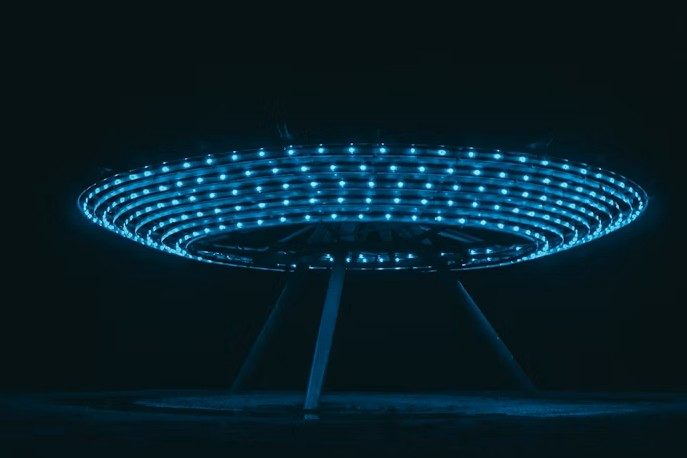
It began as a curious anomaly in the pre-dawn sky—a bright speck of light, steadily growing until it dominated Earth’s orbit over Europe. Soon, telescopes and satellites revealed it clearly: a colossal alien world-ship, kilometers long, its sleek, metallic hull reflecting sunlight as it silently took position. Inside this enormous vessel, the remnants of a distant civilization travelled—a people whose home planet had been utterly destroyed, leaving them nomads of the cosmos.
Inside The Hague’s Peace Palace, the UN rushed to create the Earth Strategic Defence Command (ESDC), cramming generals, lawyers, diplomats and scientists into a makeshift basement war room. As humanity weighed its options, the world-ship slipped into Dutch airspace. Turbolasers razed airbases and radars yet spared civilians—an ominously calculated attack. Intercepts showed a repeating burst of signals just before each strike, followed by formations adjusting in unison. Someone—or something—was clearly directing the fight with discipline.
“Tobias, listen carefully,” ESDC Commander Asser said, her voice cutting through the din of the war room. “The alien assault is precise, calculated—they’re crippling our defences without touching civilians. But make no mistake: this is war, and Earth is under siege.” She leaned forward, eyes locked on her legal adviser. “I need to launch a counteroffensive immediately. We have to defend every life on this planet. But before I authorize a single strike, I need clarity—what law governs our actions when the enemy isn’t human? Do the Geneva Conventions even apply to them?”
Col. Tobias paused, exhaling slowly. “Commander, regardless of who—or what—we’re facing, IHL still applies. It binds us,” he said firmly. Asser gave a sharp nod. “Fine. Then I need rules of engagement—clear, fast, and by the book. What are we allowed to hit?”
In the surreal quiet beneath the storm, the two began their critical deliberations, fully aware their conclusions could shape humanity’s future—not just militarily, but ethically and legally as well.
Alien War, Human Laws: Can IHL Cross the Species Divide?
Asser turned sharply to Col. Tobias. “Colonel, I need an answer! These aliens aren’t human, nor do they represent any recognised State. We’re talking about a spaceship—not another earthly State attacking us. How does IHL apply to them?”
Col. Tobias adjusted his glasses, glancing at the satellite feed as the alien ship loomed lower over the region. “For statehood, traditionally more is needed than some people and their government. Territory for instance—that’s why a ship’s crew at sea can’t just declare sovereignty,” he said, keeping his voice level despite the rising tension. “Someone once bought an old oil platform and pronounced it a State. A court threw it out—no sufficient grounding to Earth.”
Commander Asser didn’t flinch. “So they’re not a State. That rules out an international armed conflict (IAC)—right?”
Tobias hesitated, fingers tightening on the table edge. “Yes… probably. But I wouldn’t dismiss an IAC outright. There is disagreement on the exact criteria for statehood and a growing new discussion on deterritorialised States—States that retain legal continuity even without land. Tuvalu and others are working on treaties that preserve statehood post-submersion. The framework is shifting.”
Another impact rattled the bunker. “Colonel, that’s theory we don’t have time for, statehood’s a political game! The way I see it, that mothership isn’t a State. No borders, no recognition, no nothing. Let’s proceed assuming this isn’t an IAC.”
Tobias nodded reluctantly. “Then it might still be a non-international armed conflict (NIAC). Common Article 3 explicitly covers conflicts ‘not of an international character’—though perhaps the drafters never imagined something potentially intergalactic. The aliens’ presence within our air space clearly triggers IHL applicability through our domestic legislation implementing the Conventions and Protocols. Moreover, look at the reports we received of their battle tactics: heavy firepower, tactical coordination, clear command structures. They fulfil the criteria for it— intensity and organization.”
Asser drummed her fingers while fresh reports flashed. “Fine, NIAC it is. But we must act quickly. Intelligence suggests their entire culture resides on that massive ship blocking out the sun. Are these aliens even protected persons? Colonel, I prefer not being walked across the street from the Peace Palace to the ICC when this is over—can we just shoot the whole thing?”
Tobias paused thoughtfully as technicians urgently relayed damage reports in the background. “Excellent question, Commander! Legal personhood is typically tied to the capacity of bearing legal rights and obligations, but historically, IHL’s definitions have been human-centred—for example, think of the protection norms relating to pregnancy, family structures and sex-segregated prisoner of war quarters. Recall that infamous skirmish between Australian soldiers and Emus—even if the incident had passed the threshold of an armed conflict, the animals still wouldn’t be protected under IHL. Yet these aliens seem sentient, cultured and intelligent beings. Could the discovery of these extra-terrestrials prompt another evolution in our legal definitions?”
Commander Asser raised her hands sharply. “Colonel, please. Let’s keep the lecture on treaty interpretation for later. I need actionable advice. Clearly, their fighters are legitimate targets—but can’t we classify the other creatures aboard strictly as objects, akin to animals or infrastructure?”
“That would simplify targeting decisions, and appears to be supported by the black-letter law,” Tobias conceded, even as his eyes revealed deep discomfort. “But then our proportionality calculus shifts dramatically. If they aren’t protected persons, targeting the world-ship becomes militarily straightforward—perhaps too straightforward. This exact debate parallels discussions on whether artificial intelligence can one day be recognized as more than just objects, though the aliens’ presumably natural intelligence might tip the scales towards recognizing them as persons.”
Commander Asser watched the evacuation feed for a moment, then turned to Tobias, voice flat and final. “They’re cultured, sure—maybe even intelligent—but they haven’t shown any individual human behaviour we can work with. That’s not personhood. Not in the middle of a war. For our purposes, they’re civilian objects—let’s not waste more precious time on this!”
She stepped toward the tactical screen, eyes narrowing on the ship’s silhouette. “And let’s be real—we can’t surgically separate fighters from non-fighters in that thing. It’s one structure, one system. We treat it as a single military target unless you give me a legal reason not to. Every second we hesitate on this targeting decision, we lose ground.”
“I strongly recommend targeted strikes on the smallest separable military portions. Even if we consider their non-fighting entities to constitute civilian objects, we have to respect the principle of distinction,” Tobias insisted urgently.
Asser nodded decisively, rising from her seat. “Advice noted. Now, let’s get started on saving humanity.” Around them, the bunker burst into renewed activity, commands shouted and screens flashing, as humanity prepared to face an entirely new kind of warfare.
How Aliens Provoke Us to Think About Ourselves
Originally conceived as a whimsical thought experiment between the authors, this dystopian scenario evolved as we shared it with colleagues—in conference corridors and over informal dinners—into a catalyst for sustained, reflective debate. Upon reflection, we noticed these exchanges often exposing significant indeterminacies within IHL, directly pertinent to contemporary doctrinal uncertainties and debates. This section distills several key insights that organically emerged from those discussions.
Take the problem of whether an alien incursion qualifies as IAC or NIAC, which touches upon assumptions regarding statehood and territory. Questions of statehood are pivotal to the operation of IHL: the legal status of the adversary determines the classification of the conflict (international or non-international) and, in turn, the applicable IHL framework. If legal advisers in real conflicts face uncertainty regarding the very existence (or persistence) of States, our scenario illustrates ambiguities inherent in statehood criteria.
Our story also came to highlight challenges surrounding jurisdiction and territory. The current proliferation of cyberoperations underscores how conventional territorial conceptions struggle to clearly define States’ jurisdictional boundaries. Debates around the applicability of IHL principles to cyberspace reflect precisely this difficulty. Like the aliens’ mobile ‘territory’ hovering over the earth, cyberspace blurs borders, complicating legal attribution and accountability.
Furthermore, considering the proportionality analysis required under Article 51(5)(b) API, Asser’s dilemma highlights challenges seen in many contemporary battlefields related to striking military targets intertwined with civilian architecture. Exemplified by controversies surrounding urban warfare, it illustrates the practical and ethical complexity commanders regularly face. Similarly, the ESDC’s planned attack on a mixed-use alien mothership demonstrates the operational importance and difficulty of making proportionality assessments when protection hinges on definitions that are ambiguous or insufficiently inclusive.
Finally, a real head-scratcher for Asser and Tobias was the question of personhood and protection. The dilemma of whether non-human extra-terrestrials can be protected persons—or merely qualify as civilian objects under Article 52 API (or the customary equivalent for NIACs thereof)—tests the interpretation of fundamental ethical principles, particularly the principle of humanity. What does humanity conceptually encompass? Could future legal interpretations include sentient non-human entities, reshaping the scope and reach of humanitarian norms?
As we refined the thought experiment through each conversation, even more new themes surfaced. Our interlocutors always immersed themselves in the discussion with excitement: even the most tired conference participants seemed to light up with renewed energy as they engaged with our story, considered alternative hypotheses and counterexamples, and sparred with others around the table. Their enthusiasm showed us that raising awareness can take many forms, and that imagination is a power‑tool for humanitarian law. Far from sci-fi parlor games, such thought experiments can draw people’s attention to critically examine rules meant to shield us from war’s worst horrors, and stress-test indeterminacies and fault-lines within the legal framework.
Equally importantly, fictional framings often seemed to take the edge from legal questions which—if presented in relation to actual events—would lead interlocutors to disengage, or would cause groups to splinter based on political convictions. Hypothetical scenarios thus can function as an additional tool in the IHL practitioner’s toolbox to spur frank legal discussion, to be deployed in situations where the social context would not allow their real-life analogues to function as effective bases for conversation.
Now it’s your turn at the console. Will you echo Tobias’s measured restraint or Asser’s audacious resolve? Is the world‑ship a roving belligerent, a solitary military objective, or something for which our law has no name? Push the scenario further, torque the norms until they groan, and expose where they fracture. Let your imagination probe the next hard question IHL must answer.

Hendrik Mathis Drößler previously worked at the T.M.C. Asser Institute, as well as in the German Bundestag and the Lower Saxony State Parliament. He holds an LL.M. in Public International Law (cum laude) from the University of Groningen and a double Bachelor’s degree in Law and Political Science from the University of Göttingen. His research explores rule of law issues, with a focus on compliance with the International Court of Justice and international humanitarian law.
Jonathan Kwik is a researcher in international law at the T.M.C. Asser Institute, specialised in the intersection between law and emerging technologies. He is a member of the Drafting Team for the "Manual on the International Law Applicable to Artificial Intelligence in Warfare" Project (2025-2027) and a member of the Board of Experts of the Asia-Pacific Journal of International Humanitarian Law (APJIHL). He has written extensively on international humanitarian law, targeting law, AI modelling and (international) criminal responsibility. He recently published the book, "Lawfully Using Autonomous Weapon Technologies"