Since the fall of 2023, Israel’s military campaigns in Gaza have resulted in large-scale destruction, mass displacement, and a mounting death toll. As a result, concerns and scrutiny in national and international spheres regarding the legality of Israel’s conduct under international law have intensified. Not only of Israel itself, but also of third states and corporations that continue to provide military, political, and economic aid despite mounting evidence of genocide and international crimes.
In this light, arms exports to Israel have become one of the most legally contested forms of support. This gained further significance following the findings of the UN Independent International Commission of Inquiry on the Occupied Palestinian Territory, East Jerusalem and Israel. In September 2025, the Commission concluded that Israeli authorities and security forces have been committing genocide against the Palestinians in the Gaza Strip, and identified evidence which, in its view, pointed to genocidal intent, including statements by senior Israeli officials. Drawing on these concerns, the Commission called upon UN member states to:
Cease the transfer of arms and other equipment or items, including jet fuel, to the State of Israel or third States where there is reason to suspect their use in military operations that have involved or could involve the commission of genocide (para. 257(b), p. 72).
Nevertheless, as of March 2026, Israel remained the world’s 14th-largest arms importer with weapons transfers from the US and Germany. Against this backdrop, the present symposium is not merely timely. It is an essential intervention.
Recent scholarship has begun to interrogate the legal and political infrastructures that sustain the global arms trade. Shahd Hammouri, for example, has made the case for an obligation to close infrastructures of arms transfers, like ports, airspace and shipping routes, and limit corporations to prohibit complicity in international crimes. Ntina Tzouvala situates global arms trade within a broader critique of criminal law’s limited ability to deter economic actors that profit from and perpetuate war. Read together, these views demonstrate that the problem is a deeper reluctance to impose meaningful limits on the political and economic structures that enable the global trade in arms. As such, arms exports to Israel have largely continued without effective legal restraint.
Against this backdrop, arms exports licenses authorizing the transfer of arms to Israel have been the subject of legal challenges brought by human rights organizations and individuals across multiple jurisdictions, including the Netherlands (see Galina Cornelisse’s assessment here), the United Kingdom, and Australia. The growing wave of litigation challenging arms exports to Israel aim to enforce international and national legal obligations and limit governmental discretion where there is a risk that exported weapons may contribute and facilitate serious violations of international law. Generally, arms exports decisions are treated as matters of national security and executive decision-making, and have been justified by a state’s right to self-preservation and self-defense (see also here and here). As a result, arms exports licenses have often been insulated from judicial scrutiny and public accountability. It is this question of limits, as captured by the symposium’s title, Arms Exports Unbound?, that drives this intervention.
The German Federal Constitutional Court’s Gaza Case
As one of Israel’s principal suppliers of military equipment, Germany has become a focal point in debates concerning the legality of continued military support. These debates have unfolded at both the international and domestic levels. Internationally, Nicaragua instituted proceedings against Germany before the International Court of Justice, alleging that Germany’s military assistance to Israel violated its obligations under international law, including the Convention on the Prevention and Punishment of the Crime of Genocide and common Article 1 of the Geneva Conventions. Domestically, Palestinians, represented by human rights organizations, have sought judicial review of Germany’s export licenses before German courts.
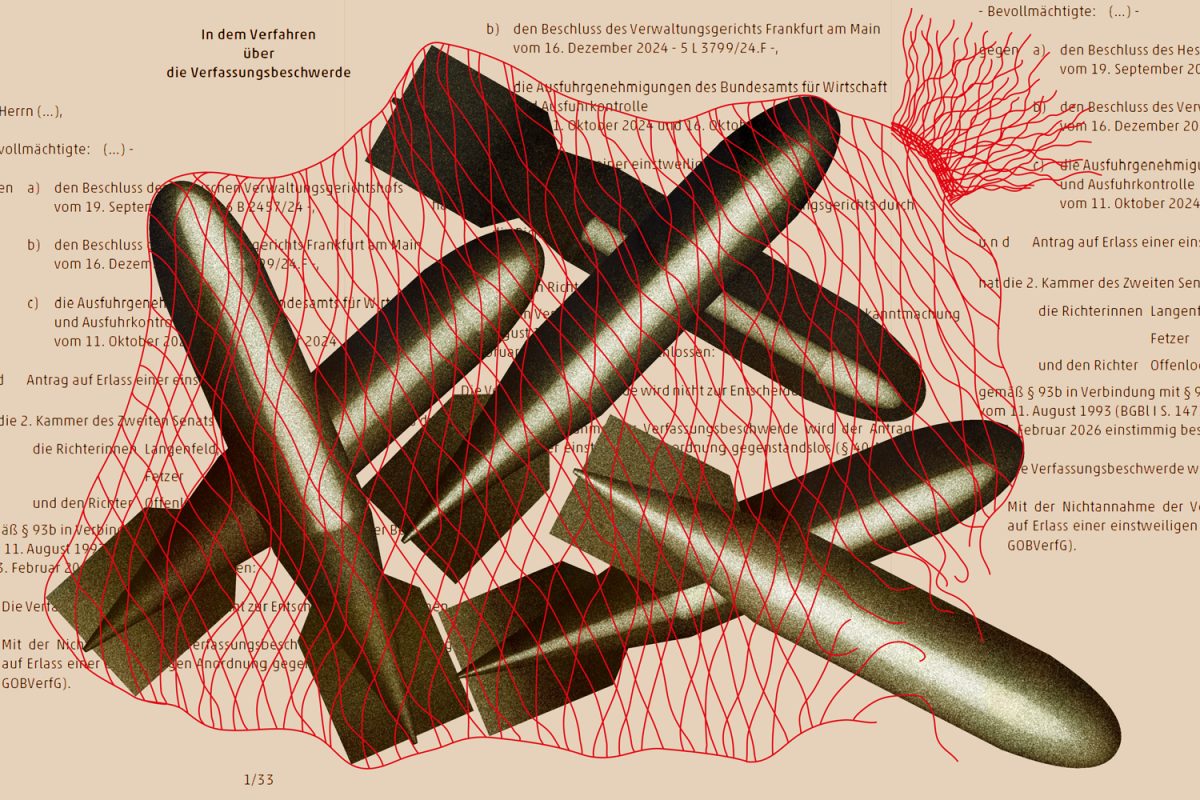
The most recent challenge was brought before the German Federal Constitutional Court (GFCC), which in February 2026 did not admit for decision a constitutional complaint of a Palestinian from the Gaza Strip. The complainant had lost his wife, daughter, father, and three brothers in separate Israeli airstrikes. After repeated displacement, the complainant was living in dire conditions in a makeshift shelter.
Drawing on the German Basic Law, in particular Art. 2(2) first sentence, and international humanitarian law and international human rights law, the complainant argued that Germany’s authorization of arms exports contributed to the continuation of Israeli military operations in Gaza, thereby increasing the risk for his own life. Therefore, these export licenses triggered Germany’s duty of protecting his right to life, which, in turn, demands the annulment of arms export licenses.
In its decision not to admit the constitutional complaint, the Court recognized Germany’s obligations under its national laws and international law. However, it also held that these obligations do not necessarily give rise to an enforceable claim to a specific action by the state. While it is within the competences of the GFCC and a common practice of the Court not to admit complaints, this particular case raises various questions, not least because the GFCC devoted more than 30 pages to explaining its reasons for not admitting the complaint. This was already highlighted by Florian Meinel, who criticized the decision as a case of “pseudo-protection of fundamental rights”. As its significance extends beyond Germany, this symposium seeks to draw attention to the decision by exploring the legal and political context as well as the implications of the case.
Overview of Symposium Contributions
We will kick off the symposium with Lilian Löwenbrück and Alina Pucko, who, as legal advisors of the European Center for Constitutional and Human Rights supported the Palestinian complainant before the German courts. Drawing from this experience, the authors argue that the GFCC’s decision not to admit the case was not the only possible route. Instead, as they point out, the court could have applied the criteria from the Ramstein judgment, which were met in the case at hand. They furthermore maintain that the unbound discretion left to the German government leaves too little room for judicial oversight and accountability.
Vincent Holzhauer, too, critiques the discretion left to the government, especially in light of the duty of protection under German constitutional law. More so, meeting the requirements for substantiating the complaint, he argues, is nearly impossible, considering that the complainant must evaluate all efforts
undertaken by the German government – information the complainant does not have access to. Based on these findings, Holzhauer sheds light on the one-sidedness of Völkerrechtsfreundlichkeit in the decision: While emphasizing Germany’s obligations under international law, the Court omits to consider whether Germany complies with its obligations.
In a similar vein, Leonardo Shahin criticizes the decision, arguing that the GFCC effectively upholds and perpetuates the double standards of Germany’s foreign policy towards Israel. The Court does this by elaborating an exceedingly complex rights doctrine that ultimately remains without practical relevance. Allof this undermines the credibility of international law as domestic courts are essential to enforcing international legal norms, particularly when they conflict with the political interests of the respective government.
Vera Strobel and Sabrina Ohm similarly highlight the crucial role of domestic courts as enforcers of international law. They chronicle strategic litigation efforts challenging arms transfers since 2024 and emphasize the positive contribution of the GFFC’s Ramstein decision from 2025. The Court misses the opportunity to further develop its legal framework in the Gaza case, while ending “future pathways to justice before German courts for civilians abroad affected by German arms exports”.
Mayar Darawsha proposes a novel argument that the legality of German arms exports should not be assessed solely through the traditional jus in bello (international humanitarian law) framework, but rather through a jus ad bellum perspective focused on the legality of the use of force and the consequences of supporting an unlawful situation. As such, Mayar demonstrates that once the focus shifts to the legality of the use of force and the duty of non-assistance toward unlawful situations, Germany’s continued authorization of military exports becomes far more difficult to justify.
Sué González Hauck and Jens Theilen, two of the most visible scholars in the debate on German arms exports to Israel (see here and here), situate the decision within the broader current context in Germany. Just like other German institutions, the GFCC overlooked Israel’s violations of international law, gesturing that there was “nothing to see” and “nothing to decide”.
Madalena Simões draws on the concept of international law’s emancipatory promise, which was developed by the legal scholar Martti Koskenniemi, to analyze whether the GFCC in its decision from February enabled or frustrated efforts by civil society actors to use international law as a tool for justice and solidarity. Using this decision as an example, Madalena shows how courts canuse doctrines of deference and limited standing to avoid meaningful engagement with international law, thereby frustrating civil society’s attempts to use international law as a tool of accountability, solidarity, and emancipation.
Unlike Simões, Shun Oshita argues that even when domestic courts, such as the GFCC, refuse to halt arms exports to Israel, the 1948 Convention on the Prevention and Punishment of the Crime of Genocide continues to constrain state behavior. Shun views the dismissal of arms-export challenges under constitutional and administrative doctrines not as a validation of the legality of such exports, but rather as evidence of the Convention’s deterrent effect. In this sense, the Convention deters unlawful arms transfers by compelling governments to conduct continuous risk assessments and by preserving the possibility of substantive international review before the ICJ.
As a practicing lawyer Armaghan Naghipour took legal action to halt arms exports to Israel. For Völkerrechtsblog she authored a piece entitled “War De Lege Artis: Lawfare and the Normalisation of Rearmament”. Drawing in particular on Evgeny Pashukanis, Naghipour explains the apparent mismatch between dense regulation and limited enforcement as a product of “legal form and procedure”.
Taking a comparative approach, Miriam Heipertz views the German arms export cases as an expression of a more general pattern. In various states, courts are acting as “gatekeepers”, blocking the judicial review of arms transfers. Heipertz argues other forms of contestation, such as protests, are also being restricted through legal regimes and court decisions. In essence, it results in “a system that formally allows challenges but substantively preserves the insulation of executive discretion in arms trade”.
In an interview with Völkerrechtsblog, Lea Kayali talks to us about grassroots organizing against arms exports to Israel. She explains how activism can be the primary driver of accountability in the arms trade. She grounds her views on the significance of social movements as the needed political pressure for challenging state and corporate complicity and the structural limitations of legal institutions.
By bringing these perspectives together, the symposium aims not only to deepen the understanding of the GFCC’s Gaza case and its implications for the interplay of national and international law in upholding human rights. The symposium also seeks to contribute to wider debates concerning accountability and the capacity of law to limit violence and to emancipate survivors as well as civil society.




I am deeply grateful to have participated in this symposium as a contributor. I sincerely hope that our collective discussions will serve as a legitimate part of the democratic process, ultimately contributing to better, more accountable arms export policies in Germany and globally. I believe the late Jürgen Habermas, a giant of intellectual thought whom we lost this year, would have strongly supported such deliberative engagement as a means to improve our governance and social life. (For a related discussion, please see my recent piece over at EJIL: Talk!: https://www.ejiltalk.org/process-oriented-review-in-german-arms-export-litigations-beyond-victories-and-defeats/ )