War De Lege Artis
Lawfare and the Normalisation of Rearmament
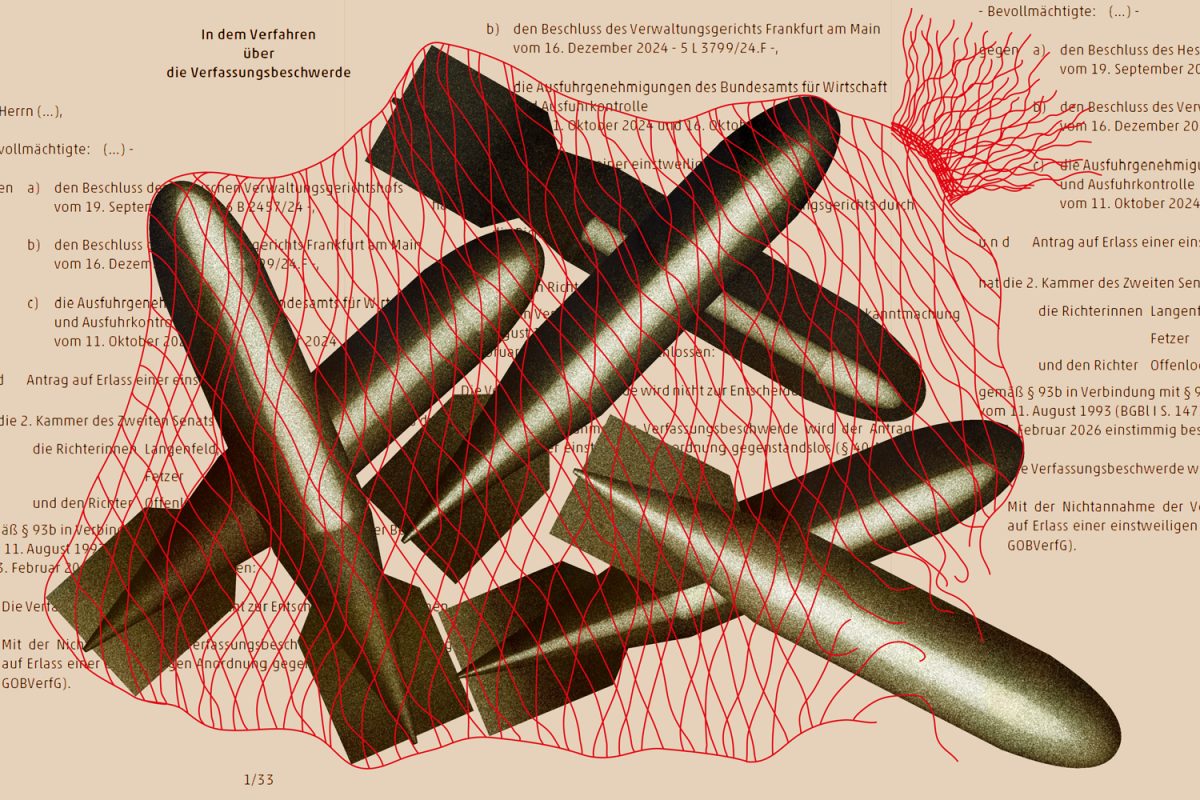
In February 2026, the German Federal Constitutional Court declined to admit a constitutional complaint brought by a Palestinian applicant from Gaza challenging German arms exports to Israel. While the Court acknowledged that Germany is bound by constitutional and international legal obligations it held that these obligations do not automatically entitle affected individuals to judicial review of arms export decisions. The Court located the primary responsibility for balancing the obligations in the sphere of executive decision-making, providing the Federal Government with a broad margin of discretion.
This decision captures a central tension in contemporary arms export control: on the one hand dense normative commitments exist; on the other, these are often not enforceable before courts.
This article argues that the gap is not simply the result of weak enforcement, but structurally produced through legal form and procedure.
Situating the German case within the broader context of European rearmament, two claims are advanced: First, that militarisation is increasingly articulated as part of raison d’État rather than as a contested political choice. Second, that procedural law—particularly doctrines of standing and evidentiary thresholds —translates this political economy into legally manageable forms that limit accountability.
Rearmament and the Illusion of Normative Control
Europe has entered a phase of accelerated rearmament. European Union Member States are among the world’s leading arms exporters. SIPRI data confirms that several EU states rank among the top global suppliers of major arms. According to the Federal Ministry for Economic Affairs and Climate Action, the value of German export authorisations for 2024 reached roughly EUR 13 billion (in comparison to 12,2 billion in 2023; with a significant share classified as war weapons). Germany recently overtook China to become the fourth largest arms exporter in 2021–25, with 5.7 per cent of global arms exports. At the same time Germany’s overall military expenditure in 2025 amounts to EUR 100 billion. This quantitative increase however is not just a statistical fact. At the EU level, this shift is accompanied by institutional efforts to expand “industrial defence readiness” and “ensure peace through deterrence”.
In political discourse, “readiness” is increasingly described as the rational response to geopolitical instability and the return of large-scale conventional warfare to Europe. The implication is that rearmament is urgent—requiring executive flexibility and rapid procurement. The EU Commission’s Joint Communication on the Defence Readiness Roadmap hence urges the Member States to equip themselves “with an independent interoperable strategic capacity, capable of responding in real time to any threats to Europe’s territorial integrity and sovereignty”.
This context matters for arms export control because export decisions are no longer a technical administrative issue, but where security, industry and law intersect.
International treaties such as the Arms Trade Treaty, European instruments like the EU Common Position on the control of exports of military technology and equipment, and domestic statutes such as the German War Weapons Control Act as well as the German Foreign Trade and Payments Act articulate constraints on arms exports, particularly where there is a risk of serious violations of international humanitarian or human rights law. Yet, in practice, these norms rarely translate into effective judicial control. The Gaza case illustrates how this configuration is juridified.
The Court does not reject the relevance of international humanitarian law; instead, it locates its enforcement within a framework of executive responsibility and limited judicial review.
This reflects a structural dynamic: arms exports are sustained into state rationality. Militarisation hence becomes part of a raison d`État and legal norms are interpreted within this framework; allowing the state to perform a commitment to legality while preserving discretion.
Legal Form and the Structure of Exclusion
To understand this dynamic, it is necessary to move beyond doctrinal analysis.
Drawing on Evgeny Pashukanis (p. 63), the commodity-form theory of law highlights how legal relations are structured by the logic of exchange. Law does not simply consist of norms; it organises social relations through the figure of the legal subject and the recognition of specific legal interactions (see also Velickovic and Bagchi, pp. 97).
In the context of arms exports the primary legal relationship is that between the exporting state and the exporting company, even though licensing decisions are centred on the recipient and end use.
The individuals most affected by the downstream use of exported weapons however—civilians in conflict zones—are external to this relation. They do not appear as parties to the administrative decision authorising the export.
This structural positioning has significant consequences. Harm that is transnational, collective, and mediated through allegedly complex causal chains becomes difficult to translate into legally cognisable claims. The problem is less evidentiary than conceptual: The present legal form struggles to accommodate harm that does not fit the model of individualised, direct injury — particularly given the limited possibilities to enforce international humanitarian law or invoke rights extraterritorially.
This conceptual difficulty is embedded in broader structural arrangements that shape which harms courts are willing to recognise. As Sonja Buckel has argued, legal subjectivity is produced through processes of subjectivation that determine which harms can appear as legally cognisable claims. This has structural implications for access to justice: Both Art. 19(4) German Basic Law and Article 47 of the Charter of Fundamental Rights of the European Union (CFR) for instance guarantee effective judicial protection, yet neither addresses the prior question of who is actually constituted as a rights-bearing subject in the first place. This reflects the selective ways in which legal subjectivity is structured – and it is at the level of procedure that this selection becomes most visible.
Procedure as a Mechanism of Executive Insulation
Three mechanisms are central here:
First, doctrines of standing operate as a primary gatekeeping mechanism. In German administrative law, standing requires the claimant to assert a violation of their own subjective rights. Article 2 of the International Covenant on Civil and Political Rights – ratified by all EU member States – requires access to effective remedies, including judicial mechanisms where appropriate (on the argument of standing see also Castellanos-Jankiewicz/Guzmán Mutis).
Nonetheless most courts in the EU have consistently interpreted arms export control provisions as serving public interests in foreign and security policy. As a result, claims brought by individuals affected by the downstream use of exported weapons are typically dismissed as inadmissible. The limits of judicial review in the field of arms exports are however not merely a consequence of the political sensitivity of foreign affairs, but also of specific procedural choices concerning standing and legal subjectivity. While the very same procedural norms in German administrative law for example are interpreted widely by the Courts with regards to NGO standing in environmental matters, comparable avenues remain absent in the field of arms exports. Comparative examples illustrate that these legal boundaries are not fixed. While most jurisdictions don’t provide broad judicial review of arms exports, recent litigation in Belgium and the Netherlands does illustrate that procedural design choices can indeed significantly affect the justiciability of export decisions. In July 2025 for example, a Brussels court prohibited the transit of military goods to Israel following litigation brought by NGOs under Belgian collective standing rules.
Second, evidentiary constraints further limit judicial review. Arms export decisions often rely on classified information, intelligence assessments, and diplomatic considerations. Courts, lacking access to these materials and not asking for them either, face difficulties in establishing the factual basis necessary for substantive review. This epistemic asymmetry is not incidental but structurally embedded in the regulatory framework.
Third, courts defer to the executive on the basis that arms export decisions involve complex prognostic judgments. Risk assessments under international law are framed as inherently political, reinforcing the perception that the executive is institutionally better positioned to make such decisions.
Together these mechanisms translate structural inequalities into procedural exclusions. But to understand why this exclusion is systematic, one must look beyond procedure to the legal form that underlies it.
Access to Justice for Whom?
Legal subjectivation, as Buckel has argued, is the process through which individuals are constituted as rights-bearing subjects capable of making cognisable claims. This process operates, in the German context, through a specific doctrinal machinery in arms export law: The Schutznorm doctrine. It does not simply regulate standing; it determines which harms count as legal injuries at all. When courts hold that arms export provisions serve public rather than individual interests, they are not merely applying a neutral procedural rule. They are deciding that the harm suffered by civilians in conflict zones — transnational, collective, indirect— does not rise to the threshold of a legally recognisable injury. Subjectivation is refused.
This refusal is structurally specific. The same courts that apply the Schutznorm restrictively in arms export cases have interpreted comparable provisions expansively to grant NGOs standing in environmental litigation. The asymmetry is a choice. It reflects a judicial construction of whose interests the administrative state is understood to protect — and whose remain external to it.
This is where the concept of cohesion becomes analytically relevant. If subjectivation describes the mechanism of exclusion, cohesion describes its systemic function. By channelling conflict into legally manageable forms — and displacing what cannot be so channelled — procedural law contributes to the reproduction of the political relations it formally governs. The accountability gap in arms export control is not a dysfunction of the legal system; it is one of its outputs.
This refusal sits in tension with Article 47 CFR’s effective judicial protection. The Court of Justice established in Protect Natur (C-664/15) that national procedural rules cannot render EU law rights practically ineffective — a logic that, applied consistently, would put pressure on overly restrictive standing doctrines as the Schutznorm theory. Its direct application to arms export decisions is however limited: where export decisions are taken under national law implementing international obligations – rather than EU law – Art. 51 CFR is not engaged.
What remains is the structural parallel: the gap between the formal guarantee of Art. 47 CFR and the material conditions of access maps precisely onto the selective construction of legal subjectivity described above – and it is a gap that EU law, as currently structured, does not close.
Strategic Litigation and Its Ambivalence
It is against this backdrop that strategic litigation has emerged – foremost as a practice that works within and against these structural constraints. Cases across Europe seek to challenge arms export decisions through judicial mechanisms (Germany, Netherlands, Denmark, see also here).
Ideally strategic litigation exposes contradictions between legal norms and political practices, it forces courts and governments to articulate their reasoning and generates public debate, thereby politicising what is otherwise presented as ‘technical necessity’. Strategic litigation may also generate transnational learning through the circulation of arguments, evidentiary strategies, and NGO cooperation across jurisdiction (see Strobel, pp.188-222).
Yet the limits are equally clear: Because this litigation operates within the very structures that produce the accountability gaps, these barriers limit their truly transformative potential. Strategic litigation hence remains a contradictory practice, because law is both a form of domination and a potential site of struggle (see also the argument of interplay between the symbolised elements of courtroom, square and palace adapted in Cebulak/Morvillo/Salomon; Hahn, pp.332-337; Redford/ Gevisser (eds.), The Revolution Will Not Be Litigated: People Power and Legal Power in the 21st Century (OR Books 2023). Its significance, especially in arms export law, lies less in immediate legal success than in its capacity to expose the political grammar of law: the ways in which legal forms translate material power relations into procedural exclusions. This is what Fischer-Lescano terms the Kassandra function of law — the capacity to articulate what the political process refuses to hear, even where that articulation produces no immediate effect. It is in this register that the cases discussed here matter most.
The Gaza decision reflects a broader dynamic in which dense normative commitments coexist with limited accountability in arms export control. The resulting accountability gap is therefore not simply a legal deficit, but an effect of procedural structures that preserve executive discretion by selectively limiting access to justice. Understanding this is a precondition for challenging it.

Armaghan is a qualified lawyer and former State Secretary in the Senate of Berlin. Drawing on her experience representing clients in arms export litigation, she is currently pursuing her doctorate on procedural aspects of arms export law as a Rosa Luxemburg Foundation fellow.