
When Death Becomes a Spectacle
IHL’s Regulations on the Dignity of Soldiers Before Dying on the Battlefield
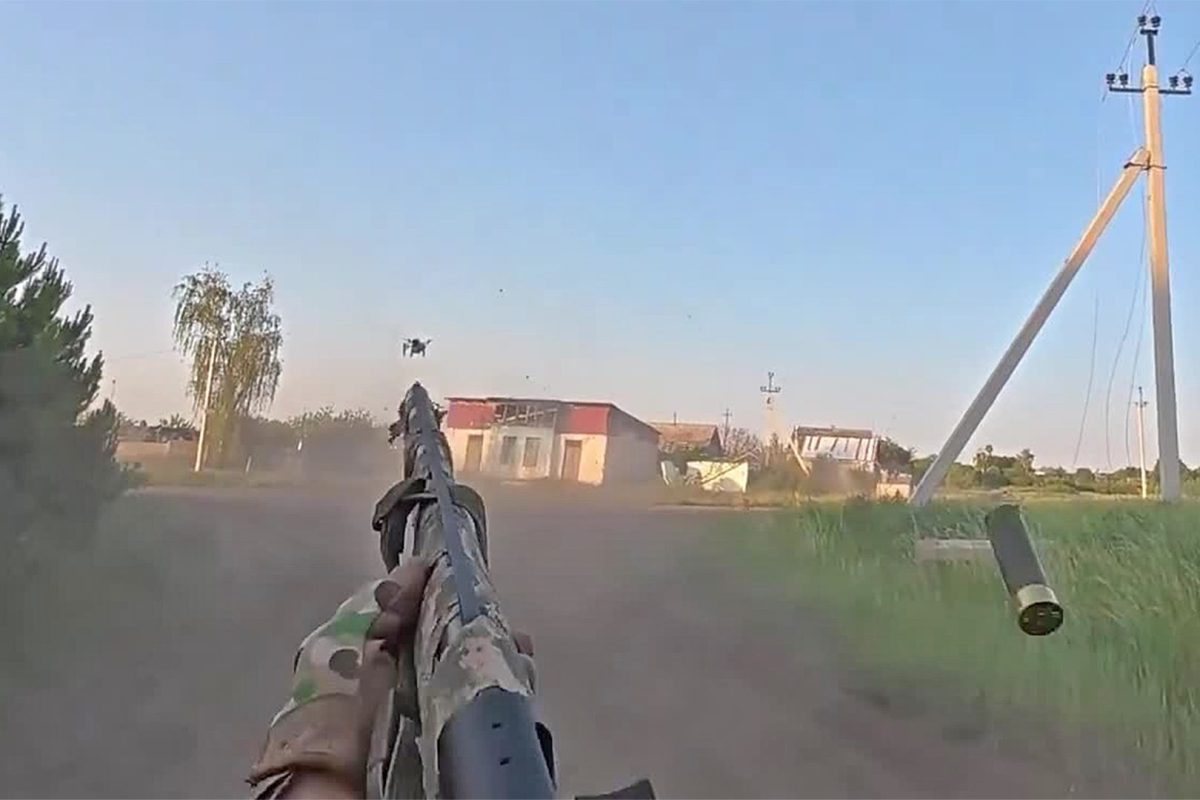
Technological battlefield innovations have been a central feature of Ukraine’s full-scale invasion by Russia in February 2022. This has been reflected in the unprecedented reliance on drones, as well as the use of electronic systems, artificial intelligence and cyber-attacks. The Internet has also been a fertile ground where a wide range of videos related to the conflict have been circulated, from the killing of unarmed Ukrainian prisoners of war to the infamous Bucha massacre in March 2022.
Against this backdrop, this post focuses on assessing the legality of an Internet trend occurring in the Ukraine-Russian conflict: the online posting by units and members of the Ukrainian and Russian armies of videos of soldiers of the opposite side being chased down while unsuccessfully attempting to escape death.
A Daily Compilation of Soldiers’ Last Minutes
From the Ukrainian side, for the last 18 months, Robert Brovdi, the leader of a new unmanned drone corps established by the Ukrainian army, has been posting videos recorded by Ukrainian kamikaze drones online on a daily basis, with one brigade having accumulated an archive of about 3,600 videos. Daily, a military editor goes through the previous day’s drone footage and selects several cuts to upload to the Internet in a two-to-three-minute compilation with its own accompanying background music, together with a weekly collection of the “best moments” of the week.
Regarding the Russian side, its Rubikon Centre of Advanced Unmanned Technologies, established in 2024, publishes regular compilations of strikes on Ukrainian targets, which include enemy combatants. In parallel, the military-affiliated Sudoplatov channel has accumulated thousands of videos, including footage of first-person view (FPV) strikes on Ukrainian soldiers with accompanying background music. Importantly, although it is not the focus of this contribution, the Russian armed forces have a recurring practice of recording FPV-drone strikes not only against soldiers but also civilians, which is well documented (see here and here).
All these videos, which are humiliating and dehumanising (the identity of the soldiers is clearly visible, and the video’s montage, with captions that contain humiliating language, is of a mocking nature), could also be branded as tools that help boost each side’s morale while sending a powerful message to the enemy soldiers of what waits for them if they join the war.
Legally speaking, unlike the recording and public dissemination of images of prisoners of war, which, as they are protected from public curiosity, has been considered a breach of the 1949 Third Geneva Convention (Article 13, dealing with the obligation to treat prisoners of war humanely; see also paragraph 1622 of the ICRC 2020 commentary on this provision), international humanitarian law (IHL) contains no specific provision that discusses whether these online videos comply with the rules of warfare or not. This is because, unlike prisoners of war, combatants fit to fight on the battlefield do not fall under any category of protected persons. Therefore, the rest of this post (1) briefly clarifies the legality of the killings themselves, (2) discusses the protection of soldiers against practices like these through the articulation of human dignity, and (3) concludes that this practice is a violation of IHL even if it assists in finding the missing and dead.
The Use of Drones to Target Soldiers
In international armed conflicts (IACs), the killing of combatants is legally generally permitted. IHL only contains a handful of limitations when it comes to the means and methods which can be used to target them. A priori, there is no reason to question that both the means (kamikaze, FPV drones) and methods (the drones locating the soldiers and detonating once they are close to their target, without seemingly having civilians or civilian infrastructure nearby, which could get damaged as a result of the detonation) of warfare used are unlawful.
In this sense, the legal question that arises is the following: as active combatants who can be lawfully targeted, could the practice of recording their deaths and subsequent uploading to the Internet be a practice that is sanctioned by IHL?
The Articulation of Human Dignity for Combatants
As a group that does not fall under any category of specially protected people under IHL, soldiers engaged in hostilities have limited explicit legal protections. Those are mainly related to the prohibition of using means and methods of warfare which, by their nature or their use, would cause superfluous injury or unnecessary suffering. Therefore, a literal reading of the main treaties regulating armed conflict would seem to easily settle on the legality of the practice discussed in the post, even if the human dignity of the combatants appearing in them is jeopardized. However, three main reasons would challenge this conclusion: first, IHL’s telos; second, the application of IHRL to armed conflict; and third, the residual application of the Martens Clause.
Since 1863, when the Lieber Code was enacted, upholding human dignity has been one of the main goals when it comes to the regulation of armed conflict. In IACs, this is explicitly mentioned in provisions related to humane treatment. This is also reflected in non-international armed conflicts, where Common Article 3 to the 1949 Geneva Conventions, whose “purpose is to uphold and protect the inherent human dignity of the individual” (see paragraph 49), must be read as a reiteration of humane treatment as a cornerstone of IHL.
However, a counterargument is that the above-mentioned provisions refer to specially protected groups, under which combatants actively engaged in the hostilities do not fall. This is where the application of international human rights law (IHRL) during armed conflict comes into play.
Currently, the simultaneous application of IHRL and IHL does not raise controversy, except in situations where there is a normative conflict between the two branches of law, which is not the case in this post’s scenario. In this regard, the International Criminal Tribunal for the former Yugoslavia (ICTY) considered that the “general principle of respect for human dignity is the basic underpinning and … the very raison d’être of international humanitarian law and human rights law” (see paragraph 183). Similarly, the ICTY also found that both IHL and IHRL “take as their starting point the concern for human dignity which forms the basis of a list of fundamental minimum standards of humanity” (see paragraph 149).
The application of IHRL, then, obliges parties to the armed conflict to respect the human dignity of those involved in armed conflict, including enemy combatants qua human beings. In this sense, the propaganda method of online posting of videos with the intention to ridicule those appearing in them, exposing the soldiers to insults and humiliation, constitutes a breach of their human dignity. This is so even if, once these images go live, they are already deceased. Importantly, the interpretation of this practice as a breach of this human right has been explicitly acknowledged in the International Committee of the Red Cross’s 2020 updated commentary on the 1949 Third Geneva Convention, where they noted that
“the disclosure of photographic and video images, recordings of interrogations or private conversations or personal correspondence or any other private data, irrespective of which public communication channel is used, including the internet … could … be humiliating[.]” (see paragraph 1624)
Finally, this practice should also be interpreted as unlawful through the application of the Martens Clause. The contemporary formulation of this Clause, which has a customary nature, can be found in Article 1(2) of the 1977 Additional Protocol I. It reads as follows:
“In cases not covered by this Protocol or by other international agreements, civilians and combatants remain under the protection and authority of the principles of international law derived from established custom, from the principles of humanity and from the dictates of public conscience.”
Understood as a form of the principle of humanity, the clause is typically read as offering guidance when interpreting actions not specifically regulated by IHL. Importantly, it precludes the assumption that “anything which is not explicitly prohibited by the relevant treaties is therefore permitted” (see paragraph 55), which has come in particularly handy in the context of assessing the legality of the use of new technologies in the battlefield.
Therefore, circling back to the scenario analysed here, during armed conflict, human dignity must be respected, not only that of protected groups by IHL, but of every person involved in it, as their human rights qua humans continue to apply. Thus, even if not explicitly contemplated in any provision, combatants also have the right to have their human dignity respected. This entails, then, that the practice here analysed constitutes a breach of this branch of law.
The Obligation to Identify the Missing and the Dead
On another note, these videos are not only popular in Ukraine and Russia but also amass a substantial audience from the ‘other side’. This relates to the fact that there is a considerable amount of battlefield opacity regarding the dead and missing (for example, there is no official recount of each side’s losses). For example, as some of these videos’ montages pause for viewers to clearly see each one of the drones’ targets, this has led to Russian citizens taking screenshots of the soldiers’ faces in order to identify them.
According to IHL, each party to the armed conflict must account for the dead and the missing (chapter 35 of the ICRC Customary IHL Study, which compiles a series of obligations related to the dead). Hence, even if not the primary goal of these videos, both parties to the armed conflict are fulfilling their obligation to, prior to their disposal, identify the dead.
However, the videos are uploaded online with the intention to ridicule. In this regard, the families’ right to know the whereabouts of their relatives must be fulfilled through sharing the available information with the ICRC, which acts as a neutral intermediary. Therefore, even if this practice inadvertently assists in the identification of the missing and the dead, the modus operandi employed is unlawful.
Conclusions
Since Ukraine’s full-scale invasion by Russia in February 2022, Ukraine has been fighting against a brutal, unlawful large-scale invasion by Russia. The pressure this state has been facing to repel the invasion has been immense, and the use of new technologies has been a powerful tool to assist it in this mission. However, both parties are bound by IHL, which means that not all conduct is allowed.
In this regard, by articulating the human dignity soldiers have by virtue of being human, the posting of scornful videos of Russian and Ukrainian soldiers before being killed in combat does not comply with IHL. This is because dignity, even if that of the enemy soldiers, cannot be rescinded.

Andrea Farrés is a PhD candidate in international law at University of Barcelona, Spain. She has worked for the British Red Cross as a research fellow, as well as for the Spanish Mission to the UN, the Norwegian Refugee Council and the World Organisation Against Torture, among others.