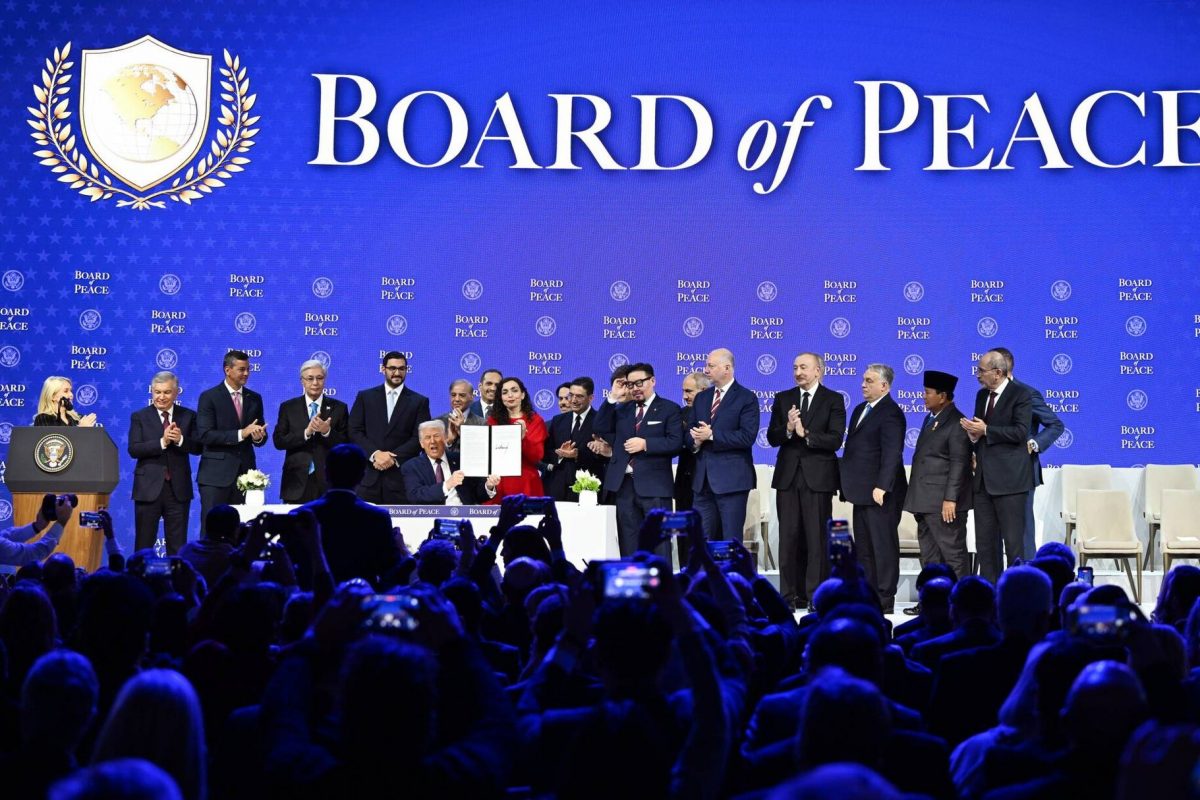

“We tried to structure this meeting like a proper board meeting, like we do in the private sector, where we have all the preparation, we get the right people together, and we really report on what our challenges are, what the opportunities are, and what are the approaches.” (Jared Kushner, 19 February 2026 see here, at 01:37:25)
Donald Trump’s Board of Peace (BoP) is, at first glance, a classical, even if rather unusual, international organization (IO). Indeed, this has been the legal classification under which most analysis of the BoP has so far occurred (see here and here). However, on closer inspection, its governance architecture rather resembles a private corporation with a centralized executive authority, flexible membership dynamics, voluntary capital-style funding, and operational autonomy. To understand these characteristics, business law may provide analytical tools that international law alone does not. What we may be witnessing is not just a new international body, but the “corporatisation” of peace governance, and we need to be equipped to speak the corporate language if we want to understand this process better. But this is not merely a matter of legal competence. The resort to the corporate form in the field of peace and security may also help the BoP to dilute foundational elements that come with the exercise of public power, like accountability and oversight, both towards its member states and the wider international community.
The following paragraphs will first set out how the BoP corresponds to some of the five basic elements of a corporation under corporate law. We will then discuss how this corporate structure relates to the centralisation of the BoP as well as its ostensibly public mission of peacemaking. Finally, we will briefly reflect on how these findings fit into the broader privatisation of peace in Gaza.
The Board of Peace Ltd.
The core five elements of corporate governance are (1) delegated management, (2) legal personality, (3) limited liability, (4) investor ownership, and (5) transferable shares. Except for (5), all of these elements can be traced within the BoP. Furthermore, the terminology used in the Charter starkly resembles the language of corporate law.
(1) Delegated Management: The BoP, as the plenary organ responsible for strategy and supervision (Article 3.1 (b) Charter of the BoP (Charter) and its Executive Boards, responsible for day-to-day management (Article 4.2), are at least evocative of the two-tier structure and delineation of responsibilities in corporate governance. The decision-making is further delegated to several sub-committees. For the moment, these institutions are focused on Gaza (i.e., the Gaza Executive Board + the National Committee for the Administration of Gaza), but new ones may be created in the future to deal with other conflicts where the BoP is active. Interestingly, four of the eight members of the Executive Board also have a background in the private sector. Steve Witkoff and Jared Kushner are both real estate developers, Marc Rowan is the CEO of Apollo Global Management, and Ajay Banga, although now the President of the World Bank, was formerly an executive at Mastercard and General Atlantic.
(2) Legal Personality: Article 6 of the Charter grants the BoP both international legal personality and domestic legal capacity within the legal systems of its member states. The former enables the BoP to operate on the international plane (e.g. holding rights and obligations under IL, see e.g. the ICJ’s Reparations for Injuries Advisory Opinion (para. 179)), while the latter allows it to act within national jurisdictions (e.g. contracting, owning property, and instituting legal proceedings). While necessary for the corporate form, legal personality does not in itself distinguish the BoP from other IOs.
(3) Limited Liability: The Charter does not expressly state that Member States are “not liable” for the Board’s obligations, so any analogy to corporate limited liability must be made carefully. Article 6(a) constructs the Board as a separate legal person with the standard capacities of an independent risk-bearing entity, so obligations are incurred in the Board’s name rather than automatically in the name of its members. The funding model somewhat reinforces this separation. Expenses are to be met through voluntary funding (Article 5.1), not an open-ended duty to recapitalise, and Member States are not compelled to participate in missions without consent (Article 2.2(b)), which limits automatic “pass-through” of operational burdens. Article 6(b) adds another layer of insulation by requiring privileges and immunities for the Board and its personnel, reducing exposure to ordinary domestic legal process in host states. And finally, the dissolution clause treats “assets, liabilities, and obligations” as matters to be settled at the entity level (Article 10.2), echoing corporate winding-up logic. Taken together, these provisions build a corporatised architecture of separation — a standalone legal subject with its own asset pool, funding channels, and protective shields.
(4) Investor ownership: When the news about the BoP initiative erupted, many of us were in shock that Trump was asking USD 1 billion from other states to become members of this new organisation. The Charter provides that Member States serve three-year terms, renewable by the Chairman, and that the contribution of USD 1 billion in cash is only for those who would like to purchase a permanent seat (Arts. 2.2(c), 5.1). On paper, governance follows the familiar multilateral principle of one-state-one-vote. Yet the USD 1 billion price tag for durable membership hints at a different logic. If access to stable governance rights is conditioned on capital contribution, the institutional design begins to look like the principle of investor ownership. States do not receive transferable shares or dividend rights, but they are effectively invited to purchase durable influence within the organisation, linking governance participation to financial commitment. This investor-like structure is further reinforced by uncertainty over who ultimately controls the contributed funds. Reports that a private account at JPMorgan Chase may be accessible to the Chairman and selected Executive Board members suggest a concentration of control comparable to that of controlling shareholders, raising concerns regarding preferential access to corporate assets and potential breaches of fiduciary duties.
All these features of the BoP seem to align with a conception of the efficient private vs. inefficient public form, which we also observe in other activities of the Trump Administration, such as in the context of DOGE UN, which denounced several UN agencies as inefficient and wasteful, leading to the US exiting them. The preamble of the BoP Charter notes that it is foremost a “results-oriented” enterprise. As the introductory quote shows, all of these features are not accidental, but a conscious choice to align the BoP with the corporate form.
The Corporate Form and Centralised Power
In most IOs, and even many private corporations, substantial decision-making power remains in the hands of the member states or shareholders, respectively. In contrast, decision-making authority in the BoP is largely centralised in the figure of the Chairman. For one, the Chairman holds full control over membership in the BoP, which requires that a state be invited by the Chairman to participate and assent to be bound by the Charter (Article 2.1 Charter), but crucially does not require consent by the BoP as a plenary organ or the other member states individually. The Chairman also controls the institutional make-up of the BoP by creating and dissolving sub-committees and other entities (Articles 3.2 (b) and 3.4 Charter). Even in those matters that are nominally the competence of the BoP as the plenary organ, the Chairman enjoys veto power (Article 3.1 (e) Charter). Furthermore, the Chairman alone decides on their succession (Article 3.2 (a) Charter) and appoints the Executive Board (Article 4.1). The Executive Board is thus almost entirely separated from the will of the member states. This is a particularly important aspect of the BoP’s centralisation, as according to BoP Resolution 2026/1, the Executive Board enjoys the same authority and powers as the BoP, subject to the direction and control of the Chairman. Given the fact of who sits on the Executive Board (Jared Kushner et al), the BoP almost resembles a family- or founder-controlled business rather than a publicly traded company with more complex and balanced governance-structures.
Public Functions in a Private Form?
Despite its corporate resemblance and high degree of centralisation, the aims of the BoP are clearly public. As Chapter I of the Charter states, its mission is to “promote stability, restore dependable and lawful governance, and secure enduring peace in areas affected or threatened by conflict”. We do, however, have well-established IOs that share some governance similarities with the BoP. For example, both the IMF and World Bank refer to their plenary organ as the Board of Governors. They also both have a two-tier structure, with the Executive Board and Boards of Directors, respectively, taking on most of the management of the organisation. The corporate form is therefore not without precedent in the international community.
However, until now, the corporate form for IOs has been limited to a very distinct category. It is traditionally only utilised for IOs that perform functions akin to private entities, like development banks. Even within the economic sphere, organisations with mandates for public governance, like the WTO, are set up as ordinary IOs. The application of the corporate form to an organisation discharging public functions, and doing so in a field as inexorably tied to public authority as peace and security, is new. In this application, there is an incongruency between the traditional input-legitimacy of delegated sovereignty (to be then exercised accountably) and the output-legitimacy of efficiency and managerialism (which may disregard public accountability as inefficient). This development is concerning in light of the increasing importance of public accountability within the international community. The recent ICJ Advisory Opinion on the Obligations of Israel in relation to the Presence and Activities of the United Nations, Other International Organizations, and Third States (UNWRA AO) demonstrates this. Here, the Court emphasized that IOs’ operations and the legal status are tied to broader public law obligations that belong only to this specific kind of actor. The UNWRA AO also confirmed that a member state cannot obstruct UN operations because of the public and indispensable nature of those operations in fulfilling collective international obligations (para 121). So, the public nature of the UN requires a harmonisation of autonomy with legal accountability, meaning that states cannot opt out of cooperating with a UN body simply because they disagree with its presence or activities. Given that the BoP performs similar functions to those discussed in the AO, how can public oversight be guaranteed if its operational autonomy is anchored in managerial logic? Where is the reference to public international legal norms? IOs operate under privileges and immunities as a public good, whereas corporations’ immunities are limited (e.g. Yearsley Doctrine in the US) and usually derivative of public authorization. The BoP’s hybrid nature could blur these boundaries with dangerous consequences for legal clarity and protection of rights.
Efficiency above all
What makes the corporatisation of the BoP particularly problematic is that it combines the exercise of public authority with a governance model that prioritises efficiency over legality. Its emphasis on “results” without reference to the legal frameworks governing peacebuilding reflects a logic in which speed, control, and financial capacity displace fundamental principles such as self-determination and representative governance. This logic will have direct implications in post-conflict contexts, especially in Gaza. Efficiency can mean bypassing the procedural and substantive safeguards of international law, including the requirement that the affected population retain agency over reconstruction and political organisation. By concentrating decision-making in a small, financially anchored executive system, the BoP risks entrenching arrangements that are expedient but legally defective, effectively foreclosing the possibility for Palestinian self-determination. As the BoP might become a possible model for future international governance (a concerning prospect to put it mildly), we as international lawyers should take these changes seriously and allow ourselves to “[reorient] toward legal fields that may be found to be more consequential for new constellations of power.” This entails expanding our doctrinal horizons to include not only international, but also business law.
Julia Emtseva is an Assistant Professor of Law at HEC Paris. Previously, she was a Max Weber Fellow at the European University Institute and a Research Fellow at the Max Planck Institute for Comparative Public Law and International Law. She is a co-founder and convener of the ESIL Interest Group on Critical Approaches to International Law. Her research focuses on questions related to private actors and privatization in international law, transitional justice, diversity and otherness in legal academia and practice, and radical approaches to international law.

Leon Seidl is a Ph.D. candidate and research fellow at the MPIL, Heidelberg. His research focuses on the socio-economic aspects of peace processes, as well as the broader intersection between economic, social, and security issues.