
Iran’s Legal Strategy in Hormuz
Law of the Sea Considerations and Rules of Naval Warfare
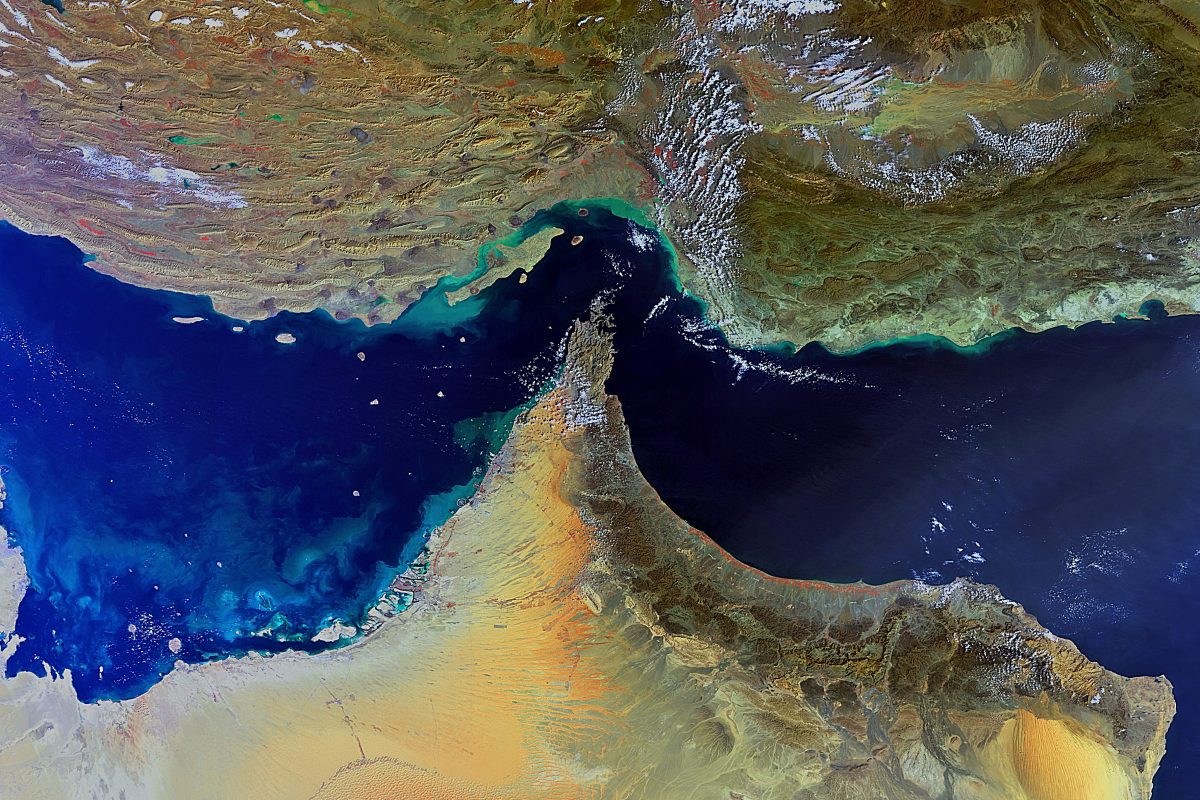
Geography remains Iran’s greatest wartime advantage and a key strategic asset in the ongoing 2026 conflict. The country’s rugged terrain, extensive coastline, and strategic depth in the Persian Gulf shape the course of the war, constraining conventional military options while enhancing Iran’s ability to leverage the Strait of Hormuz as a strategic tool. In Iranian strategic thinking, the Strait has long been seen as more than a shipping route—a view rooted in the 1622 recapture of Hormuz, when Safavid Iran expelled the Portuguese, ending over a century of control by a dominant maritime power.
The current war began with U.S. and Israeli strikes on February 28, 2026. The Strait of Hormuz quickly became a central theater, turning into a minefield. On a normal day, 20 percent of global oil supplies pass through this narrow waterway opposite Iran’s southern coast. By mid-March, commercial shipping had been repeatedly targeted, and traffic had nearly come to a standstill. The International Maritime Organization (IMO) has condemned attacks on commercial shipping and called for the establishment of a safe-passage framework in the Strait of Hormuz. IMO has also reported that around 20,000 seafarers on nearly 2,000 vessels were affected, while the Strait remained critical. At least 17 incidents of damage to commercial vessels were reported in the first half of March. Reports of attacks on civilian vessels have raised serious legal and humanitarian concerns. At the same time, a new pattern has emerged, combining military pressure, controlled navigation, and selective access. These developments have prompted growing debate over the governing legal regime of the Strait.
In this context, a potential defense of Iran’s legal stance can be built upon three interconnected arguments: First, the regime of transit passage, as set out in Part III of the 1982 UNCLOS, which Iran is not a party to, did not simply codify a pre-existing customary rule but reflected a negotiated treaty bargain. Second, even assuming arguendo that transit passage has subsequently crystallized into customary international law, Iran has exempted itself from the rule by long maintaining an express and consistent objection to that proposition. Third, in the context of an armed conflict, the law of the sea cannot be viewed in isolation; it must be considered alongside the law of armed conflict at sea.
The Legal Regime of Passage: Transit or Innocent?
The distinction between the two passage regimes is crucial. Although Iran is not a party to UNCLOS, its provisions remain relevant in illustrating the conceptual differences between the two regimes.
Under 1982 UNCLOS (Part III, Section 2), transit passage through international straits “shall not be impeded,” meaning it cannot be suspended or interrupted (Art. 44), and therefore, States cannot impose fees on it merely for the passage itself. By contrast, according to Part II, Section 3 of UNCLOS, Innocent Passage itself is not absolute freedom. Such passage is subject to the condition that it does not harm the peace, good order, or security of the coastal State, which maintains the authority to regulate navigation, including the right to temporarily suspend passage for security or environmental reasons.
While UNCLOS establishes transit passage as the primary regime for straits utilized for international navigation, the customary nature of this principle remains a subject of debate. Iran signed UNCLOS on December 10, 1982, yet has refused to ratify the Convention. More significantly, at the time of its signature, Iran issued an interpretative declaration based on Article 310 of UNCLOS, highlighting that certain provisions of the Convention were merely the result of a quid pro quo arrangement and did not necessarily codify existing custom or represent established practice. Therefore, Iran does not consider itself bound by the rules of transit passage.
The claim in question remains open to debate. Many maritime nations, including the U.S. (itself also not a party to UNCLOS), view transit passage as generally indicative of current customary law, regardless of the treaty status of the coastal States involved, and thus apply it to the Strait of Hormuz as well (see Lott, p.12 and Gioia, p.31). Meanwhile, UNCLOS III plenary discussions indicate that transit passage was not necessarily a codification of pre-existing customary law, but rather the product of a negotiated compromise. Prof. Yoshifumi Tanaka has also highlighted in his significant book (p.107) that there seems to be little evidence supporting the existence of ‘extensive and virtually uniform’ state practices and opinio juris regarding the right to transit passage. This very disagreement creates sufficient ambiguity for Iran’s argument to be defensible. Thus, when the customary status of a norm is contested, and one State has consistently opposed it, it becomes more challenging to assert that the norm applies to that State without reservation.
The distinction between treaty law and customary international law notably strengthens Iran’s legal position, as it is not bound by the conventional provisions on transit passage. Even if the right of transit passage forms part of customary international law, it can also be argued that Iran has been a persistent objector with consistent practice against the formation of the rule. The 2018 ILC Draft Conclusions (Nr. 15) recognize that a State which persistently and clearly objects to a rule during its formation is not bound by it. Here, Iran’s interpretative declaration upon signature is central because it shows that Iran’s objection to the customary status of transit passage is neither recent nor opportunistic; it was articulated at the very inception of the Convention.
Additionally, Iran’s legislation, as set out in the 1964 Iranian Maritime Code and its subsequent 2012 amendments, as well as in the 1993 Act on Marine Areas, has consistently stated that the Strait of Hormuz is subject only to the regime of innocent passage. This position has also been reflected in the materials of the United Nations Division for Ocean Affairs and the Law of the Sea, emphasizing the more aligned approach with the pre-UNCLOS legal framework, under which innocent passage was the primary regime governing straits and granted coastal States greater regulatory authority. Hence, unlike transit passage, which is characterized by its non-suspendable nature and broad freedoms granted to both commercial and military vessels, innocent passage is the applicable legal regime in the Strait of Hormuz, from Iran’s legal standpoint, which lies entirely within the overlapping territorial waters of Iran and Oman and is thus subject to full Iranian territorial sovereignty in its northern part.
Not Closure, but Control: Iran’s Wartime Legal Narrative
Once the applicable framework is recast as innocent passage, the role of armed conflict becomes significantly more pronounced. Iran frames itself as the victim of an unlawful existential war, attributing responsibility not only to the U.S. but also to certain regional actors hosting U.S. military bases used in operations against Iran, and also to allegedly playing a behind-the-scenes role in the continuation of the conflict. In this context, oil tankers linked to such states may be viewed as contributing to the economic support of parties to the conflict. Relying on Article 51 of the UN Charter, Iran argues that where the movement of vessels poses a genuine threat to its national security, it may adopt necessary and proportionate defensive measures.
At the same time, Iran maintains that its measures in the Strait of Hormuz are not intended to close the waterway but to regulate passage under wartime conditions. Requirements such as prior notification, routing, monitoring, and inspections are framed as tools to distinguish between neutral and non-neutral traffic. Iran has characterized such measures as lawful countermeasures in response to sanctions targeting its oil exports or maritime trade—albeit provided they remain proportionate, temporary, reversible, and fall short of complete closure.
Even within a regime of non-suspendable innocent passage, Iran may still retain the authority to prevent passage that is not innocent on a case-by-case basis. To the extent that the applicable framework reflects the Corfu Channel approach rather than UNCLOS, Iran may plausibly assert a right to regulate passage in a restrictive, but not suspensive, manner where specific instances are deemed non-innocent.
Nevertheless, security measures cannot justify the complete or discriminatory closure of the Strait or undermine freedom of navigation. Any such measures must remain within the limits of maritime law. For this reason, Iran has consistently framed its approach as selective and conditional. Tehran has stated that vessels must coordinate with its naval authorities while maintaining that the Strait remains open in principle and that restrictions apply only to “enemy-linked” ships.
This position was reflected in the Iranian Ministry of Foreign Affairs’ statement of 22 March, which reaffirmed commitment to freedom of navigation, attributed insecurity to the unlawful use of force by the U.S. and Israel, and framed Iran’s actions as self-defense. Accordingly, Iran distinguishes between hostile and non-hostile vessels: ships not involved in hostile operations may pass subject to compliance with security requirements. Foreign Minister Abbas Araghchi similarly noted that passage was allowed for states considered friendly, such as China, Russia, India, Iraq, and Pakistan. In practice, while some vessels, particularly those that provided prior notification, along with nearly 100 others, were allowed through, many more faced delays or remained stranded, indicating a de facto system of differentiated access rather than a complete closure.
Naval Warfare in the Strait of Hormuz: Security vs. Navigational Freedom
The situation that began in February 2026 clearly amounts to an international armed conflict (IAC). Thus, the law of the sea must be interpreted together with the law of armed conflict, under the principle of lex specialis. UNCLOS continues to regulate navigational rights, but issues not governed by it are informed by customary naval warfare law, notably as reflected in the San Remo Manual. Although not binding as a treaty, the Manual is widely treated as an authoritative restatement of the law of naval warfare. It confirms that peacetime navigational rules do not apply in isolation during armed conflict.
State practice generally accepts that a belligerent may close a strait to enemy vessels, while neutral vessels retain their navigational rights. (San Remo Manual Rule 27, Caminos and Cogliati-Bantz, 20-21 and 24-29, also Newport Manual, 74). Belligerents may also impose restrictions such as visit, search, interception, diversion, and capture, provided these measures comply with humanitarian law. (Ronzitti, 6, and Caminos and Cogliati-Bantz, 26). Naval hostilities may occur in belligerent territorial seas, EEZs, continental shelves, on the high seas, and even in neutral EEZs with due regard to neutral rights (San Remo Manual Rules 14-37). Naturally, where one belligerent borders an international strait, that strait may become an area of military operations. On that basis, Iran may argue that the Strait no longer functions as a fully neutral space and that some vessels fall outside the protections attached to neutral passage. Iran may close the Strait to enemy shipping, but certain vessels may also fall outside the protective regime of neutral passage (Part II, Sec II, Rules 23-26).
In the hours following the attack against Iran, at least three tankers were struck by missiles or drones, including the U.S.-flagged oil tanker Stena Imperative. Under Additional Protocol I (Arts. 51 and 52) to the Geneva Conventions and the San Remo Manual (Rules 40-41), civilian ships may be attacked only if, by their nature, location, purpose, or use, they make an effective contribution to military action and their destruction offers a definite military advantage. However, as the Newport Manual characteristically notes, “the law of naval warfare is characterized by an element of economic warfare”. The Stena Imperative may qualify as a lawful military target if its participant role in the U.S. Tanker Security Program brought it within Rule 60 (b) and (g) of the San Remo Manual If Bahraini territory was also used to support U.S. operations against Iran, Bahrain’s neutrality could be questioned, reinforcing the view that the tanker operated within a broader military setting rather than protected neutral space.
Even so, any attack must comply with the principles of military necessity, distinction, proportionality, and precaution. Civilian casualties alone do not render an attack unlawful; the decisive question is whether the target offered a concrete and direct military advantage and whether any incidental harm was excessive. The central issue, therefore, is whether oil tankers transiting Hormuz contribute to the enemy’s war-sustaining efforts so as to become lawful military targets. State practice, as reflected in the Newport Manual, remains divided. While such oil flows may indirectly support U.S. or Israeli military operations, this alone does not qualify tankers as military objectives under the law of armed conflict, and most States reject the view that general economic support suffices. Enemy merchant vessels and their cargo may generally be captured outside neutral waters. Likewise, ships under direct U.S. military escort or closely linked to hostile forces may, in some cases, lose neutral protection. In that sense, U.S. statements about “protecting ships in the Middle East,” may not serve as operational deterrent but as a possible legal basis for targeting such vessels.
Conclusion: Gap Between Law & Reality
The Strait of Hormuz clearly illustrates the practical limits of the law of the sea, where legal rules such as the right of passage are not, by themselves, enough to guarantee freedom of navigation in times of crisis and conflict. Legally, the Strait should remain open to transit, yet in practice, military threats, insecurity, and state action can lead to a de facto closure without a formal declaration. The law of the sea largely rests on assumptions of cooperation and peacetime conditions. Its effectiveness becomes constrained when confronted with armed conflict or intense geopolitical rivalry. As a result, in situations like Hormuz, military realities and security considerations often prevail over legal norms, showing that the law of the sea framework alone is insufficient to manage or prevent escalation.

Soheil Golchin is an international law specialist in the law of the sea and international water law. He holds a PhD from the University of Tehran and is currently pursuing a second Master’s degree in Human Rights Studies at Fulda University of Applied Sciences in Germany.
Thank you, Soheil, for this very well written and interesting piece! This sheds light on this delicate matter and is in my mind a highlight of the scholary debate around the Iran war.