International Organizations: From Black Boxes to Kaleidoscopes
I was drafting this review in Bogotá in January 2026, at the precise moment when the United States crossed into Venezuelan territory and captured Nicolás Maduro in a military operation that, within hours, had him on a transfer track to New York. To me, the juxtaposition was hard to miss: on my screen, a set of books insisting that international institutional law needs more theory; outside my screen, a spectacular reminder that the international order still turns, very often, on force, executive discretion, and the speed of the news cycle. When, a couple of days later, President Trump was asked whether Colombia could be next, he replied, ‘It sounds good to me.’ In Bogotá, that line landed as it should: not as a quip, but as a threat. It triggered a familiar mixture of anxiety and grim curiosity, and, somewhat to my surprise, it also triggered an abrupt spike of interest in international organizations (IOs).
For about forty-eight hours, the informational ecology in Latin America changed. Media outlets that just the day before were busy covering whatever viral clip could be engineered into clicks were suddenly pivoted to staging earnest explainers on the United Nations, the Security Council, and regional institutions. What could the UN do? Would the Security Council act? Would the Organization of American States respond? The answers were, of course, underwhelming. Certainly, the Security Council met, statements were delivered, and the familiar rhetorical furniture was put back on stage. The UN Secretary-General warned about precedent and called for dialogue. The OAS leadership spoke the language of calming escalation and constitutional pathways and convened its own discussions. None of this was meaningless, to be sure, but none of it looked like ‘reaction’ in the sense that Bogotá, like much of the region, was suddenly craving: an institutional interruption of unilateral power.
This is the point at which the seemingly naive question, what are IOs and what are they for, stops sounding naive. In the standard account, IOs are fora for political discussion and bargaining; they facilitate cooperation on narrow technical matters and, at their best, on larger challenges of governance. Those are not false descriptions, but they operate at a different register. They are descriptions that, in moments like January 2026, can feel like telling someone caught in a storm that the point of a roof is to provide a place to discuss architecture. The question that seemed pressing was not only what IOs are in the abstract, but how they operate in the world, how they exercise authority (or fail to), how they interact with states that ignore them, and how, if at all, they act through law when law is precisely what is being stress-tested.
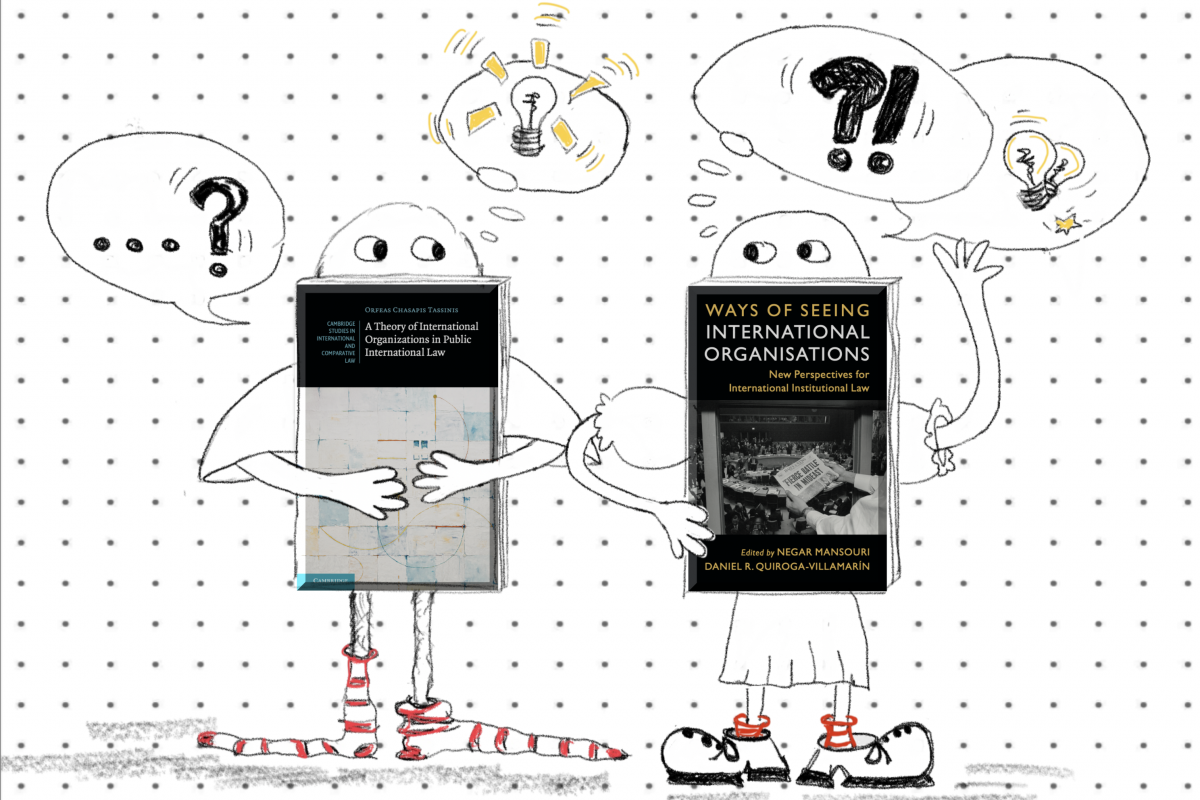
Even if not formulated with theoretical expectations, these are deeply theoretical questions with crucial practical implications, and were at the top of mind as I sat down to finish this piece. Orfeas Chasapis-Tassinis’ A Theory of International Organizations in Public International Law, and Ways of Seeing International Organisations: New Perspectives for International Institutional Law, edited by Negar Mansouri and Daniel R. Quiroga-Villamarín, present themselves as interventions into what they identify as a deficit of theorizing in the law of IOs, a field said to be trapped in theoretical complacency, or otherwise insufficiently grounded. I’m not fully convinced that their diagnosis, taken literally, is right; if anything, there are signs of a resurgence of methodological and conceptual experimentation in recent years (e.g., Sinclair, 2019, Gasbarri, 2021, Marceau and Gött, 2025, Hooghe, Lenz and Marks, 2019, Klabbers, 2025 and von Borzyskowski and Vabulas, 2025). Still, both books are sophisticated efforts to push past inherited habits, particularly the tendency to treat IOs either as neutral technical instruments of their member states or as a doctrinal afterthought of public international law.
They do so, however, in notably different registers, political sensibilities, and styles. A Theory of International Organizations wagers on conceptual reconstruction and ontological clarification. Ways of Seeing embraces a plurality of voices, foregrounding practice, expertise, and the mundane routines through which authority is performed. Yet the distance between them should not be overstated. Both books, in their own idioms, are efforts in revealing hidden truths: they are both in the business of making the machinery of international institutions legible by exposing the conceptual assumptions on which it runs. And, for better or for worse, they end up doing so in a moment when the background assumptions of the postwar order and its international organizations are not merely contested but increasingly disregarded. That context of reading could not have been anticipated at the time of writing, but it weighs heavily on the books’ reception. As reception theory in literary studies reminds us, this is a contingency all authors must face
A Theory of International Organizations and Ways of Seeing are extremely rich, and they offer multiple entry points for sustained engagement. In what follows, I focus on the way each book addresses the two questions flagged earlier, which provide a useful vantage point from which to assess their contribution in today’s context of reception. What, after all, is an international organization? And what does it do?
The Concept of the Concept of an International Organization
Ontology is the point at which international institutional law decides what its object is. Both A Theory of International Organizations and Ways of Seeing treat that decision as neither innocent nor merely conceptual: it structures what the field can ‘see’ as an international organization, which questions become legally tractable, and which accountability claims can be framed in the first place.
Ways of Seeing makes its ontological intervention by challenging the discipline’s default gaze. The editors argue that international institutional law has settled into a ‘reified set of issues’ that appear to ‘naturally’ belong to jurisprudence, and they insist that ‘looking’ at international institutions is not a neutral operation (p. 5). That methodological claim becomes ontological once the volume refuses to treat the IO as a bounded legal ‘thing’ that can be captured by instruments, competences, and member relations alone. In a way, as Guy Fiti Sinclair explain, the intervention here is deliberately ontological: the volume offers a ‘kaleidoscope of images’ in which IOs appear ‘startlingly heterogeneous’ and not as ‘discrete, self-contained, coherent entities’ (p. 316). Across the volume’s thematic axes, the IO is approached as an assemblage composed of actors, artefacts, routines, infrastructures, and circulations. The analytical implication is that ‘what an IO is’ depends on what one follows, and that following practices and materialities changes what becomes visible as law, authority, and responsibility.
A Theory of International Organizations reaches a similarly anti-reductionist ontology through analytic reconstruction. It begins from two linked problems: whether and why IOs can be legally distinct from their members, and what the content of their legal personality is once that distinctness is granted. The book’s key move is to treat those problems as questions about corporate existence, and therefore to rebuild the ontology of IOs from a general account of how corporate entities become possible objects of legal thought.
To do that, Chasapis-Tassinis proposes a method of ‘institutional genealogy’. The aim is to shift away from defining ‘platonic types’ (statehood, international organizations) and toward the ‘continuous line’ connecting these entities to a common ontological core, namely the status-generative capacity of certain communities (p. 176). As a result of this move, the book’s core claim about ‘legal ontology’ is pretty flexible, and hence useful: we do not need to ‘exhaustively define’ international organizations as a separate class before admitting them into the ontology of international law (p. 197).
Both these approaches seem promising in terms of understanding how IOs act (and cannot) act in the world. Both books contest the reified picture of IOs as self-contained units, but they locate reification in different places. In true STS fashion, in Ways of Seeing reification is methodological: the container-like IO is an artefact of an optic that preselects what counts as ‘legal’ and screens out socio-technical conditions of authority. In A Theory of International Organizations, reification is doctrinal and conceptual: inherited ‘all-embracing dichotomies’ lead to an ‘analytical dead-end’ (p. 92), and anthropomorphic images of the state entrench mistaken intuitions about what kind of entity an IO could be.
Distributional Stakes in Defining International Organizations
This sort of ontological framings allocates agency and responsibility, thus distributing costs, risks, and authority. In that regard, I felt that the books’ anti-reification strategy paid out in terms of political economy and distribution, and not merely in terms of conceptual tidiness.
Ways of Seeing is more explicit about its ambitions on this front. Negar Mansouri’s excellent contribution is particularly clear: it takes capital and class as the organizing lens, showing how international institutions are embedded in capitalist modes of production. It traces how bureaucracies and experts can reshape production relations, link production and exchange, and depoliticise capitalism by recoding distributive effects as technical and neutral governance. The volume’s broader claim follows from this: reification is not merely an analytical error, but a distributive technique. Treating the IO as a coherent unit can conceal the social relations and material infrastructures through which global governance is assembled and its costs allocated.
A Theory of International Organizations is less explicit in political economy terms, but it also implies an ontology that is distributionally consequential. The anthropomorphic intuitions it critiques render certain allocations of authority intuitive; for example, one could read the book’s tight discussion on the presumption that personality conferred by member states cannot bind non-members without recognition in such fashion (p. 105). By relocating the foundation of corporate existence to communal status-generation and its legal recognition, institutional genealogy changes the argumentative terrain on which claims about autonomy, obligation, and responsibility are made (pp. 176, 197). And it is thereby opening the space for a distributive analysis in the legally constituted ‘independent will’ of the IO. Chasapis-Tassinis does not engage in such distributive analysis – it is clearly outside the scope of the book’s project. However, it seems that this undertaking is well warranted today.
How would that look like? Maybe a conversation between the two works could provide some clues. Assemblage accounts (Ways of Seeing) and corporate genealogy accounts (A Theory of International Organizations) converge on a shared anti-reification stance, but they generate different criteria for attributing agency to IOs. In A Theory of International Organizations, the operative unit remains the unitary corporate entity. Attribution and normativity run through the architecture of corporate existence, legal personality, and opposability, and through the practices that stabilise corporate status vis-à-vis insiders and outsiders (pp. 1, 105, 176, 197). Agency therefore remains centred on the organization as a legal bearer of rights and duties and, even though the book rejects the idea that this bearer should be treated as a black box, its very ontology continues to work as an on/off switch in terms of distribution of power, and hence agency: either the organization has a certain power, or it does not.
This view could be complemented with the approaches in Ways of Seeing, where the operative unit is the assemblage. Agency here follows chains of practice and infrastructure: which actors assembled expertise, which routines stabilised decisions, and which material arrangements made particular outcomes possible – for example, in the rescue of migrants in the Mediterranean, as described by Kiri Olivia Santer, or in defining ‘hidden hunger’, in Juanita Uribe’s chapter. In all these processes, agency tends to look diffused, and a distributional analysis becomes useful to see who ends winning and who ends up losing, particularly in hybrid public private governance (as is the case of the telegraphic standards example, in Jan Eijking’s contribution), where outcomes are co-produced by contractors and technologies that standard doctrine may treat as external.
Thus, each book offers different (but potentially complementary) logics for organizational agency. In a way, read together, they propose a continuum of a pulling agency inward and then pushing it outward, which may be useful when thinking about the political economy of IOs. Indeed, Ways of Seeing and its assemblage approach pushes the agency analysis outward toward distributed governance and its political economy. Once one starts from assemblage rather than entity, agency appears distributed. Acts are not simply ‘the organization’s’, but the output of chains of practice that include secretariats, consultants, devices, templates, data infrastructures, funding instruments, and professional performances. The analytical pressure point is outward, toward how governance is assembled across sites and how political economy is sedimented in the mundane techniques through which international administration operates.
In contrast, A Theory of International Organizations and its genealogy pull agency inward toward a clarified corporate subject of law, which allows the author to argue for a robust, opposable corporate personality without defaulting to a state analogy.
The core move, which in part meets international law’s need for well-defined subjects, is genealogical. IOs and states are treated as points on a continuum of corporate entities, rather than as categorically distinct ‘types’. On this view, a coherent structure of attribution is not a fiction but a legal achievement. Acts and responsibilities can be attributed to the organization as an entity because corporate existence is precisely the device through which international law stabilises collective agency and renders it opposable.
International Organizations Acting in the World
This divergence is productive, and it also reveals a shared turn to ‘practice’ in both books – at different analytical scales and with different ambitions for what ‘practice’ is supposed to accomplish in international institutional law. In both A Theory of International Organizations and Ways of Seeing, the shared target is the idea that one can derive what IOs ‘do’ from constituent instruments alone, as if charters, implied powers, and a catalogue of formal competences were sufficient to explain how authority is produced, stabilized, and contested.
Ways of Seeing reject that idea by locating the problem in disciplinary habit. It argues that mainstream international legal work on international organizations remains confined to a familiar repertoire, centered on interpreting constituent instruments and reading judicial decisions. The result is a picture of IO law that tracks what can be extracted from texts and contested in adjudicated disputes. The claim is that this optic is structurally incomplete: it concentrates on rules of status, structure, and functioning, while displacing the production of power and influence to the margins. But, how to reverse that gaze? The editors’ bet is not to append ‘context’ to doctrine, but to treat practice as constitutive of institutional legality. Their wager is that legality and authority are stabilized through material performances and the practical conditions that give technocratic governance and bureaucratic action traction. ‘Practice’ here is micro-practice: where institutional life happens, and materiality is one of the conditions that allows legal claims, decisions, and routines to take effect.
In A Theory of International Organizations, ‘practice’ is constitutive in two related ways. First, the book treats certain doctrinal questions as genuinely determinate: a theory that cannot resolve them is not merely incomplete, but methodologically ‘mis-framed’. It presses this point by arguing that personality is either opposable to non-members without recognition, or it is not; and that IO practice either counts toward the formation of customary international law, or it does not (p. 30). Second, it maintains that those answers cannot be read off constituent instruments, because the decisive legal effects, especially opposability and objective personality, flow from general international law’s modes of institutionalization rather than from member consent alone. This is what motivates the turn to corporate analogies and to the debate over objective versus subjective personality, including the question whether legal existence depends on recognition (pp. 74 to 78).
Accordingly, although the book’s account of recognition and opposability is doctrinal, it remains practice-based in a distinct, macro-register that is broadly Hartian. It treats the existence and legal effects of corporate entities as stabilized through practices of self-description and their acceptance as part of the legal system’s ordinary operation. Unlike Ways of Seeing, this is not ‘practice’ as everyday institutional routine, but a macro-practice as systemic uptake and normative consolidation. This is also why ‘practice’ becomes central to the argument about customary international law. Outputs of IO organs, including outputs not reducible to member state conduct, can constitute the organization’s own practice and therefore contribute to customary norm formation, subject to an assessment of their weight and representativeness (pp. 216 to 217 and 224).
I see a plausible complementarity between the two approaches. A theory of institutionalization that is both empirically sensitive and doctrinally usable would treat macro recognition and opposability as partly dependent on micro practices, and micro practices as structured, enabled, and constrained by macro legal status. In A Theory of International Organizations’ terms, ‘self-description’ is a capacity with legal consequences (p. 189). Yet, in organizational life, self-description is rarely a single speech act. It is sustained through recurring micro practices, including drafting, circulating, standardizing, recording, delegating, classifying, and performing authority in ways that make an entity’s will legible and durable over time. Conversely, the macro endowment of legal personality, privileges, and immunities shapes the ecology of micro practices. It can insulate routines from external scrutiny, reallocate legal and reputational risk, and organize the internal division of legal labor. This is the kind of dynamic that Roberto Dañino, the Peruvian World Bank lawyer wonderfully portrayed in Dimitri Van Den Meerssche’s chapter in Ways of Seeing, would readily recognize.
Adjacent scholarship that conceptualizes competent legal performance as ius-generative practice can serve as an intellectual bridge between these two levels, as my own work with Armin von Bogdandy on the Latin American community of human rights practice has sought to demonstrate. The point is not to collapse sociology into doctrine, but to connect them without reducing either. On this view, institutional life becomes probative for core doctrinal categories such as ‘distinct will’, attribution, and the scope of opposability, while doctrine supplies the criteria for identifying which practices matter legally, for whom, and with what effects.
Legal Organizations, Legal Means, Legal Action
A Theory of International Organizations’ and Ways of Seeing’s turn to practice also problematizes the centrality of law in actual IO behaviour. That skepticism toward the regulative power of the legal form is well taken. Yet neither book, in its ontological register, offers a sustained account of how their ‘object’ (the international organization) exists in its broader context and, more specifically, how law figures in that existence.
Each book helps answer a first-order question: how can an IO be understood as a legal object? Ways of Seeing does so by showing that the object is not a container, but an assemblage that must be traced across practices and infrastructures. A Theory of International Organizations does so by showing that the object is not reducible to member states, but rather a corporate bearer of authority whose legal existence can be explained without relying on anthropomorphic shortcuts. Both, however, stop short of fully theorising the second-order question that follows: how do IOs live out their being in the world through law?
This matters because IOs do not merely ‘have’ law as a surrounding normative environment. They create realities, struggle for power, and distribute resources as specifically legal objects, which operate, for better or worse, at least in part through legal forms. In Samantha Besson’s succinct formulation, IOs are both ruled by, and rule by, law. The paradox is that, even where reification is rightly criticised and practice is rightly celebrated, part of what an IO is cannot be separated from what it does, and much of what it does is done through law.
Put differently, anti-reification can illuminate the dangers of treating the IO as a sealed box, but it does not by itself explain the constitutive role of law in the organization’s worldly existence. Assemblage accounts risk rendering law as one technique among others, without explaining why legal forms are so persistently central to authority, legitimacy, and distribution. Genealogical corporate accounts risk treating law as the stabiliser of ‘entity-hood’, without tracing how legal techniques mediate the organization’s interventions in social reality.
The question that remains, and that both books invite without fully answering, is therefore: how can we theorise law as a medium of institutional life, not only as the vocabulary in which an IO is described, but also as the infrastructure through which it governs, allocates, and transforms? A next step might be to treat ‘through law’ as a distinctive modality of IO existence, a set of legal technologies that make power portable, scalable, and contestable across distance and time. That would connect ontology to political economy to practice in a more direct way, by showing how socially created legal forms are themselves distributional devices, shaping who benefits, who bears risk, and which injuries become intelligible as wrongs.
This is, ultimately, an agenda for the future. Chasapis-Tassinis, and Mansouri and Quiroga-Villamarín, deliver a valuable gift today: books on international institutional law in which theory is not an ornamental prologue to doctrine, but a method for grasping what is at stake when institutions claim authority in a world that increasingly ignores them. In different idioms, they press the field to stop treating IOs as benign instruments or as mere doctrinal residue, and instead to confront their contested being, their practices, and their distributive effects. They also leave the reader with a productive unease. If IOs are both ruled by international law and rule by law, then the next task is to specify how legal forms become the medium through which organizations govern, allocate, and transform, and how that medium can be rendered contestable. These books open that agenda with welcome urgency, at a moment when theory is a condition of responsible engagement.

René Urueña is an Associate Professor in International Law at Universidad de los Andes in Bogotá, Colombia, and Max Planck Law Fellow.