Not Beyond Good and Evil
The Practice and Theory of International Organizations
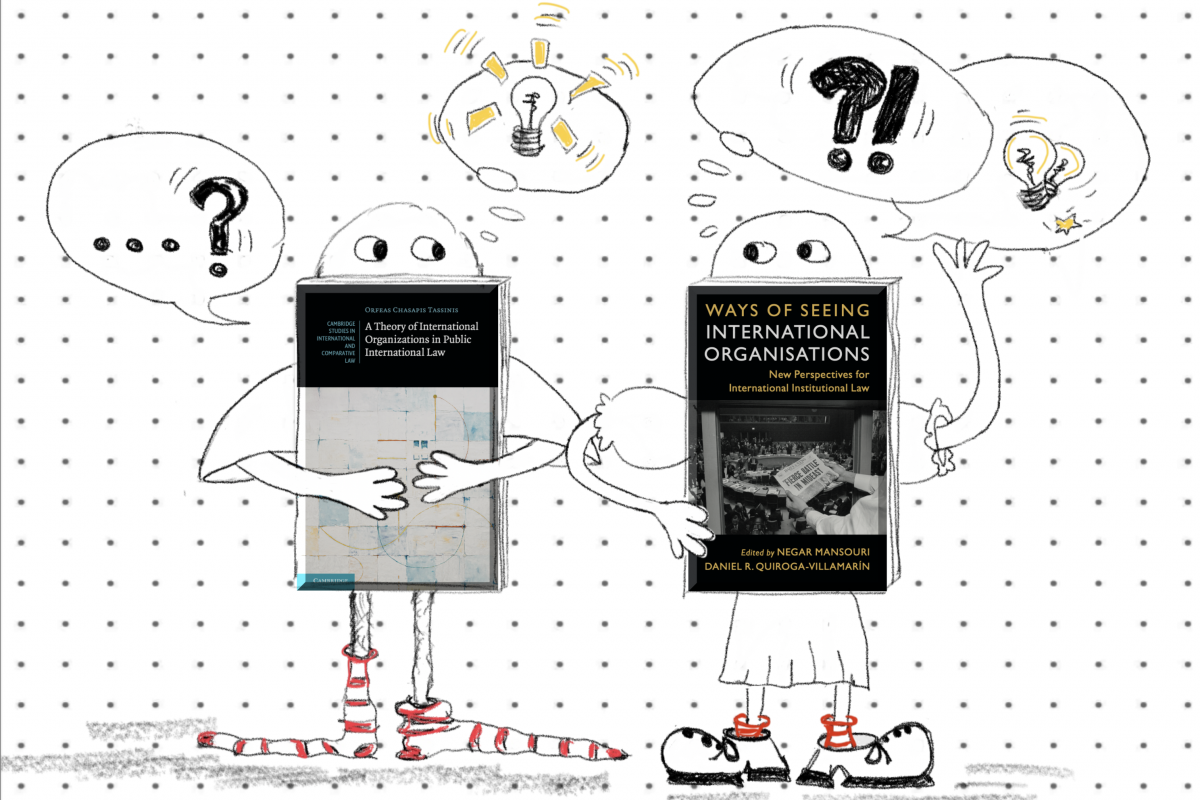
‘When I’m really enjoying a book, I stop taking notes’ said one of the 2025 Booker Prize judges in a recent interview. I found myself in the same situation with these two books under review. Ways of Seeing International Organisations edited by Negar Mansouri and Daniel R. Quiroga-Villamarín and A Theory of International Organizations in Public International Law by Orfeas Chasapis-Tassinis. Since we are discussing the theory of IOs in both cases, and not narrating some sweeping adventure, romance, or dystopian minimalist story, one must give credit to the authors for these novel, relevant, well written and captivating books. They prove that not everything has been invented, and there are new things under the sun which in many respects is a sign of hope in these anxious times. The comments that follow, also those that are critical, disagreeing, or offering alternative routes, are framed within this sense of wonder and renaissance. In this contribution I was also asked to share what would my own work add to the staged discussion between the two books at hand. Thus, and deviating a bit from a more classic book review, I will introduce reflections on my own work in the discussion.
Novelty Within a Certain Tradition
Negar Mansouri and Daniel R. Quiroga-Villamarín write in their introduction that ‘[I]t is time, we argue, for the discipline to start seeing IOs differently’ (p. 5). Some might find that this opening statement does not do full justice to the work on IOs out there, since even some of the contributors in their own volume have been walking that path for years. For instance, in key pieces, such as ‘The EJIL Foreword: The Transformation of International Organizations Law’, more recently in his edited volume Cambridge Companion to International Organizations Law, with several chapters touching upon similar topics as this book, and many other publications, Jan Klabbers has shown that IOs are political creatures, embedded in the political economy of the world. He has further forcefully demonstrated that functionalism has not been a sound theory to deal with the demands of accountability and governance that their existence entails. Although arguing that a more fundamental critical viewpoint has to be produced by means of specific historical and theoretical tools, such as positioning the analysis of the relationship between postcolonial nations and IOs ‘in deep structures of neocolonialism’ (p. 23), B.S. Chimni also states, in what is perhaps the most programmatic contribution of the volume, that this critical work has already been done for decades. The need to be cautious about the use of expert knowledge in global networks and IOs has been a familiar theme for some time (see Garcia-Salmones). And the turn to history in international law, analysed almost two decades ago by George Rodrigo Bandeira Galindo and more recently by Ignacio de la Rasilla has undeniably left its mark. In that sense, the editors and contributors to Ways of Seeing have not ‘killed the father’, as Freud would describe new beginnings facilitated by a complete departure from the past.
And yet, the book is certainly novel in the manner it aims at theorizing the promotion of ‘diversity of methods’ in the study of the law of international organisations, (p. 6), at becoming almost a manifesto in the process, and at gathering a nearly corporate strength in its endeavor. The volume generally engages in a common enterprise of ‘tracking and tracing, mapping and multiplying’ of the people and things that law assembles (Van Den Meerssche, pp. 245-46). It is in this sense a welcome evolution in critique. While often we need to start seeing IOs with materiality, as the contributors do, that is not the same as saying that a materialism can fight another materialism – it is the thinking and reflective individual that does so (Fiti Sinclair, pp. 311 ff.).
A Common Exercise of Common Sense?
Mansouri and Quiroga-Villamarín also write: ‘Our goal is not only to promote diversity in the methods and methodologies used to study IOs, but to actively challenge the current ‘common sense’ way of doing things, within the subfield of international institutional law.’ (p. 6) Here, I find myself asking: what is wrong with ‘common sense’? Since the ‘common sense’ in the sense of ‘mainstream thinking on IOs’ has been challenged for decades already, as mentioned before, I read that expression as the sound judgment in practical matters, and effectively as the ‘good sense’ in A. Claire Cutler’s contribution: ‘Governance through good sense contemplates self-reflexivity as well as conscious recognition of and moral and ethical engagement with contesting social forces.’ (p. 290) I would defend that despite their initial statement, it is the Editors’ common sense what moves the project of this volume to begin with. The chapters show that throughout the 20th century, people dealing with IOs’ law as a discipline, have displayed a notorious lack of common sense in their working methods, treating their creatures of study, the IOs, simply as expressions of the international and not as real organisations (Klabbers), as non-political expressions of the international at that, thereby disregarding the most obvious colonial and corporate political economies developed through their micro-politics (Eijking), while at the same time failing to address the fact that there exist different visions of global justice or transnational capitalism (Clement). When assessing IOs, groups of experts, whose habitat tend to be the IOs themselves, have displayed a propensity ‘to insulate themselves from partisan squabbles and processes of political contestation’ (Uribe, p. 107) and to focus on technical aspects, and of glossing over or obscure political issues and their implications (Littoz Monnet, p. 66), displaying on the whole little common sense, indeed.
Surely, science taken to be the outcome of experts’ work, is not pure politics. But politics ought to be at least one of the angles when studying relevant scientific issues – in particular when IOs’ activities are the object of study. Not to do so amounts to, e.g. ignore what diplomacy has been doing for thousands of years, that is, trying to achieve what you need or want, while staying in friendly relations with the other rulers, empires, regions, kingdoms or IOs.
Common sense in the area of IOs would seem to amount to a combination of the acknowledgment of power structures in global order and the general desire of those in power for maintaining them (Chimni, p. 25). Therefore, it is important to approach the work of any IO with healthy skepticism. At the same time, common sense tells us that people are free and that nothing ever remains the same in institutions, that ‘old alliances break down and new ones emerge, in a continuous process of assertion, contestation, and restructuring.’ (Soave, p. 138) This common sense standpoint also means to understand that IOs are ruled by real people, individuals, with real life projects that can affect the whole culture of an IO (van den Meerssche). In a world where everything is uncertain and relative, we occasionally encounter managerial figures, like Roberto Dañino, former World Bank General Counsel, who seem to be immune to uncertainty. Such individuals will do the job as they see it, are efficient and full of energy and will not accept a ‘no’ – whether based on a legal argument or any other challenge. Common sense, at the same time, recommends to remain skeptical about legal arguments as well. Who knows whether someone like Ibrahim F. I. Shihata would not advance their own project of depolarization through legal argument?
But also, and here lies the difficulty with the IOs, common sense bespeaks of humans’ natural wish to do good and to improve the lot of our fellow citizens and (if possible) of humanity, as classic authors remind us (see Aquinas, p. 317, Locke, p. 401). Whether the IOs’ rituals of technical legalities, such as one may find in UN Human Rights Committee, will make a better world, is difficult to say (Halme-Tuomisaari). But, with other contributors in this book (Halme-Tuomisaari; Chimni p. 33) we might want to suggest that there is a glimpse of that in the project of raising human rights standards, and more generally in other IOs’ projects of promotion of the common good.
A common sense approach would start by asking simple, critical questions. Such as, should not promotion of the global or regional common good be the primary response to massive immigration, rather than engaging in morally dubious campaigns aimed at advancing the interceptions of migrants, maritime or otherwise (see Santer)? Who is funding any particular experts? Or as A. Claire Cutler puts it in her contribution: ‘‘[W]ho gets what “from resilience talk and just “whose resilience” are we talking about.” (p. 272) Or, what is the aim of gathering so much data in a certain case? The aim should be precisely to improve the lifes of peoples, whereas that, unfortunately, will sometimes not happen due to the international and domestic politics at play, or indeed, due to the lack of reliable data (Uribe, p. 113). These may not seem to be the most sophisticated questions. Moreover, only once they are asked they appeared common sensical. However, much of what is considered breakthrough science starts when someone asks such simple questions driven by curiosity and good will (Klabbers), and IOs as a field of knowledge have no reason to be different.
Destabilization of Complacency
Continuing with this plea of common sense approaches I want to emphasise how much Negar Mansouri’s chapter illuminates what IOs are doing and not doing and how. Whether the Hobbesian – Lockean distinction she proposes is convincing, is perhaps not so crucial for the chapter. I, for once, tend to read in John Locke’s Two Treatises of Government a full theorisation of the public good of a commonwealth. But Mansouri’s deep and at the same time broad assessment illuminates IOs’ work within larger political and economic historical waves, and the place, sometimes minimal sometimes crucial that IOs play in global order. There are facts, such as that in the 1970’s the Global South provided still 90 % of raw material while owning only 6% of the tankers in the world market carrying out the shipping. And there are also ideologies: one is brought to reflect on how difficult it is to limit the growth-logic when there is no alternative political language to free trade, private enterprise and sovereignty over natural resources (Mansouri). When indeed the only measure is the materialist neoliberal measure, when capital is the god, while sometimes, when ascertaining the real advantages of health and education, e.g., one feels for a second tempted to think that that is perhaps true, our common sense invites us to look at the ugly face of capitalism and at IOs’ evil practices in its name, as some of the contributions in this book do. Some of the chapters feel like stories that one listens while during a walk within one of the Geneva buildings that Daniel R. Quiroga-Villamarín so aptly describes – this happened here, in this transitory and unsuited place. This awkwardness of buildings somehow eases the embarrassment that a European feels listening to Ethiopia’s Emperor Haile Selassie I’s humiliations during his IOs’ skirmishes (Quiroga-Villamarín), somehow the result of Europe’s own provincialism – the international still far from being (re)created.
International Organisations and the Corporate State
From destabilizing we move to a potential assurance of stabilizing in Chasapis-Tassinis’ text. The book’s opening chapters with its strict doctrinal contours and revisions, such as, ‘are international organizations bound by the same customary norms as states’? (p. 3) initially keep the emotions runing low. At least in comparison with Mansouri’s and Quiroga-Villamarín’s almost Wagnerian ‘Sturm und Drang’. At the outset it appears that Chasapis-Tassinis’ book is an exercise and continuation of the doctrinal tradition, one which transmits a familiar language and refines the concepts and the grammar of international law.
But at some point half way through, we come to understand that this text is something else and something more; that is,an existential investigation of the role of corporate entities in human relations and of their impact in ‘what is going on in the world’ (p. 87). Ultimately, Chasapis-Tassinis explains international organizations through ‘how international law recognizes the capacity of a community to self-organize’ (p. 195). Chasapis-Tassinis does all this with an ambitious explanatory effort of legal ontologies by means of an eclectic approach to philosophy that includes analytical, linguistic, Kantian and Greek classical thought. It was probably time that Finn Seyersted’s insightful, though practice-oriented and less philosophical project would again be tried again: to come up with a theory of international organisations standing at the same level as Otto Gierke’s domestic corporate realism (p. 81).
The stated goal of the book is to explain ‘what it means to understand the problem of international organizations in a system that already recognizes the corporate existence of states, rather than one where international organizations are to be compared to states that are considered equivalent to natural human beings’ (p. 139). Chasapis-Tassinis is fully committed to the theoretical premises that this quote suggests and thus has proceeded in his study all the way down to rethinking the state, and then even deeper, rethinking the human being in order to be able to think the IOs. Having proved along the book that there is ‘no analytically hard-wired category distinction between states and international organizations as species of legal entities’ (p. 216), this insight naturally has far-reaching consequences for many difficult questions of contemporary theory of IOs, such as the IOs’ capacity to contribute to the formation of customary law (generally chapter 9). Someone not inclined to or interested in theory would ask: ‘why is all that useful?’ And one might even feel that that is a legitimate question when the world is on fire, quite literally…
A Real Theory
Others, like myself, will find Chapters 5 and 6, where Chasapis-Tassinis’ introduces his own philosophical proposal, particularly delightful, challenging, adventurous, a wild ride, and frankly, a tour de force in the theory of international organisations. The proposed theory is able to explain, e.g. how communities that are not (yet) organized as a state can nevertheless become a member of an IO, (p. 202) or to overcome much of the complexities that questions of legal personality have generated (p. 215). The book is fantastic in evidencing that, since Leviathan was published almost four centuries ago, we have been so invested in it as a theory of the state that to theorize on international organisations would require another Thomas Hobbes. Moreover, it possesses also an enchanting Hobbesian thread. This is visible, for instance, in Chasapis-Tassinis’ discussion of Christina Korsgaard work: ‘As she explains, ‘there are agents of different sizes in the world. Whenever a group wants or needs to act as a unity, it must form itself into a sort of person’, (p. 150) or in the fact that the states are theorised ‘as artificial entities’ (p. 195). Is this book the Leviathan of the world of international organisations? While this is a unique book, and despite its very serious foundation on the history and philosophy of science, on contemporary philosophy, and on Oxfordian 20th philosophy (for lack of a better word), its brilliant choice of Hart (and Honoré, p. 119) as theoretical inspiration, and even despite my certainty that it breaks new ground in several respects, I would suggest that it is not a Leviathan’s equivalent.
What About the Theological?
My reason for hesitating is that, unlike Hobbes, Chasapis-Tassinis does not address the theological problem. Hart famously wrote in The Concept of Law that these are difficult questions that he would ‘seek to evade’ (p. 168) and in this respect Chasapis-Tassinis’ book is also Hartian. The author also employs the Hohfeldian rights’ magic (p. 188). As I argued some time ago, Hohfeld having adopted key concepts of the medieval scholastics on rights and powers, by not acknowledging his debt, renounced all their depth, and in a Munchausen fashion hung his theory in his own theory. To be sure, I do not mean to claim that tackling the most complex theological issues would not be a Herculean or a Hobbesian (in the positive sense of naming the hero) task. However, at some point it is necessary.
Chasapis-Tassinis refers to Korsgaard to affirm the fact of human freedom and that her ‘explanation of human agency on normative grounds suggests a deeper connection between individual and collective agency’ (p. 150). Implying that whether we talk about international groups, domestic groups or human beings as organisation is a question of scale, Chasapis-Tassinis calls a human being a ‘mini-organisation’ (p. 146). Here we are dealing with matters of freedom and normativity that by means of his Hartian approach are tempered, softened and ultimately made invisible. But, if I am allowed to translate the message of Mansouri’s and Quiroga-Villamarín’s book into theological terms, has not their book precisely shown how embedded IOs are in matters of good and evil, that they are not mere (semi-biological) organisms, and that somehow they ought to account for their activities in the world beyond extreme situations of human rights violations?
Human Being as a Microcosm
Hence I would like to mention how Chasapis-Tassinis’ argument that the human being is a ‘mini-organisation’ inspired me to revisit ideas about the human being as a microcosm, already present in Greek antiquity and early Eastern Christianity. According to these theories, human beings bear in them all elements of the world, or of Creation, as St. Maximus the Confessor (around 580-662) wrote. A human being is ‘formed after the pattern of the Cosmos and not the reverse’, and thus it is a mirror of the harmony of the universe (Lars Thunberg, p. 142). One could say perhaps, following Chasapis-Tassinis, a mirror of the organisation of the universe. At the same time, a human being is not just another organisation, a fact also noted by Chasapis Tassinis (pp. 153-155). Human beings are called ‘to mediate between the intelligible and the sensible world.’ (Lars Thunberg, p. 144) Whether one would see the Christian divine image in a human being as Maximus (or Grotius, for that matter, see Janne E. Nijman) or not, it is uncontroversial to state that there is something ontologically different when a human being appears in the chain of organisations existing in the cosmos. A human being is arguably a spiritual and certainly a free being, and while we would make gods of us at our own peril, as some contemporary ideologies propose, level human beings down to matter, with other contemporary ideologies is equally unsatisfactory and dangerous. Following Maximus the Confessor, the aspect of mediators between matter and spirit seems a good mean for such complex beings and a good foundation for the state and IOs, one that connects well both books under review.
I left here the readers to pursue their own musings, without forgetting to advise them to read these rich books as soon as possible, and enjoy the opportunity they offer to think and see matters of IOs, states and human beings differently.

Mónica is Assistant Professor of Foundations of Law at Maastricht University. She was previously Senior Researcher and Associate Professor of International Law at the University of Helsinki.