Courts as Gatekeepers
Domesticating Contestation in European Arms Export Control?
In Germany, attempts to challenge arms exports to Israel have repeatedly failed to reach the merits. Courts have dismissed claims for lack of standing, characterised alleged harm as merely indirect, or declined to engage altogether. The German cases are not exceptional. Across European jurisdictions, similar challenges to arms export authorisations are blocked, narrowed, or deferred through doctrines of standing, jurisdiction, admissibility, justiciability, and standards of review. This contribution maps these patterns in arms export litigation concerning Palestine, but the point is not simply to provide an overview of cases. The comparative picture reveals a recurring legal architecture of non-accountability: binding norms exist, and Article 47 of the Charter promises effective judicial protection in the EU, yet effective judicial control is repeatedly evaded. Focusing on judicial gatekeeping captures only part of this gap. Contestation over arms transfers also takes place through challenges to supply chains and transit, through protest and industrial action, and through attempts to obtain the information necessary to identify licences, shipments, and routes. The accountability gap is produced through the legal organisation of contestation: who can challenge arms transfers, when, before which forum, on what evidence, and against which object. Contestation is domesticated and the core authorisation decision remains insulated.
Arms Transfer in Practice
These litigation patterns unfold against continued arms transfers to and procurement from Israel despite well-documented serious violations of international law, including what is widely characterised as genocide in Gaza and awaits adjudication before the ICJ. The value of European arms deliveries to Israel surged fivefold by the end of 2025 compared to its pre-2023 average.
Germany accounts for most of these transfers. Yet even States announcing “halts”, such as Italy or France, may remain materially involved: such measures often cover only new authorisations, while existing licences continue. Supply chains involving components, maintenance, and logistics allow states to remain involved without appearing as direct exporters, as the F-35 programme illustrates. Spain is the only example, as of September 2025, of a total arms export ban.
Courts as Gatekeepers: How Judicial Review Is Blocked, Narrowed, or Deferred
Arms transfers are constrained by Articles 6 and 7 Arms Trade Treaty and Criterion Two of the EU Common Position on Arms Exports, with the latter requiring denial of export authorisation where there is a “clear risk” of use in serious IHL violations. Common Article 1 of the Geneva Conventions also requires states to ensure respect for IHL. Yet these constraints rarely translate into judicial control. The cases reveal distinct gatekeeping mechanisms: (1) standing (Who can sue?); (2) temporality (When can a decision be reviewed?); (3) justiciability and jurisdiction (Can courts engage at all?); and (4) deference (How far will courts go on the merits?).
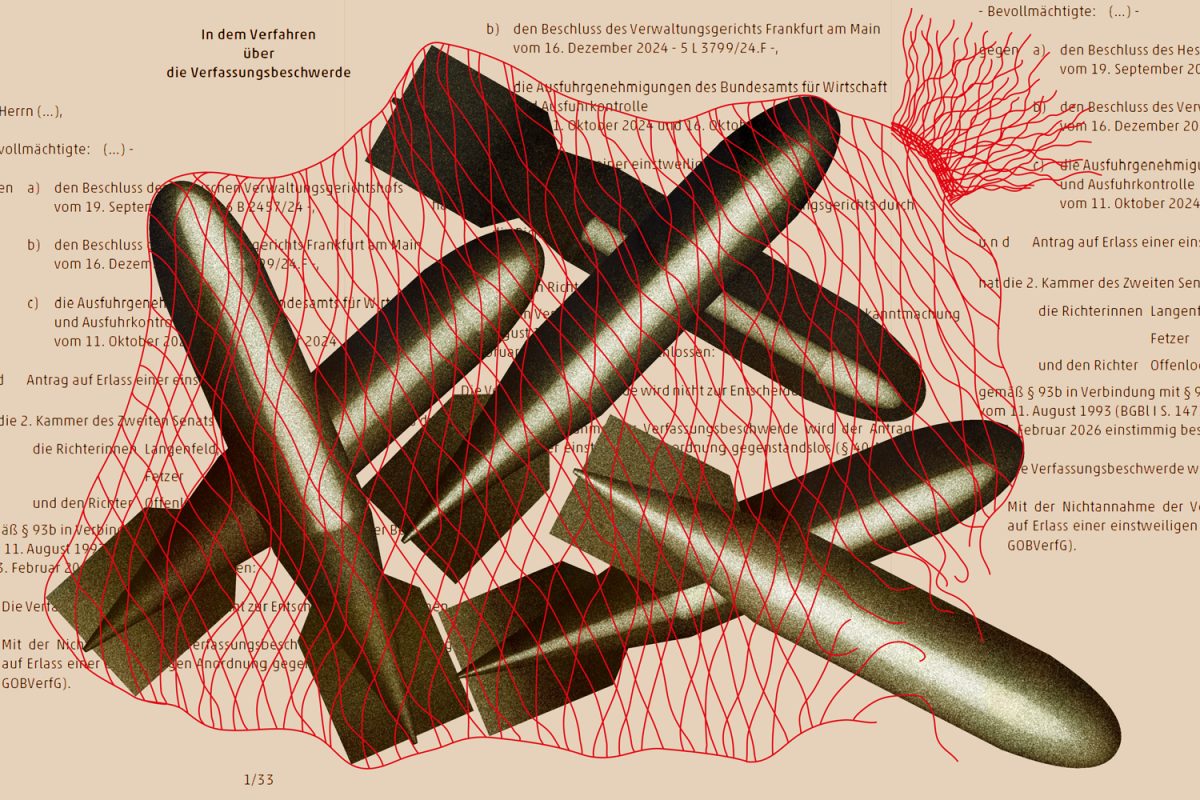
Germany illustrates this pattern clearly. Gazan applicants challenged export licences for military equipment supplied to Israel. The Frankfurt Administrative Court, however, held that the export control law does not confer individual-protective third-party effects, with the result that the applicants lacked standing. The Hessian Higher Administrative Court confirmed this approach, characterising any harm suffered in Gaza as merely indirect and factual rather than legally protected. A subsequent constitutional complaint was not admitted by the Bundesverfassungsgericht. These claims did not fail on their merits; they never reached them.
The Berlin proceedings show how this exclusion is reinforced. Preventive claims seeking to block future export licences were rejected as inadmissible, as judicial review presupposes an existing administrative measure. Conversely, challenges to already executed licences were dismissed for lack of a sufficient interest in a declaratory ruling. The court further denied a sufficient risk of repetition, relying on the government’s announcement that future approvals had been suspended. Within days of the ruling, Germany announced a return to case-by-case licensing. The sequence reveals the vulnerability of legal protection to executive timing: before a licence exists, review is too early; once it has been implemented, it is too late; and when approvals are temporarily paused, the risk of repetition disappears just long enough for the claim to fail – a structural Catch-22.
In France and Italy, the same result is achieved through justiciability and jurisdiction. The Conseil d’État treats export decisions as actes de gouvernement, while the Corte di Cassazione denies jurisdiction altogether (difetto assoluto di giurisdizione). In Denmark, as in Frankfurt, claims fail for lack of a sufficiently concrete legal interest (retlig interesse).
The Dutch litigation shows that even where claims directed at specific export authorisations enter review, they do not necessarily produce sustained judicial control. In proceedings concerning the export of F-35 components, the Court of Appeal of The Hague ordered the State to halt exports, finding a clear risk of serious violations of international humanitarian law. That opening was short-lived: the Hoge Raad quashed the judgment and held that courts may review whether the relevant criteria, particularly the EU Common Position’s clear-risk criterion, were applied but may not substitute their own assessment for that of the competent minister. As a result, the minister was ordered to reassess the licence. Review thus remained narrow: the court could require reassessment under the clear-risk standard, but the decisive risk assessment remained with the executive.
Claims framed at a higher level of generality encounter a different obstacle: the object of review is too abstract. Attempts to obtain broader suspensions of arms transfers were excluded before review, as they are not directed at a sufficiently concrete administrative decision. Concreteness is thus a necessary condition for judicial review but is not sufficient.
Across jurisdictions, the vocabulary differs, but the structure is strikingly similar. Standing, temporality, justiciability, concreteness, and deference operate at different points in the litigation process. Some claims are excluded before review; others enter review only to be narrowed where export risk would have to be assessed. The pattern is not simply one of failed cases, but of judicial review configured so that binding norms rarely operate as effective limits on individual authorisation decisions.
Redirection: Targeting the Infrastructure of Arms Transfers
When authorisation decisions remain insulated, claims move sideways: towards the material and institutional infrastructure that enable arms transfers.
One line of litigation targets state involvement in the facilitation of transfers, including transit regimes, transport infrastructure, and defence cooperation arrangements. The clearest instance of a binding injunction with immediate operational effects to date is Belgium. In July 2025, the Tribunal de première instance de Bruxelles ordered the Flemish Government to block the shipment of military-related goods transiting through the port of Antwerp and to prevent comparable future transit unless civilian end-use could be verified. The claim was anchored in the enforcement of existing transit-control obligations and tied to a concrete shipment within Belgian territory. This allowed the court to treat the case as one of administrative legality – whether applicable controls had been properly applied – rather than as a general challenge to foreign policy or export authorisations. The court’s intervention thus addressed a failure to enforce existing controls and did not review export policy as such. The subsequent decision by Belgian authorities to halt further shipments on licensing grounds suggests that scrutiny of transit can translate into administrative intervention.
Similar strategies appear elsewhere. In Ireland, proceedings challenge the use of national airspace and infrastructure for the movement of military-related goods more generally. In Germany, attempts to target defence cooperation arrangements, including participation in the Heron TP drone programme, failed at an early stage on standing and justiciability grounds. The Belgian case shows that such claims can succeed only under tightly delimited conditions: an identifiable shipment, a territorial nexus, and an existing regulatory framework translated into enforceable administrative obligations. These conditions are not easily reproduced.
A parallel strategy targets private actors and transactions through which arms transfers are enabled. In Italy, proceedings seek to invalidate arms-related contracts involving Leonardo S.p.A., reframing the issue as one of contractual validity rather than administrative authorisation. In Spain, litigation targets supply chains and logistics, including proceedings concerning the steel manufacturer Sidenor and investigations against transport operators linked to Maersk. Courts have allowed investigations to proceed in part, but confined them to narrowly defined domestic offences, avoiding engagement with broader claims of complicity in international crimes. Similar claims have been brought in Belgium against shipping companies, alleging unlawful transit operations of defence-related materials through the port of Antwerp without the required licences under regional arms trade regulations.
These pathways may increase the legal, reputational, and administrative friction around specific transfers. But they are knowledge- and resource-intensive: movements must reconstruct the operational chain of the arms trade – licences, shipments, routes, companies, and contracts – while the underlying authorisation regime remains largely intact.
Beyond the Courtroom: Litigation and the Wider Field of Contestation
The apparent failure of arms export litigation cannot be assessed by court outcomes alone. Litigation interacts with public pressure, protest, industrial action, investigative work, and access to information. These forms of contestation can expose and sometimes interrupt arms transfers but are themselves legally and politically constrained.
Strategic litigation against direct or indirect arms exports to Israel has produced precious few formal victories in the European Union, Australia, Canada, and the UK. Yet precisely through these failures, it brings into view how arms export decisions remain insulated from effective legal control. It also generates awareness and public pressure. The UK illustrates this: the proceedings ultimately failed in court, but litigation and mobilisation helped turn licensing decisions, including the risk assessment and justification behind the F-35 carve-out, into matters requiring public explanation. This is a significant achievement of sustained mobilisation.
Yet, litigation carries costs and risks. It requires time, expertise, funding, and organisational capacity. And while procedural dismissals do not establish legality, they can still produce a rule-of-law legitimacy effect: official discourse may present the matter as dealt with through proper legal channels, even where no court examined the substance of the claim. Litigation can therefore inadvertently become a mechanism through which critique is absorbed and neutralised. It may also reinforce a hierarchy of contestation in which recourse to courts is treated as the legitimate response, implicitly delegitimising more disruptive forms of protest.
Attempts to interrupt arms transfers have taken place through collective forms of action, including dockworkers’ refusals to handle military cargo and protests targeting specific shipments. Such mobilisation has occasionally delayed or halted transfers. Yet the space for disruptive action is constrained. Industrial action for political-ethical reasons may be permitted only under conditions that limit its disruptive impact or expose participants to legal and economic risks. More broadly, crackdowns on protest, restrictions on industrial action, and pressures on public and academic expression concerning Palestine narrow the conditions under which such contestation can occur. Contestation thus remains permitted only in limited, indirect forms.
Contestation is not only constrained in form; it may be prevented from taking shape at all. Both litigation and collective action depend on the ability to identify and target specific transfers. Yet arms exports are characterised by limited disclosure, fragmented data, and the involvement of private intermediaries. The information needed to identify licences, shipments, routes, companies, or contractual links is often precisely what states and companies do not disclose. This opacity is, in part, legally produced.
Judicial restrictions on access to information do not simply withhold knowledge; they shape contestation by making it harder to litigate or organise against concrete transfers. Where courts require a concrete future measure or risk of repetition, refusals to disclose future deliveries or operational details make admissibility difficult to satisfy. The result is a procedural loop: claimants are told that their claims are too abstract or speculative, while the information needed to make them concrete remains unavailable.
Conclusion
The comparative picture therefore matters not only as a survey of cases; it shows how accountability is defeated through the organisation of contestation itself. Courts block merits review; litigation is redirected to adjacent targets; protest is constrained when disruptive; and opacity prevents claims from ever taking shape. These dynamics may be understood as a broader push to domesticate contestation: a system that formally allows challenges but substantively preserves the insulation of executive discretion in arms trade from effective legal accountability.

Miriam Heipertz is a PhD researcher at the University of Amsterdam, working at the intersection of international law, European law, and critical political economy. Her thesis research focuses on property, natural resources, extraction, and legal contestation, while her broader work examines how legal forms shape accountability in contexts including resource extraction and supply chains.