
Writing from the Margins
A Conversation on Decolonial Method in International Law
This blog post is part of the symposium “The Rooms We Wanted: What a Year of Decolonisation Seminars Revealed about a Law School”, reflecting on the Decolonisation Seminar Series at the University of Edinburgh.
In conversation with Dr Ahmed Raza Memon, we explore different questions relating to Decolonial Method in International Law, starting with the question of the value of the Decolonial Theory and Methods seminar series for postgraduate and early career researchers, and then shifting over to the question of the tensions coming with translating non-western knowledge for western academic audiences, the challenges of publishing and positioning interdisciplinary work, and the personal and intellectual weight of engaging critically with international law’s complicity in imperialist narratives and violence.
Dr Ahmed Memon is a Lecturer at Cardiff University School of Law and Politics. He is an interdisciplinary scholar working across international law, global governance, history and decolonial theory. His work draws on sociology and political geography in Indigenous, Black radical, anti-caste and anti-colonial traditions to interrupt Eurocentric vocabularies of legal thought. He also works on decolonising the university, developing anti-racist and anti-sexist tools for teaching, research and writing about law.
Dr Ahmed Raza Memon together with Dr Rohini Sen spoke at the Decolonial Research and Methodologies Seminar Series, on finding a scholarly voice within dominant frameworks of international law, working across disciplines, and engaging forms of knowledge that resist translation into conventional academic structures.
Ahmed, what value do you see the Decolonial Theory and Methods seminar series offering to postgraduate researchers (PGRs) and early career researchers (ECRs) in their academic journeys? What kinds of insights or contributions from participants surprised you or stayed with you?
Ahmed: A methods series based entirely on Decolonial Theory and Methods is a springboard for creative, self-reflexive thinking, writing and research that has the potential to shift how we define ‘research’. Decolonial methods and theories have a social and political imperative that urges generative, even existential, questions about the political economy of knowledge-making. As a scholar from the Global South and part of the Global majority, my experience in these spaces is that most PGRs and ECRs desperately need them to find answers they are either struggling with or have been waiting to ask in the right forum. Rather than feeling surprised by insights or contributions, the feeling I always leave with after these sessions is that we need more of these conversations.
Scholars working with Indigenous, anti-caste, or other non-western knowledge traditions often describe a tension: to make that knowledge legible to western academic audiences can mean domesticating it, stripping out what makes it distinct. How do you sit with that tension in your own work? Do you think something is always lost in translation and what happens to these ideas as they travel between contexts?
Ahmed: I think this is not just to do with western/non-western, I think this is for me, more to do with organic and dialectically emergent forms of practice that we see as ‘knowledge’ in the academic institutional form. I think some very problematic ‘knowledge’ also emerges from non-Western knowledge that hides internal violence/coloniality. For example, let’s take just decolonial theory. The most referenced decolonial work in the Global North is written by Hispanic and sometimes European scholars like Santos and Mignolo. There is a convincing charge against these scholars of co-optation from indigenous organic thinkers through what Sylvia Rivera calls the “arboreal structure of knowledge production” in Global North University Presses like Duke University Press. Co-optation and mistranslation can and do happen in the non-Western institutions but do so within the internal structures of coloniality. Domestication, thus, is more an issue of ‘institutional’ or academic knowledge versus organic/material knowledge rather than a Western/non-Western binary.
When you are working with knowledge that doesn’t fit neatly into existing frameworks, how do you decide where it belongs, in terms of publishing/authorship? How do you figure out which journals will receive this kind of work?
Ahmed: A lot of this decision rests on the editors and their practices of being more open. This is something that requires a closer look at a combination of what is published in the journals and who the editors are.
On work that is more experimental, horizon widening and completely unfamiliar to the mainstream journals, I have found it much easier to narrow down journals which are looking for something very unique and different. My piece on caste, for example, in the London Review of International Law, wasn’t just methodologically historical sociology. There was engagement with visual theory (lightly), theorisation of race together with caste, in a way to also give a ‘way forward’ for thinking more seriously about caste as part of international legal production.
Publishing decisions become trickier when a piece introduces new conceptual vocabulary. In those cases, my reason for sticking with well-known critical journals, even if it takes a while to publish, is the epistemic authority it creates for that conversation without essentializing the conceptual and therefore political concern I have. It provides younger scholars something to hold on to, cite, or even critique. So, in that way, it is also a strategic decision. These are all things that need to be thought of pragmatically and ethically. For example, I do not publish in a journal if they ask me to compromise on the ‘depth’ of a particular conceptual framework and the politics attached to it.
How do you do interdisciplinary work without it just becoming law consuming everything else? When you’re bringing in voices or frameworks from outside law, how do you stop the legal form from flattening them out?
Ahmed: I think it is fundamentally important for us to acknowledge what happens when thinking about ‘disciplines at all’. Even interdisciplinarity can fall into the trap of diluting traditions of practice/thought that are organic into abstract thinking that can ‘answer’ a disciplinary question – and we call it interdisciplinary.
The thing I have grappled with the most is the disciplinary question – and the disciplining of material/political questions for the sake of answering this disciplinary question. Unfortunately, the PhD training does that. It is part of the examination. But after the PhD, this drive to ‘answer the disciplinary question/concern’ becomes fuel for standing out as a scholar. We need to, as a mentor once said to me, ‘brand’ ourselves. So even decolonial is a brand or ‘bandwagon’ that puts you forward as a scholar who is answering a ‘disciplinary concern’ uniquely.
But the disciplinary concern can be restrictive and counter-intuitive to the concerns raised outside of this ‘discipline’ or sometimes even against ‘disciplinary thinking’. The concerns of, for example, organic/material practice-oriented thinking, are not always about disciplines. An issue with translating work from other disciplines is that the depth of internal difference, tradition, and context/politics is often missed because law is invested in itself (i.e. to say its own questions). When you try to do justice to these traditions, you can alienate people within the discipline who just want you to be coherent, direct, clear and accessible. My approach is to be adamant, in references, in continuing work, to understanding counter-disciplinary traditions as exactly what they mean to be; not in service of legal discipline, but to the social/political and epistemological concerns they are invested in. All of which are rooted in practice.
As you are active in the field of public international law, how have you found the process of 1) conducting decolonial work which critiques the complicity of international law in the normalisation of imperialist narrative and violence without becoming itself complicit in its structures, and 2) how are you actually doing? Because this isn’t abstract, you are sitting with material that documents real violence, real erasure. What do you do with the weight of it, personally?
Ahmed: The language of complicity in this instance isn’t always useful to me personally. It suggests that somehow, I have to position myself within this ‘not-complicit’/complicit binary. Further, the response of ‘we are all complicit’ is not moving towards a generative practice. I think I would go back to the question of why we must think of writing/thinking as separate from ‘doing’/practising. For example, we must also ask when we write, sit with research, who are we accountable to, and who do we serve in the end? I think this goes back to what the decolonial method and theory urge you to consider. I would argue that ‘sitting’ with materials that are not abstract and document real violence/erasure is an isolating experience that reiterates the foundational logic of colonial capitalism. In fact, asking whether something is not abstract raises the question of what it means to practice knowledge. In certain traditions of thought, for example, knowledge does not exist as abstract. It is always done/lived and thus inherently communal/relational. For me, thinking about my work or job as an academic is ultimately not about the political economy of journal publications, grant projects, book publications, but more about living with and in the service of the community, which sounds more like a generative way of redefining what it means to really do research.

Matilde Masetti Placci is a Hauser/Remarque Joint Fellow at New York University. She recently completed her PhD in the history and theory of international law at the University of Edinburgh Law School.
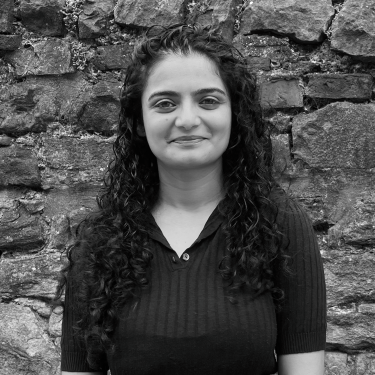
Bhavinee Singh recently completed her PhD at the University of Edinburgh Law School, funded by the Swiss National Science Foundation. Her research examines constitutional law theory and fiscal federalism in India.

Raza Memon is an interdisciplinary scholar of race, caste, and decolonial theory with a focus on international legal history, theory and critical geography/ecology.