Reflections on the Contours of International Organizations Law
A Joint Concluding Interview
Dear Orfeas, Negar, and Daniel,
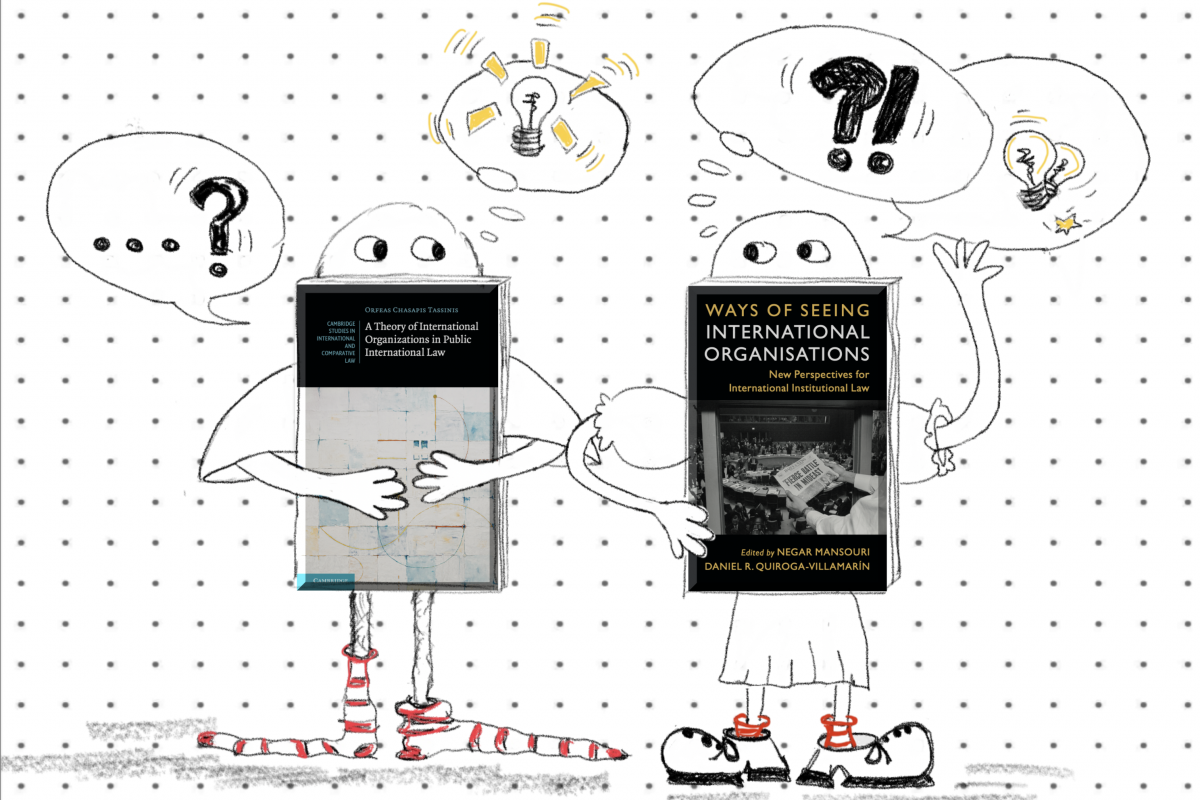
Let us start our conversation by taking a step back. When I first suggested doing a joint book review symposium on “A Theory of International Organizations in Public International Law” (TIOPIL) (The Introductory Chapter, Chapter 4 and 7 will be available Open Access until end of May 2026, courtesy of CUP) and “Ways of Seeing International Organisations – New Perspectives for International Institutional Law” ((WISO) available Open Access here), thus on two books that are obviously very different in structure, ambition, and methodology, what were you thinking? And how do you now reflect back on the interlocutors you had in mind when conceptualising, writing, and editing the two books? Did they and the conversations you initially wanted to have and carry forward change or evolve?
Orfeas: When Anna first suggested putting the two projects in conversation, I was a bit hesitant. Then I skimmed WSIO and thought: ‘Oh my god, this might just be impossible.’ Indeed, in their powerful introduction, Negar and Daniel set out to ‘challenge the dominance of “problem-solving thinking” in the study of international institutions in international law’ (p. 7). At that moment, I felt ‘guilty as charged’. Indeed, much of my curiosity/creativity as a scholar is driven by disambiguating analytical puzzles. I am such a problem-solver that I even tried to pre-empt Negar and Daniel’s type of critique in my book’s introduction, where I suggest that: ‘the search for doctrinal answers does not negate the presence of an “outside” world with its own dynamics, and indeed normative as well as distributional contestation’ (p. 4). But then, I read WSIO more closely and saw Anna’s vision (Anna was kind enough to suggest that we could also have separate symposia and did not force her views on having a joint conversation at any point). At the very least, for all the flaws and limitations of my approach, one thing that I hope comes out of my ‘problem-solving’ orientation is that International Organisations (IOs) may not be that special after all, and that doctrine should not be dealt with as immutable and fossilized, but worth engaging with on its own terms. In the end, I am much richer for going forward as we did.
Negar: I think there is no better time to put books like WSIO and TIOPIL in conversation. As Rita notes in her review, Orfeas’ book tackles the conceptualization of IOs as ‘monolithic entities’ to open the space for a more sociological reconstruction ‘within’ the doctrinal approach, and WSIO illustrates various ways of understanding IOs as ‘sites of contestation’ (without claiming to be exhaustive, of course). Angelo also makes a great point when he says that now that the international institutional order has come under unprecedented assault by one of its leading founders, the United States, both sets of efforts can help reflect on ways to mobilize law’s transformative and humanizing potential. The current conjecture of the international institutional order makes us ask questions like, what projects did IOs come into being for? How did ‘people with projects’ reshape them? And why will some of them be kept as they are, some of them almost disappear, and others be reconfigured?
Daniel: I must admit I was partially pleased that WSIO has prompted some readers, like Orfeas and María José Escobar Gil, to feel interpellated by our critique of the field! But our aim was not for this to serve as a conversation stopper or to ‘accuse’ colleagues, but rather to prompt a broader reflection about what we seek to do when we engage in international legal scholarship. And I was very happy we could have this conversation together, also in relation to Orfeas’ new book. I think that we, who self-identify as critical, feminist, or postcolonial scholars, have very little to gain in talking solely to ourselves—as Charlesworth lamented.
And to be sure, I do not think either that critique is incompatible with solid doctrinal work. In line with Negar’s comment above on the assault by the US on the international order, it seems we require solid doctrinal work more than ever—compare with Howse’s dismissive critique of those of us who have, in his eyes, pathetically ‘held up that piece of paper known as the UN Charter’ against his president. Here I have to echo Orfeas and say: guilty as charged! More than ever, our times of world war require us critical scholars to engage publicly and seriously with both the ambiguities and certainties of legal doctrine—as Craven, Marks, Simpson & Wilde noted now more than two decades ago. I completely echo René Urueña’s call to bring together work that does not ‘collapse sociology [or any other discipline, for that matter] into doctrine, but to connect them without reducing either’.
Anna: The relationship between theory and practice, and the purpose of moving away from problem solving to critique power relations outside the existing orders are centered in all the reviews. Sebastían Machado asks, ‘what is the difference in practice that demands further theoretical insight?’ René Urueña detects a turn to practice in both books. Mónica García-Salmones Rovira poses the questions, ‘what is wrong with ‘common sense’ that WSIO seeks to challenge? Bridging the differing directions of the two books, María José Escobar Gil concludes with the statement that ‘finding legal solutions to legal problems does not exempt me from situating the object of my study in a wider context’ while Maiko Meguro problematizes ‘the path from critical deconstruction to institutional reconstruction’. Angelo Jr. Golia argues that the move by TIOPIL and WSIO towards, respectively, normative/critical destabilisation and conceptual reconstruction, ‘are not alternatives but can be mutually reinforcing. Together, they lie at the core of any attempt to guide the evolution of law and to preserve its transformative and humanising potential.’ It would be great if you could share your thoughts with our readers!
Negar: I fully agree with the points made about the productive exercise of oscillating between ‘understanding the law/common sense of liberal institutional practice’, on the one hand, and ‘mapping the power relations that they generate’ by denaturalizing the status quo, on the other hand. In the case of WSIO, the 2021 conference that culminated in the volume was organized out of a context where Guy Fiti Sinclair’s To Reform the World had been out for two years, and similar deconstructive accounts of IOs by Dimitri Van Den Meerssche (see review symposium published on the blog in 2022 here), Richard Clement’s, and Tommaso Soave’s books were about to be published. At the same time, IOs law teaching and scholarship, at least in Europe, were still dominated by the usual topics and research questions. Daniel and I had also begun writing our theses on the histories of IOs. But even in an interdisciplinary institution such as the Geneva Graduate Institute, it was difficult to write about what could not be characterized tout court as legal questions, for example, the class implications of neoliberalism or the architecture of IOs. So we thought we’d bring people together to promote critical social theory in the study of IOs and by doing that, we ended up doing what Machado has for example called ‘recasting boundaries of international law’ in the sense of introducing external non-legal topics—such as producing governable topics, the personal profiles of diplomats that created the International Telegraph Union, or an ethnographic account of the lives of IOs on the ocean, and involving non-law scholars. When it comes to the question whether critical social theory can or should, in all instances, be translated into practice, we, as editors and the contributors, were particularly interested in the way we ask questions about IOs. Of course, one can argue that Cutler’s chapter on ‘Resilience Talk’ or Clement’s account of the technicalization of the ICC reform are not irrelevant to the practice of global politics, as we are talking about the crisis of neoliberal wisdom or the case of Gaza as the plain failure of international criminal law. On a day-to-day basis, diplomats, IOs staff, and independent experts must navigate the politics of issue-framing (scrutinized by Uribe), the shifting modus operandi of development banks and IFIs (that Van Den Meerssche engages), or the limits that the spatial configuration of IOs embodies (as deconstructed by Daniel) in WISO.
Orfeas: In my mind, theory and practice are closely interlinked, but I am very hesitant to speak in terms of any general epistemic dos and don’ts in that respect. I do have the habit of employing real-life problems to anchor my scholarship, although readers will surely notice that things quickly tend to balloon into more abstract realms. In many ways, this is what my work has to offer (for whatever that’s worth): to draw connections between different ideas that are seldom examined together, both within as well as across disciplines, so as to unlock new ways of seeing old puzzles. These new ways of seeing become necessary because of real-life problems, but the way that I approach them seeks to go beyond the ‘theory vs practice’ binary, at least as academic genres.
The real-life situation that prompted me to write my book was the doctrinal gap surrounding the obligations of IOs in customary international law. I understand that even this may seem too abstract to some, but in my case (graduating from law school as the IMF was ‘saving’ Greece), it felt so odd that international law had little to say about all this in terms of substantive law. And then I took this problem and ran with it, in a way that I hope productively challenges the standard image of what doctrinal work is supposed to look like. By this, I do not mean that lawyers representing victims of human rights violations committed by IOs must employ philosophy or social ontology. I do understand the more stylized form of legal argument that exists in practice, and the final three chapters of my book speak directly to that. But the idea that at the very bottom of our intellectual constructs lie common problems that may benefit from being viewed together (always within the bounds of what is humanly possible), seems to me inescapable if we are to make the most of our privileged position as academics and aspiring intellectuals, whether we are more or less doctrinal in our orientation.
Finally, yes, there is a sense in which my book falls squarely within what Dimitri Van Den Meerssche describes in his chapter as an intervention in international institutional law that is oriented towards abstraction and is almost devoid of any empirical element. However, I would hesitate to imbue this orientation with a negative value right out of the gate. I am not sure that this is a zero-sum game where one way of doing scholarship precludes the other. In other words, even though I could have never written a book like WSIO, I certainly learned a lot from it and am thankful for its existence. Conversely, abstraction can be a tool for getting that critical distance that allows for some clarity and genuine reflection (and thus breaking with existing path-dependencies). Of course, abstraction can also be the exact opposite: a technique of avoidance or deferral. I wish I knew where the exact fault line fell, and I only hope that most days I am on the right side of it.
Daniel: Like Orfeas, I think this is a false dichotomy. Scholarship is a type of practice, and legal practice always requires a theoretical framework—usually a bland liberal one. Machado offers a good example of how limiting this dichotomy can be. By arguing that both volumes are unconcerned with how ‘flesh-and-blood human beings’ could mobilize these insights, Machado shows that (like many legal scholars) he equates the world of ‘practice’ with that of ‘legal practice.’ It reminds me of the discussions we had around Anne Orford’s narrow understanding of ‘legal practice’ and its relation to the craft of historical scholarship. This is not the place to rehash those debates, but I do want to note that scholars, like us, are still flesh-and-blood human beings! They are the audience of my work—not legal practitioners, whether they work in IOs, law firms, or foreign ministries. Rather, the practice I am interested in engaging with is that of professional scholars of international law and institutions—like Orfeas and all of the reviewers of our symposium. I was not surprised that Urueña, who has done a lot of work around ‘communities of practice’, rightly identified the book’s (actually both books’) ambition in this sense.
But what does WSIO have to offer, then, to the people who do work in IOs, law firms, or foreign ministries? When we launched this volume at the Central European University in Vienna, our colleague Patryk Labuda asked us a variation of this question. My answer—which might differ from Negar’s—is that they are not the target audience of my work. They might be enriched by it, I hope. But they are tangential to it. This is not because I think less of lawyers or policy people, I just do not think that treating legal scholarship as an appendage to their work is helpful for either of our practices.
I have learned a lot here from how architectural historians or historians of science and technology think of the relation of their work vis-à-vis practising architects or scientists: the study of the so-called practitioners is done with the same distance an anthropologist might approach a foreign culture. This is very shocking to international lawyers, who often have a normative approach to their own field. This is how I read García-Salmones Rovira’s important point about the pursuit of the common good or Angelo Jr. Golia’s aspirations in relation to the ‘humanising potential’ of ‘modern law.’ But I am myself somewhat agonistic about both the law and legal practice, at least in terms of its values or purpose (we discussed this at some length in my capacity as a discussant for Laurie Benton’s recent Global Law Distinguished Lecture at Wuhan University, recorded here). I write legal history and conduct socio-legal research because I want us to understand better how the law operates not to train better lawyers. I do care a lot about education, but in relation to the training of other scholars, not of legal policymakers, advisors, or litigators.
I was also very pleased to see that Sebastían thought our volume read as ‘a symposium on Science and Technology Studies!’ I don’t think he meant it as a compliment (as Urueña did), but for me it truly is one! And I think it is one (perhaps the only one, really) important difference with Orfeas’ work. While he uses philosophy to enrich legal scholarship without the ambition of addressing ‘an audience of philosophers’ (TIOPIL, p. 115), I do want my work to be read by historians and social scientists in their own terms. That is an integral part of the mandate of my fellowship at NYU: to engage, at the same time, with both historians and lawyers without caveats or disciplinary apologies. I have grown increasingly tired of the move, often employed by ‘crits’ but also by some mainstream scholars, of engaging in interdisciplinary work while always prefacing their intervention with a disclaimer about the fact that they are lawyers and not social scientists or scholars of the humanities. But, because one cannot speak to everyone, this also implies trade-offs. If the price of making my work legible to scholars in the social sciences and the humanities is to make it seem less useful for legal practitioners, that is a compromise I am more than happy to embrace. That is my theoretical practice.
Let me conclude my response to your question with a note related to common sense, a point also raised by Mónica García-Salmones Rovira and, to a degree, by René. This is a good place to say that I’ve always found claims that critical/feminist/postcolonial perspectives have now become ‘mainstream’ or ‘hegemonic’ exaggerated. In May 2006, for instance, Klabbers noted that ‘critical legal studies’ became the ‘new orthodoxy.’ Little over two decades later, Becker Lorca claimed the same for TWAIL. I really would like to agree with them, if anything, out of wishful thinking! My own experience in the European and American teaching market is that this is certainly not the case. Maybe a very reduced number of senior critical scholars have gained acceptance in the salons of mainstream legal thought (to continue with Klabbers’ helpful German metaphor), but that says little about the state of the field as a whole.
For one, it might have been that some of those salonfähige scholars were never that radical to begin with! Moreover, in most of the Law Schools I am familiar with, the rise of critical/feminist/postcolonial perspectives has led to the tokenization of certain individuals more than any real destabilization of the ‘mainstream.’ It reminds me of the critique that Sluga once made of a tradition of international history that merely ‘adds women and stirs.’ In my view, the mainstream tradition has stirred in some dissident voices, but it is not a cocktail that has been thoroughly shaken. Conversely, in editorial and hiring practices, I have seen crits (especially younger ones) purged left and right. In continental Europe and the Americas, traditional gatekeepers still man the walls. To a degree, the hold of tradition might be looser today in certain parts of the British Empire and its former dominions, but I do not think that is the case for Oxbridge. Orfeas would perhaps know better.
Anna: Across several reviews, the possible futility, or at least irony, of embarking on projects about IOs in such times (Angelo Jr Golia, Mónica García-Salmones Rovira, but also René Urueña point to that) was highlighted. What are your reactions?
Negar: That’s right! I also started 2025 under Trump 2.0 with the question of whether international law would persist as a discipline or decline/mutate, as has already been the case with fields such as conflict resolution or peace studies. Ultimately, any attempt at a reconfiguration of the international institutional order has to engage with the Eurocentric origin and trajectory of these institutions in one form or another (so multiple critiques of liberalism/capitalism in the volume would continue to be relevant). Golia also takes the stance that ‘theorizing IOs law is perhaps even more necessary than ever’. It would definitely be very interesting to reflect on the move from a unipolar to a multipolar or apolar order, where emerging economic powers with very different foreign policies than the Western liberal democracies become the key member states in existing IOs, and how that would reshape the framing of issues and institutional culture. Having said that, 14 months into the Trump administration, and amidst multiple crises in global politics (Iran, Venezuela, Greenland, Gaza) and them zooming in on China’s reaction, we can probably confirm that the former has remained ‘the global police’ and the latter has remained committed to the ‘international law of non-interference’. So, one has to be careful when talking about a completely new international order. At the same time, the US withdrawal from some 80 international institutions will not be without effects. One scenario is that IOs will move away from their post-1945 ideological underpinning around liberal institutionalism towards some form of ad hoc mechanisms for technical assistance and financing. The other is Europe reaching a consensus on its place in the international institutional order and making modest but influential attempts at reconfiguring these institutions.
Orfeas: That is a fair point that has crossed my mind many times. The world seems indeed ‘on fire’ as Mónica García-Salmones Rovira suggests in her review. Is there a place for the type of intellectual exercise that my book represents in today’s world? Here I am also reminded of Melissa J. Durkee’s words that my project betrays ‘a more exposed, and in some ways more vulnerable, optimism about the classic project of international law’.
Reading these words, my mind instinctively went to Harry Potter and the Deathly Hallows – Part 1. At the beginning of that movie, there is a wedding scene between two relatively minor characters. This is the darkest point in the story’s timeline yet, prompting Ginny to ask Harry: ‘It seems silly, doesn’t it, a wedding? Given everything that’s going on.’, to which Harry reluctantly replies: ‘Maybe that’s the best reason to have it because of everything that’s going on.’ I find myself feeling the same way more and more about what I do lately. Of course, I know that weddings cannot win wars, and my book, at the very least, cannot save anyone. But there is something that these things may come to represent that needs to be preserved. No one really knows where things are going, and the idea that self-restraint born in balanced self-reflection may have a role to play in all this seems powerful enough to me. That is also why I resist Sebastían Machado’s reading of my work as an invitation to a heaven of legal ideas where one can meet ‘many concepts of jurisprudence in their absolute purity, freed from all entangling alliances with human life’ (citing Felix S Cohen). If anything, I hope that my book stands as an experiment for showing the deep and anything but coincidental entanglement of some concepts of jurisprudence with human life (a topic that I more explicitly tackled in my recent talk ‘Theory as Therapy?’ at the MPIL and my essay with the IAI, ‘Can life be a journey? On the human origins and limits of abstract thought’). It is by transcending these boundaries that scholarship on child psychology and whether we are born as individual monads found its way into a book on IOs (TIOPIL, p. 156 fn 68). And this is what I wish to suggest when I say that, at the end of the day, human organization should not be approached as some ‘deep mystery’ (TIOPIL, p. 247). Thus, for me, Machado’s ‘heaven of pure legal ideas’ represents an impoverishing understanding of what legal scholarship can do. At the same time, we should be careful not to mistake clarity for purity: seeking to be as exact and clear as possible does not mean that good ideas cannot come from literally anywhere.
To then go back to Melissa’s excellent point, it is in the nature of the optimist to be vulnerable. In the Harry Potter episode just mentioned, the wedding is abruptly stopped by a Death-Eater attack (Death-Eaters = bad guys). But just as clarity does not have to mean purity, being an optimist does not necessarily mean being naïve. It can also mean preserving a more aspirational stance towards human nature.
Daniel: There is a certain delay between the conception of a project and its eventual publication. As Negar already mentioned, we convened our initial workshop back in 2021 at a moment in which the world was on fire, but in quite a different way. Our hands and minds were preoccupied with the Covid-19 pandemic, and we could already see some shadows looming on the horizon for multilateralism, but I do not think anyone could have anticipated how bad things would turn out just a couple of years later. I think it is true that our books largely took for granted not only the existence of IOs, but that they would continue to be supported by United States patronage. There were important hiccups before, but the close imbrication between the UN and US foreign policy and its projection of soft and hard power made it hard for me to imagine that this polity would so seriously undermine these institutions.
And yet, here we are. I think that we should see January 2026 as a watershed moment in the history of global order, both because of the US armed attack against Venezuela (on which René also reflects) and its subsequent withdrawal from a slew of IOs. Certainly, WSIO belongs to the previous era. But I hope that it can serve to fertilise new inquiries that respond to what Golia (citing Peters) rightly calls a time of monsters. For instance, many of its insights could be productively deployed to make sense of the so-called ‘Board of Peace’, and the way it articulates a nexus for many of our concerns—from the privatisation of multilateralism to the relationship between race and global ordering, passing through the uses and abuses of expertise. But I think we must be honest and recognize that we were not seeking to anticipate the future with our volume. At least that is a practice I rarely attempt to do.
Anna: Another recurring theme that is almost inevitably raised with books such as yours is that of the paths not taken or ‘gaps’, questions that have remained bracketed or unaddressed. How do you react to these points raised by the reviewers? Is there an un- or underexplored path or gap you wished you had explored?
Orfeas: Indeed! In fact, I think that all reviewers bring up at least one issue or angle that my book could have addressed but did not. I found this strikingly productive and contributed to my sense that these reviews are not really reviews in the classic sense but pieces of scholarship in their own regard. Inevitably, some things that the reviewers mention I never thought about, and I am glad to be prompted to think more about them. Others I thought of, but decided that it would be too much to fit into the narrower focus of my book. Even if I cannot do the reviews full justice here, I feel that these questions or critiques should be given proper space, if only to map the main gaps of my work and recognize the reviewers’ deep engagement with my work.
Maiko Meguro suggests that my book leaves untheorized how
‘the multiple manifestations [of public power] can be coordinated toward collective action (…). The appeal to common ontological foundations, while theoretically elegant, leaves unaddressed the concrete mechanisms through which conflicting community self-descriptions might be coordinated or resolved.’
Meguro is right: the potential conflict between differing descriptions of institutional reality is a point that I address only in passing in my book (TIOPIL, p. 188 et seq). While writing, I thought that such conflict represents a cross-cutting phenomenon that is equally encountered within my ontologically unified family of institutions and did not (thankfully!) speak to the actual legal questions that I was tackling in that instance. Of course, saying that a problem is not unique does not resolve it, even as it may be just good enough for the narrower problems that my book sought to address. I have a lot more to think about that front if I were to further develop my theory.
María José Escobar Gil raises important questions regarding the immunities of IOs and private parties. I must admit that this was the single doctrinal issue in the book that I had conflicting intuitions about until the very end. María José here offers a valuable perspective to my focus on immunities, suggesting that ‘[f]rom a human rights perspective, the core issue is then how to address situations in which immunity is necessary to safeguard the organisation’s independence but results in legitimate claims remaining unsettled’. I fully agree with that. My main issue with existing ‘human rights’ approaches to the problem has been that little time was often devoted to asking, ‘rights towards whom?’ In other words, are human rights that exist vis-à-vis states equally applicable to IOs, and if so, why? My book provides an affirmative, and I hope convincing, answer to this question, which could perhaps provide a firm grounding for the type of approach that María José puts forward.
Rita Guerreiro Teixeira also points to further directions for research. These include issues ‘related to attribution and responsibility (where the duality between responsibility of member states and the IO requires rethinking), privileges and immunities (where the presumption that IOs are always exercising public power that calls for these protections should be reconsidered), and the scope of IO powers (which might not always need to find a basis on the will of member states).’ I fully agree with Rita that these problems need rethinking. My contribution hopefully is to see these problems as less idiosyncratic than normally thought. In my mind, they are, and should be, approached as manifestations of more general problems of public international or, where appropriate, constitutional law.
René Urueña presents an exceptionally well-crafted theoretical synthesis of the two books, far better than anything I could have produced myself. In this context, René suggests that the two works invite, but do not answer the question of ‘law as a medium of institutional life, not only as the vocabulary in which an IO is described, but also as the infrastructure through which it governs, allocates, and transforms.’ I fully understand this point as far as my work is concerned. It reminded me of a surreal episode at the height of the Greek crisis whereby the OECD turned its gaze on what should count as fresh milk (for the episode and Ntina Tzouvala’s excellent commentary see here). Indeed, if there is something truly distinctive about IOs in practice is the extent to which they employ law (broadly construed) to govern in the ways that René describes in his piece. This is something that got lost in my book with its focus on ontology. In hindsight, I am not sure that this was inevitable. In any event, this is an angle that intrigues me greatly and one for which I have a lot more to learn.
On her part, Mónica García-Salmones Rovira asks: ‘[i]s this book the Leviathan of the world of international organisations? While this is a unique book […] I would suggest that it is not a Leviathan’s equivalent. […] unlike Hobbes, Chasapis-Tassinis does not address the theological problem’. Again, this is absolutely right. Indeed, the word ‘spirit’ appears only twice in my book (p. 139, p. 186). In part, this is because I felt unsafe employing the idea of a spirit as an analytical tool in a world that has become more and more spiritless, and where it might mean entirely different things to different people. Hence, I remain tentative and do not ask my reader to make up their mind on the nature of individual existence (TIOPIL, p. 161). Beyond that, I am deeply suspicious about the classic binary terms in which the spirit vs matter problem tends to be presented in classic Western philosophical thought (the latter conflicting with many of my philosophical instincts as a Greek; yes, Greek ≠ Western). If I understand Descartes correctly, then my (admittedly less refined) idea of spirituality is something entirely different. For me, the bifurcation of the world in spirit vs matter is bound to eventually undermine ontologically everything related to the former. But the modern tendency of trying to ‘explain’ consciousness or else relegate it to ontological unimportance seems deeply misplaced. Thus, in my mind, spirituality can be found not in positing ‘ghosts’ in the machine but in overcoming the divide between the material and the immaterial. At its core, this is a world where existence is deeply relational and non-analytically founded.
Melissa J. Durkee and Angelo Jr Golia raise questions as to how my theory translates when it comes to other entities in public international law, such as indigenous peoples, cities, transnational corporations, investors, and others. Melissa asks: ‘[a]re international organizations fundamentally distinct from these other forms of human representation, or are they privileged by legal choice rather than by any deeper ontological difference?’ In a similar vein, Angelo poses the question: ‘why do communities such as indigenous peoples, some large transnational business enterprises with their own policies, independent central banks, global cities, hegemonic political parties ‘occupying’ state structures, some hybrid networks, or even some expert networks—just to name a few liminal examples—not fall within the same genus of entities directly bound by (customary) PIL? Are we sure that none of these communities is effectively capable of putting in place a rule of recognition that prioritises certain descriptions over others?’
There is a lot to unpack here. First, to respond to Angelo, I am not sure that any of these communities is effectively capable of putting in place rules of recognition, and hence I reject his assumption that they would not fall within the same genus of entities directly bound by customary international law. Following my theory, indigenous peoples, as well as central banks and cities (not just global) either already enjoy the recognized right of self-description in international law (a shortcut for this is to examine whether they possess a right of self-determination; that’s why the UNDRIP recognizing that indigenous peoples enjoy a right of self-determination assumes critical significance following my theory) or are expressions of that right (this is the case with central banks and cities). Business enterprises (regardless of whether they are ‘large’ or ‘transnational’) do not have that right and are not expressions of it: there is no ‘public’—always within the formal sense of my theory—behind them. Hence, they do fall within a different class of legal persons (pending the emergence of special rules, that class is essentially that of individuals). This does not mean that customary law does not bind them, just that we cannot automatically extend the rights, duties, and protections that international law affords to states and international organizations to them. Thus, to go back to Melissa’s point, yes, there is an ontological difference between these different forms of organization, owing to their different roots: one category is the product of communal self-description and identifies in that manner, the other not (always within the bounds of what international law counts as ‘communal’ and ‘public’). This ontological difference matters, however, only because international law has been structured around it, and not because of any immutable metaphysical reason.
Sebastían and Angelo both raise questions about the ‘paths not taken’ and my book’s lack of more extensive engagement with certain strands of literature, especially sociology. These points are well taken. They have also pushed me to explore new materials or re-read some old ones. But they have also prompted me to reflect more generally on the purpose of philosophical writing and the epistemological role of past ideas in it.
Let me begin by readily admitting that I avoid putting into my work ideas I do not understand with a certain level of confidence. Thus, the problem with some of the sources that Sebastían and Angelo mention is that I never really understood what they were trying to say, as opposed to necessarily disagreeing with them. Now, you could say that this is my problem, that I should have been smarter to do justice to my topic, tried harder, etc (I am not saying for a moment that either Sebastían or Angelo is insinuating this). I think it’s such a big taboo in academia to say ‘I did not get that’ or ‘this work did not really interest me enough to try to understand its nuance’, because the (internalized) assumption often is that when you don’t understand something the problem lies with you rather than the source (or at least that it shows a certain lack of sophistication to say that someone’s work, especially one of the classics, does not really speak to you). But to get back to the point about (not) being smart enough, I do not think that showing intelligence is our main goal as scholars, let alone using that intelligence to find timeless truths in the way that is often associated with the ‘hard’ sciences (imagine a 21st-century physicist writing in ignorance of Newton’s laws). Rather, I think that we are supposed to uncover, and then follow as resolutely as possible, the paths of knowledge that seem most natural to us and grow organically out of our real-life circumstances and thoughts, taken as a whole. In other words, I firmly believe that our type of scholarship should be, at its core, authentic. When it comes to ideas such as justice or personality, our biggest service might be precisely offered in our attempts to reinvent the wheel—re-entering that mode of genuine exploration and discovery that makes these ideas meaningful to us.
Of course, this is not how we tend to view things, and this is probably why entire sections of academic philosophy have become overtaken by a mindset of cataloguing past ideas as opposed to producing new ones that are resonant with today’s ways of being. It is no coincidence that most contemporary philosophical scholarship feels out of energy and pace. But imagine how silly it would sound if someone told Cavafy that he cannot write poems about love without considering Baudelaire or that, in doing so, he had ‘banished’ French poetry altogether, to put it in Sebastian’s words. Instead, we just ask: is this a good poem? In my mind, philosophy—regardless of the oppressive marketization of scholarly output that we increasingly experience—lies much closer to poetry in that regard, as opposed to, let’s say, physics. It is an endeavour that should be deeply interested in authenticity. This is not because of narcissistic tendencies nor due to any ambition of finding immutable ‘laws’. Quite the opposite, it is because being born out of a unique moment in the present is the one thing that past thinking, however great, cannot offer. At the end of the day, we are the flesh-and-blood carriers and ambassadors of our own ideas. Ideas do not matter, they cannot change the world if we do not feel comfortable with them and make them our own.
Let me give one example of this in my case. Angelo suggests looking at ‘constructivist theorists of causality’ and the idea of ‘emergence’, namely, the idea that new properties, behaviours, or patterns arise at the level of the whole system that cannot be fully explained by, predicted from, or reduced to the properties of the system’s individual components. While superficially intuitive, such theories introduce new conceptual elements: ‘emergence’, ‘systems’, ‘components’, and many others. But what makes something a system? Most believers in systems theory would say: ‘but, of course, the fact that something actually has emergent properties!’ To me, this felt hopelessly circular or otherwise just producing a more abstracted description of the world without much value being gained for the questions I was asking (much in the way that many contemporary IR studies tend to redescribe the world in terms of general laws that have so many exceptions that one is often better off just reading history). I understand that there are counterpoints to all this—within and without systems theory. However, in the end, I decided that the best use of my time would be to focus on the problems I set out to address as opposed to disambiguating what scholars such as Luhmann really meant in this or that passage, let alone trying to somehow redeem them. The ultimate foundation of my theory, namely, there being multiple levels of description with no inherent hierarchy between them, also felt as a more stable ontological point of departure that was much more straightforward on its premises. Again, for me, this is not about ‘purity’ but clarity, accessibility, and keeping my eyes on where I wanted this book to go while employing ideas that I could understand well enough.
Negar: Just very briefly, as to ‘an unexplored path’ that WSIO could have taken, I’d say having someone write about communication theories might have been a good idea (see Angelo’s review). These theories give an interesting view of the back-and-forth between political elites, the public, and the media, which is a good way to see IOs as the complex social beings that they are in national and international politics. Having moved from the Geneva Graduate Institute (where international law and international relations are dominant) to the Copenhagen Business School (where sociology and socio-legal research are central), I’ve found so many interesting strands of literature (with ‘International Historical Sociology’ a prime example) that could be useful not only to the study of IOs in international law but also to comparative international law. I have to agree with Orfeas; it is ultimately the scholarly bias of sticking with familiar scholarship, and, of course, something to push against for the sake of tackling long-term stagnation in disciplinary thinking. In addition to these marginalized theories in international law, if I could go back in time, I would also try to convince some of our contributors to discuss how their approaches help ‘reconstruct or reimagine the system (see Maiko’s review), which would have yielded some interesting insights.
Daniel: No edited volume aspires to comprehensiveness, ours included. I think an interesting research agenda raised by several reviewers (Durkee and Guerrero Texeira, chief among them) related to the interrelationship between IOs and private actors. Of course, this is also the subject of Klabbers’ much-celebrated PRIVIGO project, and I’m glad some of his former and current collaborators contributed to this symposium. I’m excited to see where that path will take them!
In fact, I am writing my response to this reflection in the wake of the Inaugural Association of Law and Political Economy Conference held in Richmond earlier this month, and I remain committed to the importance of a ‘Global LPE’ research agenda. I have always found the Unitedstatesean LPE movement to be both very promising but also deeply parochial in scope and ambition. As such, I believe international law scholars will play a crucial role in connecting this community with the work already ongoing in another jurisdiction on political economy, on the one hand, and with scholarship on global law and policy, on the other.
In this sense, I am very pleased to see how much more acceptable it has become to speak of ‘capitalism’ in contemporary scholarship—in relation to both IOs but also to many other things. I do not think it would be wrong to say that both Negar and I felt it was a taboo to even address this topic some years ago. Fast forward a couple of years: even Martti Koskenniemi, whom I remember to be one of the strongest critics of the uses of this term, is writing about the ‘Legal Infrastructure of Global Capitalism’ or redescribing his earlier work as a ‘legal history of capitalism’ (see Of Law & The World (2023), p. 187). And similar things have been happening in the discipline of history, including the creation of a similar-minded ‘HPE’ project and even a recent global history of the term itself by Sven Beckert (2025).
I was also very moved by García-Salmones Rovira’s invitation to Orfeas to engage further the theological dimensions of international ordering. This is something, in fact, Negar and I were quite interested in and wrote something about—telling, it was not selected by one of the journals that García-Salmones Rovira cites to argue that our portrayal of the mainstream does not do it justice. But I do hope to see more work on this, especially now that the so-called liberal international order is increasingly under pressure. More work on the religious and eschatological roots of this order will continue to show that perhaps there was very little ‘liberalism’ at its heart, and that instead there are many of its elements that are better understood as part of an extension of Christian values which can only claim to be ‘secularized’ if one disregards their provenance and operations.
Anna: So, where do we go from here? What work do you imagine your book and the conversation we started in this symposium to do in the future and for future generations of scholars?
Orfeas: Where do we go from here? Long-term, I would be honoured if my book contributes to any of the following directions. First, I hope that the book stands as a solid attempt at transcending genres of academic writing, thus expanding what we think is possible in ‘doctrinal’ writing. Second, specifically with respect to IOs, I hope my book shifts focus back on members, including states, as a prelude to any serious attempt at theorizing IOs. More generally, I would wish that my books moves international legal ontology away from a discourse that revolves around platonic archetypes (in essence what looks like a state in an abstract sense) and closer to one that seeks to understand the shared existential conditions of things (in essence accounting for how states are possible in the first place in the eyes of international law). This could then help reimagine problems concerning the rights of future generations as well as the continuation of legal personality of states when some aspect of the Platonic ideal of statehood (such as territory) lapses—an issue of increased importance in the case of low-lying island states and climate change. Finally, I would be really curious to see whether some of the epistemological/aesthetic choices of my book, especially how I approach interdisciplinarity—most notably not using it as a magic wand and trying to keep the use of -isms at a minimum while maintaining clear premises—are picked up by others.
Negar: First, I hope WSIO will be read broadly by students of international studies and also by those writing on IOs in international law. Second, it would be great if the volume as a whole, and contributions by non-legal scholars specifically, trigger an interest among IOs law scholars to engage more actively with interdisciplinary debates on the past and present of the world order, crises, and succession of accumulation regimes, which are in fact at the core of international institutional change. In my view, critical IOs law scholars still remain absent from historical IR and global history circles, for instance. This closely connects to a question that René asks: ‘how can we theorise law as a medium of institutional life, not only as the vocabulary in which an IO is described, but also as the infrastructure through which it governs, allocates, and transforms?’ I think good critical scholarship in international law reflects ‘legal sensibilities’ while understanding law as one of the many elements to reflect on (essentially as ‘politics by other means’). Ultimately, we all study the same social world and should be able to reflect on themes that transcend the binary of ‘social’ and ‘juridical’, as per Tomlins. Just to make an example, if a new form of politics has been emerging in the industrialized world in the age of low-to-no-growth, essentially since the 1970s (what Brenner and Riley call ‘political capitalism’ grounded in politically engineered upward redistribution), what does that mean for the world of IOs and international expertise? There will be legal change, for sure, but also a change in the language, ideologies, and authority of international secretariats.
Daniel: Ultimately, we wanted our volume to open vistas for new research, especially for younger researchers, rather than to settle all matters related to the field of international institutional law. I still remember when, not long ago, one of the book review editors of a leading periodical in this field turned down a book review I proposed, as his ‘journal has traditionally focused more directly on international institutional law, and consequently this book (focusing on the early years of the field of International Relations) is somewhat beyond the scope.’
My hope is that our volume increasingly renders this mono-disciplinary understanding of the field increasingly untenable. And for that reason, I was very pleased to see that our symposium participants largely agreed, despite the aforementioned appeals to ‘legal practice,’ that the only way forward is through interdisciplinarity and broadening the scope of research. That is what I would like our readers to take away from the volume —especially those who are writing their PhDs with supervisors or facing colleagues that might be policing very strictly the contours of what they understand as international institutional law.
As for myself, I am taking a break from the field, if anything, because of the very specific requirements related to the habilitation process in the German-speaking world. But a matter which I will continue to explore—and would like to see further developed in the literature—is that of regional IOs. I’ve done some of this in my forthcoming first book too, but I think this is but the tip of the iceberg. If the reviewers are right—and I think they are—in relation to troubling times we are living in for ‘universal’ multilateralism, we opt to pay much more attention to the inner lives of regional institutions—as René convincingly argues in relation to international law in the Americas. In my second book and habilitation project, I would like to explore some of these matters, thanks to the continued support of the Swiss National Science Foundation. But in this project, I will not foreground IOs as such, but treaty-based military alliances. Interestingly, there is some degree of overlap in relation to these two categories: think of the martial origins of the United Nations as a coalition before it was understood as an international institution. A recent history book I am now finishing really captures the almost bipolar nature of this institution: the author uses ‘United Nations’ in caps to talk about the IO and ‘united nations’ in lowercase to refer to the military alliance out of which it emerged. It reminds me of The Strange Case of Dr Jekyll and Mr Hyde. But we ought to remember that ‘Dr United Nations’ (who saves the world and provides us with internships) and ‘Mr United Nations’ (who exercises enormous military might and occupied large swathes of the globe long after the end of the war) are, ultimately, the same person.
Anna: Before we conclude, would you mind sharing one piece of scholarship (or prose) you added to your reading list which you had not thought of before engaging with each other’s work?
Negar: I’ve been recently trying to refine my thoughts on the relationship between historicism and abstraction in social theory: How to deduct categories without reductionism! So, I immediately picked up on Orfeas’ reference to Luciano L’Abate’s volume, Paradigms in Theory Construction (2012).
Daniel: Legal historians and analytical philosophers are natural intellectual antagonists, as it is well known. A good example is Orfeas’ reference to an online legal dictionary (TIOPIL at p. 161). Others are his two long footnotes on the history of international law and the development of human communities (TIOPIL, pp. 173-174, fn 43 & 44). Although I wish that the ontology was left to the footnotes and the history came up instead up to the main text, I will probably return to these two passages in the years to come!
Orfeas: For me, too, the biggest puzzle of them all is the relationship between history and abstraction. It might take me several years to properly visit this, but WSIO has certainly prompted new thoughts on that front. Negar’s chapter and its references to Marxist theories of law is a case in point (WSIO, p. 249, fn 2 & 3). Thanks to WSIO, I also discovered Daniel’s article ‘Beyond Texts? Towards a Material Turn in the Theory and History of International Law’, which has helped me put many of my thoughts about intellectual history in order and orient them in a more productive way.
Anna: Thank you very much for sharing your reflections and for agreeing to be part of this project.
We hope you enjoyed it as much as we did!

Dr. Orfeas Chasapis-Tassinis is Research Fellow at Gonville & Caius College at the University of Cambridge and Fellow at the Lauterpacht Centre for International Law

Dr. Negar Mansouri is a postdoctoral researcher at Copenhagen Business School.

Dr. Daniel R. Quiroga-Villamarín holds a PhD from the Geneva Graduate Institute and is currently a Hauser/Remarque Global Fellow in International Law and European History at New York University (USA).

Anna is a PhD candidate at Humboldt University Berlin and holds a scholarship from the Heinrich Böll Foundation. She is currently working as a Research Fellow at the Max Planck Institute for Comparative Public Law and International Law with the humanet3 research project, which is based in Berlin at the Centre for Human and Machines at the Max Planck Institute for Human Development. She is a Co-Editor-in-Chief at Völkerrechtsblog.