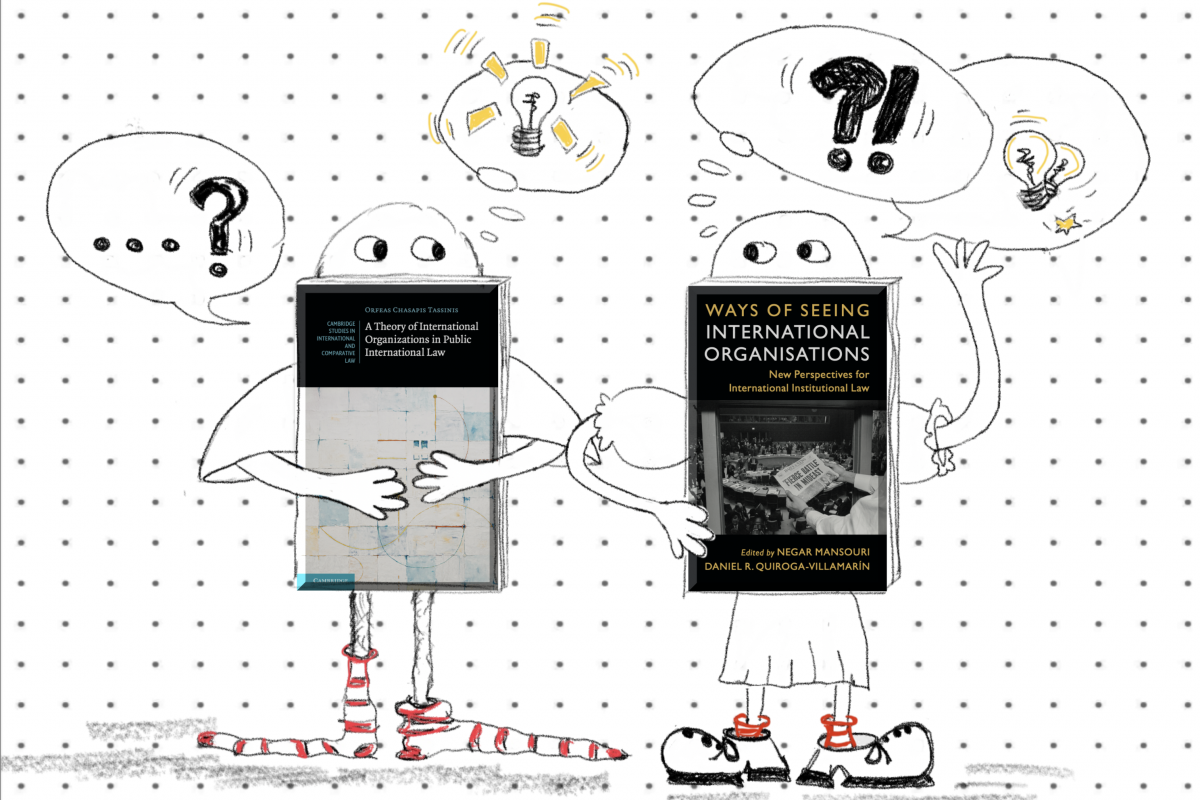
Reading a book is usually something you do on your own. It is an opportunity to practise solitude, offering a contemplative moment of voluntary seclusion. It is the time to recharge and think deeply. However, at times during these cherished moments, the mood changes. Not because of external disruption, but because that rare feeling withers away and a sense of loneliness starts to creep in. You may indeed even feel lost, disoriented. Suddenly, you find yourself craving company, the opportunity to have a conversation, articulate your hesitations, ask questions, listen to alternative interpretations of the text you have just read. Ask: What do you make of this?
With book reviews published on Völkerrechtsblog, we are always trying to create such opportunities. These reviews are not primarily aimed at handing out an award to outstanding scholarly work (though this remains an unescapable element of it), but rather to engage a collective reading exercise.
With this joint book review symposium on Orfeas Chasapis-Tassinis monograph “A Theory of International Organizations in Public International Law” (The Introductory Chapter, Chapter 4 and 7 will be available Open Access until end of May 2026, courtesy of CUP) and Negar Mansouri and Daniel R. Quiroga-Villamarín’s edited volume “Ways of Seeing International Organisations – New Perspectives for International Institutional Law” (available Open Access here), we were able to add another layer to the collective readings exercise from the very beginning.
Instead of asking reviewers to engage with one book from their individual perspectives and later publishing their contributions together in one symposium, we confronted them with the task of reading and reviewing both books jointly.
This joint reading experiment generated scholarly engagement reaching far beyond International Organisations (IOs) and international law. It has turned into reflections about the relation between theory and practice, doctrine and critique, on translations between law and other disciplines, on the relation between ontology, epistemology, and method (something I explore in my own research). Further, it allowed authors to ask: who do we write for, and why? And why it can be sobering to find yourself ‘guilty as charged’ (stay tuned for our joint concluding interview). In many ways, this review symposium has achieved more than I had hoped for when pitching the idea to Daniel, Negar, Orfeas, and our reviewers.
Throughout the following week, you will come to understand why.
On Monday afternoon, Maiko Meguro foregrounds the two different versions of IOs International Organisations developed in both books as configurations of public power, and explores their convergences and limitations. Tuesday starts with Mónica García-Salmones Rovira, who invites us to take a step back and asks what role common sense can play in moving international legal thinking forward, and what “real theory” looks like. We then continue with María José Escobar Gil, who reflects on what the ambition of opening the black box of IOs shared by both books tells us about the ‘technical or human errors’ of the sub-discipline.
On Wednesday, Sebastían Machado Ramírez invites us to scrutinise both theoretical innovations suggested through the lens of practice more rigorously. In the afternoon, René Uruña picks up this thread and offers a different reading of the relation between theory and practice that Sebastían Machado Ramírez asks us to revisit.
On Thursday, Rita Guerreiro Teixeira offers a complementary reading of both books, which connects to María José Escobar Gil’s reflections about her own position in IO scholarship. Angelo Jr. Golia takes the joint reading as a prompt to reflect on the inherent limits of modern law, such as how the dependence on, and determination of, specific concepts (such as subjectivity) are rarely articulated explicitly. He appreciates the task, posed by both books, to explore these questions in more detail and depth, and for readers to be rattled and have to reassess and adjust their own positions. Melissa J. Durkee jumps in where Angelo Jr. Golia and others point to an underexplored concept in Chasapis-Tassinis monograph. That is where we shall draw a category distinction between collectives with the capacity to self-describe. By connecting both books to her own work on states and forms as corporate entities, she puts them in a new light and points to a number of different, unaddressed questions.
On Friday, Negar Mansouri, Daniel R. Quiroga-Villamarín, and Orfeas Chasapis-Tassinis share their thoughts on both books and the reviews in a joint concluding interview with me.
Enjoy!