
Since Nuremberg, accountability for mass crimes has relied almost exclusively on a model centred on individual criminal responsibility, by transposing criminal doctrines and procedure from ordinary criminal law into contexts of structural and systemic violence. This gap between the individualizing logic of criminal law and the structural nature of mass crimes remains one of the field’s central unresolved problems, failing to establish accountability in a manner that reflects the empirical dynamics of such violence. And yet, this paradigm was consolidated in the 1990s through the statutes and jurisprudence of the ad hoc tribunals, the establishment of the ICC, the creation of domestic war crimes prosecution units and the expansion of universal jurisdiction. Thus, the established model centered on individuals, and simultaneously, it has marginalized the criminal responsibility of states and other collective entities. Early debates within the UN International Law Commission did consider extending criminal responsibility to states, and such an extension was deemed “not a priori impossible”. The 2001 Articles on State Responsibility, however, closed this debate, entrenching a “dual” responsibility model in which criminal responsibility is reserved exclusively for individuals. This closure, however, was not conceptual but rather a political and institutional choice in a given moment. Within these confines, international criminal law has stretched individual doctrines to encompass collective dynamics of mass violence — command responsibility, joint criminal enterprise, and complicity. These doctrinal adaptations, however, have generated internal tensions with the principles of legality and certainty.
Institutionally, this “dual responsibility” framework produces problematic outcomes. On the one hand, the International Court of Justice (ICJ) functions as a forum for determining de facto state crimes, including torture or genocide, and can even assess a state’s genocidal special intent (dolus specialis). Yet, while relying on the same legal language used to establish individual criminal responsibility, the ICJ reaches its conclusions without the fundamental procedural tools of criminal justice—most notably, without a criminal investigation. Instead, it relies almost exclusively on secondary materials submitted by the parties, such as UN and NGO reports or media sources, assessed through procedures that lack both the authority and the capacity of criminal inquiry. Conversely, criminal investigations at national war crimes units or the ICC, despite being increasingly labelled as “structural”, deploy vast evidentiary records only to establish the individual responsibility of one or a few individuals, reducing broader structural findings to background “context.” This produces legal processes marked by a profound conceptual disjunction between individual, collective, and state or structural levels of accountability, despite their empirical interconnectedness.
Parallel debates on non-state entity responsibility for human rights violations, coupled with corruption and other transitional crimes treaties, have led several domestic jurisdictions to recognize corporate criminal responsibility for mass crimes. For example, Article 121-2 of the French Penal Code, in force since Dec 31, 2005, set that legal entities (e.g. corporations, associations) can be criminally responsible for offenses committed on their behalf by their organs, without excluding the parallel responsibility of individuals. The provision, however, explicitly excludes the criminal responsibility of the state. At least 20 other states have similar legislation.
While the extension of criminal responsibility to corporations has not yet been generalized to other collective actors central to mass violence—such as state institutions, bureaucracies, military units, religious institutions, or non-state armed groups— it confirms that criminal accountability is not conceptually confined to natural persons.
In this context, the Lafarge case marks a significant development. The following sections examine this landmark case on corporate criminal responsibility for mass crimes and reflect on its broader implications for ICL.
The Lafarge case: Corporations as bearer of criminal responsibility for mass crimes
The case concerns the French cement company Lafarge and its Syrian subsidiary. Between 2012 and 2014, the company paid around ten million dollars to Daesh and other armed groups to keep its factory operating in Daesh-controlled territory. In 2016, Syrian employees revealed these payments, as well as mistreatment and crimes committed against them by Daesh, in the French newspaper Le Monde. Following the article, a judicial investigation was opened in France, initially for financing terrorism and violation of commercial embargo. NGOs and victims later filed complaints alleging complicity in crimes against humanity.
On the other side of the Atlantic, U.S. proceedings began in 2017 with a federal investigation in the Eastern District of New York. In a 2022 plea agreement, the company—then merged with Holcim—pleaded guilty to providing material support to a terrorist organization and paid USD 778 million. The agreement barred it from contesting these facts before foreign courts. Perhaps as a gesture toward the French judges who shared investigation files, The New York Times revealed in 2024 that the U.S. Department of Justice planned to transfer USD 200 million to France, under federal rules allowing the Department to share forfeited assets with governments that assisted in the investigation. This transfer has not taken place, because of bureaucratic reasons, and later on due to the change of U.S. administration.
While the plea bargain was useful for the French investigation, it has been particularly lengthy, with the corporation’s lawyers systematically appealing investigative decisions. In 2024, the case was split: the allegations of complicity in crimes against humanity remain under investigation, while the charges of financing terrorism were brought to trial in November 2025, lasting six weeks. The judgment found all the defendants as well as the company guilty, and the former CEO was imprisoned.
Together with my graduate students at Sciences Po Paris, we followed the trial before the French Criminal Court on a daily basis. Our court reports, published in six episodes are available on the website of Justice info.
Crimes Against Humanity Landmark Ruling
In 2021, the Supreme Court ruled that the company—and not only its directors—may be prosecuted for complicity in crimes against humanity: the corporation did not need to share the intent of the crimes perpetrated; it is sufficient that it had knowledge of them. This sets a lower mens rea threshold than that applied at the ICC under the Rome Statute in Art 25 (3)(C), which requires that the accomplice provide aid/assistance “for the purpose of facilitating the commission of such a crime.” As the Court stated:
“Crimes against humanity are the most serious of crimes because, beyond the attack on the individual—which they transcend—they target and deny humanity itself… A different interpretation …, would have the consequence of leaving numerous acts of complicity unpunished, whereas it is precisely the multiplication of such acts that enables the crime against humanity.” (French Court of Cassation, 2021, par. 64, 70).
This significant jurisprudence opens the door in France to prosecuting corporations that, for example, sell arms to state or non-state actors engaged in the commission of international crimes. Ironically, this has been possible thanks to Lafarge’s corporate defense counsel, equipped with unlimited resources, which regularly appealed up to the Supreme Court as part of a strategy of procedural exhaustion.
As of 2024, at least thirteen criminal proceedings were ongoing in France against companies and their executives for complicity in international crimes, including genocide, war crimes, torture, and enforced disappearance, with cases relating to Syria, Rwanda, the Central African Republic, Yemen, Sudan, and Egypt. As indicated in the table below—drawn from the Amnesty International France website—most of these proceedings were initiated following complaints filed by NGOs.
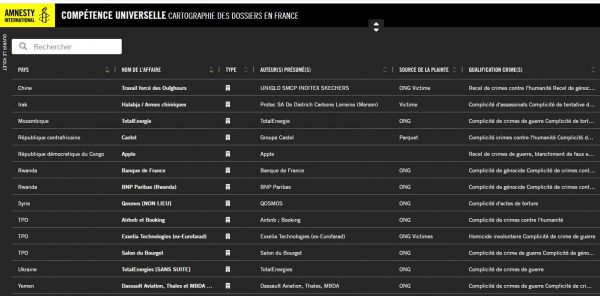
Still, these proceedings advance at a very slow pace, with limited resources for the prosecution and relatively small teams handling complex and sensitive cases. NGOs have been particularly active in supporting the prosecution, thanks to the procedural rights granted to them. In France, both NGOs as legal entities and individual victims who have suffered direct injury can file complaints for the commission of international crimes and be recognized as civil parties. This status—which can be attributed by the investigating judge from the opening of the investigation until the end of the trial—grants significant procedural rights, including access to the investigation file; the ability to submit requests and documents; full participation in trial hearings (including the right to question the accused and witnesses); the right to seek compensation; and the right to appeal judicial decisions throughout the proceedings. And yet, litigating against a corporation means entering the white-collar legal sphere, where structural asymmetries are stark. The NGO lawyers who submit the complaints—along with extensive documentation, legal analysis, and filings throughout the procedure—are often young, underpaid women working under precarious conditions, standing in sharp contrast to well-funded, heavily resourced corporate legal teams backed by powerful capitalist structures. The decade-long duration of the Lafarge proceedings ultimately highlights a paradox: recognition tends to accrue to NGOs such as Sherpa or ECCHR, rather than to the individuals who worked hard on these cases. In this sense, these NGOs come to resemble corporations themselves, more than the individuals who sustained the work over time.
Preventive and Repressive Terrorism Approaches Transpose into ICL?
While the 2021 decision of the French Supreme Court referred to an earlier precedent—the Papon Nazi collaborator case—it appeared willing to apply a lower mens rea threshold, drawing on well-established counter-terrorism jurisprudence under the offence of association de malfaiteurs à caractère terroriste (AMT). Interestingly, this Court’s decision was issued one day before the opening of the mediatized Bataclan trial, and in the same courthouse.
Over the past decade, French criminal courts have regularly prosecuted terrorism offences under AMT, notably involving French nationals who joined armed groups such as Daesh in Syria. The Lafarge case concerns the financing of this terrorist organization, responsible for major attacks in France, and forms part of the broader body of case law developed by the 16th Chamber of the Paris Criminal Court, which has specialized in terrorism cases since 2015.
This illustrates how security-oriented legal frameworks, particularly counter-terrorism regimes, may in practice advance ICL. While counter-terrorism frameworks have absorbed much of the institutional capacity devoted to international crimes—most notably within the National Anti-Terrorism Prosecutor’s Office (PNAT)—they have also enabled cases to reach the courtroom, at least with respect to the terrorism charges brought last November against Lafarge, and have generally fostered international judicial cooperation. Crucially, they facilitated doctrinal development in ICL. Although the investigation into crimes against humanity may never reach trial, the criminal process allowed the Supreme Court to deliver the above landmark decision in 2021, and the lower threshold for mens rea was arguably influenced by preventive terrorism rulings.
From International Criminal Law Toward a Criminal Law of Mass Crimes?
While scholars and practitioners often emphasize uncertainty about the future of international criminal law, urging to “keep the faith” and to “believe” in ICL, domestic systems are emerging as robust actors precisely because they do not operate through such spiritualized contexts. Supported by domestic legislation, specialized prosecutorial units, and bureaucratic infrastructures—offices, files, paperwork, hierarchical dynamics, career aspirations—judges and prosecutors act as professionals in an established and routine legal environment rather than engaged actors advancing an agenda. This bureaucratization and routinization is a sign of evolution in the field, a dynamic particularly visible in civil law systems, where victims and civil society actors may initiate proceedings and where trials—rather than plea bargaining—remain central.

Source: Official data from the French judiciary
Holding mass crimes trials at national, accessible and open courts allows the public to witness proceedings directly. Attending the Lafarge trial—following the daily hearings, observing the evidences and listening to the accused and witness testimonies—made clear that prosecuting a handful of individual directors does not fully capture how corporate and capitalist structures enable and sustain mass crimes. Courtroom discussions clearly revealed that profit was the only driving forces behind any of Lafarge’s actions, despite the human consequence. This is why it is equally important to prosecute the corporate entity itself, not just individual directors, to address the systemic role of the corporation in facilitating mass crimes. Likewise, other entities—bureaucratic, institutional, or state-level—can enable and obscure such crimes. In this sense, the Lafarge case may signal a shift beyond Nuremberg’s legacy of focusing solely on individuals, pointing toward the recognition of other entities—and, potentially, even State criminal responsibility—at least in the context of mass crimes.

Sharon Weill is a Professor of International Law at The American University of Paris and Research Associate at the Centre for Comparative Law and the Internationalization of Law at Sorbonne University. Her work adopts a socio-legal approach and draws on trial ethnography to examine the role of courts in contexts of violence.