
Welcome to the latest interview of the Völkerrechtsblog’s symposium ‘The Person behind the Academic’! With us we have Judge Ioannis Ktistakis, and through the following questions, we will try to get a glimpse of his interests, sources of inspiration and habits.
Welcome Judge Ktistakis and thank you very much for accepting our invitation!
May I first ask what it was that brought you to academia and what made you stay?
I come from a family of lawyers; in a sense, I grew up in a law office. Initially, therefore, my ambition was simply to take a further step in my professional career by placing one foot in academia while keeping the other in legal practice.
Very soon, however, I discovered a second—and ultimately more compelling—reason. From the early years of my legal practice, I repeatedly encountered questions that my training up to that point could not fully answer: Why did a particular interpretation of the law prevail over others? Whose experience did the law make visible—and whose did it overlook? And how could legal institutions preserve their legitimacy while society itself was constantly changing? These questions multiplied after I met the eminent Professor François Rigaux in Brussels. Academia offered me something that legal practice alone could not: the freedom to explore such questions systematically, critically and in depth.
I remained in academia for another, equally important reason. Academics enjoy the remarkable privilege of growing older each year while their audience—their students—remains consistently young, fresh and intellectually demanding. Students compel you to revisit what you think you already know and to offer new, clearer and more persuasive explanations each academic year. Academia is, above all, a unique environment of continuous intellectual renewal.
What would you say is the most difficult part of the academic life?
I would say that the most difficult aspect of academic life is navigating the tension between certainty and genuine inquiry. The academic world often rewards confidence, productivity and definitive conclusions. Authentic scholarship, however, begins with doubt: with the willingness to question established assumptions, exercise critical judgement and, when necessary, revise one’s own conclusions.
I have often found myself at this difficult crossroads. In my case, the challenge has been particularly acute because my research focuses on minorities and, more broadly, on human rights—fields that are both politically sensitive and deeply connected to people’s lived experiences. They require intellectual independence and methodological rigour, but also humility, empathy and the courage to resist easy or convenient answers.
If you were not an academic (and now a judge of the European Court of Human Rights), what would you be?
I would probably have remained a practising lawyer. Before joining the Court, I spent many years representing applicants in Strasbourg and litigating before the Greek Council of State and the Court of Cassation. I valued the concrete character of that work: behind every abstract principle was a person, a community or a landscape requiring protection.
What are three texts that you would wish all academics working on international law would read?
Rather than three works offering a single canon, I would choose three texts that pull international lawyers in different but complementary directions. First, Articles 31 and 32 of the Vienna Convention on the Law of Treaties: deceptively short, inexhaustible, and a constant reminder that interpretation is a legal discipline. Second, Hersch Lauterpacht’s International Law and Human Rights, for its insistence that the individual cannot remain invisible within international law. Third, Martti Koskenniemi’s From Apology to Utopia, which should be read not as an invitation to cynicism but as a demand that we recognise the argumentative structures and choices hidden behind apparently neutral legal language.
Would you say that your upbringing has had an impact on your research interests or your perception of justice?
Certainly. As I mentioned earlier, I was, in a sense, born into a law office. I belong to the third generation of a family of lawyers who have defended individuals before the courts. That background instilled in me, from an early age, a deep faith in justice and in the role of the law as an instrument for protecting rights.
At the same time, I belong to the generation of students who entered the Law School of the Democritus University of Thrace (Greece) at the pivotal moment of the fall of the Berlin Wall in 1989, when Europe—and indeed the entire world—was undergoing profound transformation. My four years as a student and my many subsequent years of teaching in Thrace—a border region where different languages, religions and legal traditions coexist—gave very concrete meaning to questions of minority rights, religious freedom, migration and equality.
What is your favourite place to read and write? What is always near you when you read and write?
I read and write best in a quiet room, always early in the morning, at a desk near a window. I am less attached to any particular place than to the absence of interruptions. Around me, there are usually books stacked in an order that makes sense only to me, along with a cup of coffee that invariably goes cold. My laptop is, of course, indispensable, but the first genuine development of an idea often begins in scattered notes on my phone.
What is an energy and inspiration booster, at times when you have none?
Energy, as such, is rarely something I lack. Inspiration, however, is another matter; there are certainly times when it deserts me. When that happens, I usually turn, in this order, to a cold shower, the pages of a history book, or a short break away from the city—preferably somewhere I have never visited before. A cold shower clears the mind; history restores a sense of perspective; and an unfamiliar place disrupts routine and makes one look at the world with fresh eyes. Over time, however, I have learnt that inspiration cannot be summoned by force. It tends to return only when one stops demanding it and quietly makes room for it.
Have you ever drawn influence from any form of art in your work? Is there anything artistic about teaching, writing academic texts or (opinions annexed to) decisions?
Yes. At an early stage of my academic career, while writing my doctoral thesis on religious freedom, I drew inspiration from Hieronymus Bosch’s The Garden of Earthly Delights.
Since then, however, I cannot say that I have consciously associated the transmission of knowledge—that profoundly human endeavour we call teaching—with any particular art form. Nor do I tend to think of academic or judicial writing in artistic terms. A separate opinion accompanying a Strasbourg judgment, in particular, resembles a mathematical equation more than a work of fine art.
Which of your academic publications is your favourite one? And which of them is your least favourite?
My favourite is the work that grew out of my research about Sharia law in Greece. The subject never remained purely academic for me; it accompanied my work as a lawyer, professor and judge, and it continually revealed new tensions between collective identity, individual autonomy and the neutrality of the State. As for a least favourite, I would not disown any particular publication. Some of my early texts tried too hard to be exhaustive and not hard enough to be selective. Yet they are an honest record of learning. Rereading one’s older work is a useful exercise in humility: if there is nothing one would now change, one has probably not moved intellectually.
Which advice would you give to early career scholars reading this interview?
Choose a real problem, not merely a fashionable topic. Read the primary sources closely, and engage seriously with the most important scholars whose views you do not share. Spend time where law is actually made, applied or challenged, because abstract thinking becomes sharper when confronted with real-world consequences. Write as clearly as you can. And, of course, work tirelessly: intellectual laziness is unforgivable.
If you could, which unspoken rule of academia would you instantly erase?
I would abolish the unwritten rule that seriousness must be expressed through unnecessarily obscure language. Complexity is sometimes inherent in the subject matter, but it should never become an excuse for unclear thinking. Legal reasoning should aspire to the precision, rigour and logical discipline of mathematics. Clarity does not diminish intellectual depth; it reveals it.
Ideally, whom would you want to find waiting for a meeting with you outside your office next Monday?
Ideally, a former student whom I have not seen for years, arriving with work of which they are proud and an argument that contradicts something I once taught them. Few meetings could be more satisfying. It would show that education continued after the classroom, and that the best legacy of a teacher is not the reproduction of his or her own views, but the confidence and intellectual independence to question them.
Thank you very much, Judge Ktistakis, for participating in our symposium and for having taken the time to respond to our questions!
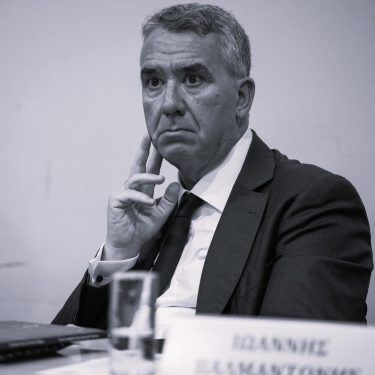
Ioannis Ktistakis is a Judge at the ECtHR (2021-) and President of its Third Section (2024-). Prior to that, he was an associate Professor of Public International Law at Democritus University of Thrace [Greece], assistant Professor at Boğaziçi University [Turkey] and visiting Professor at George Washington University [USA].