Finding the Truth After Fifty Years
The Springhill Westrock Inquest and Legacy Justice
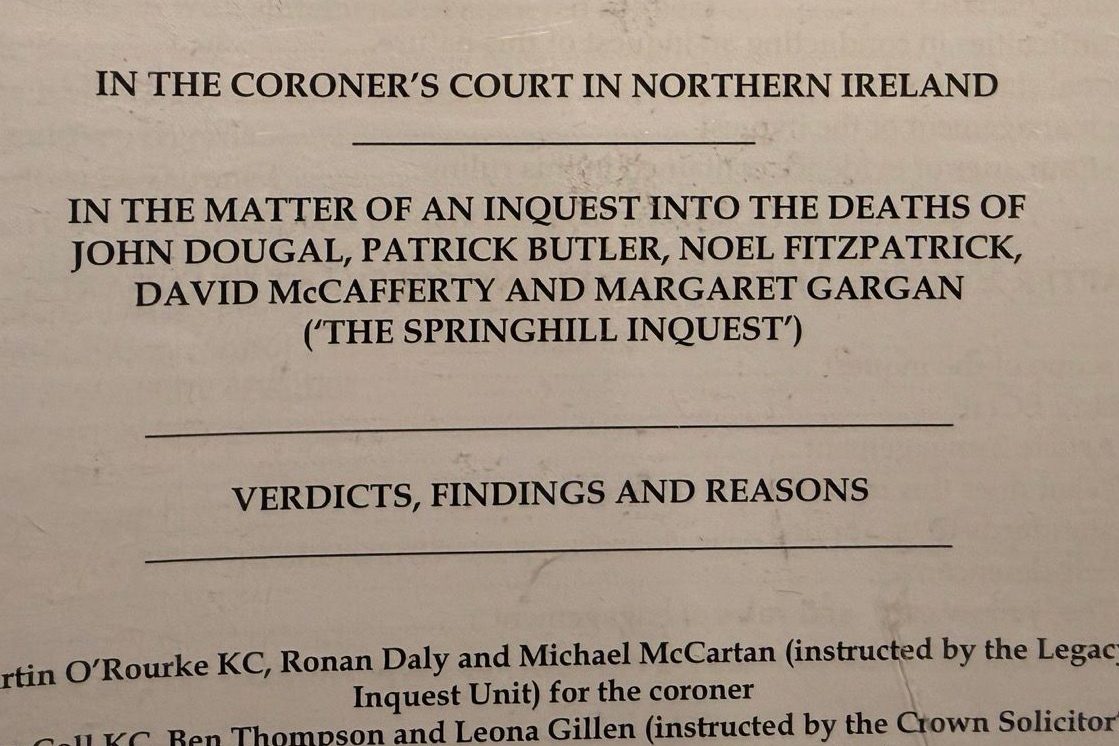
Time has made killings from the Northern Ireland conflict difficult to adjudicate, but recent inquests show that coroners can still establish what happened more than 50 years ago. On April 30 this year, a coroner conducting the latest in a series of inquests into deaths during the 30-year conflict issued verdicts in the killing of five people in the Springhill/Westrock district of Belfast, shot in a single incident on a July night in 1972. It followed similar inquests into civilian deaths from the early days of the conflict, including a 2021 verdict on ten people killed in Belfast’s Ballymurphy neighbourhood in 1971, a 2021 verdict on the death of Patrick McElhone in Pomeroy, and a 2022 verdict on the 1971 killing of Kathleen Thompson in Derry. The coroners ruled in all of these cases that British soldiers had shot dead civilians without justification.
London sent troops to Northern Ireland in 1969 following civil rights marches that were partly inspired by the U.S. civil rights movement. Protesters were met with a repressive crackdown ordered by local politicians and supported by the British Government. The military was meant to “temporarily” restore order, but remained for decades. The Irish Republican Army (IRA), viewing itself as the protector of the Irish nationalist community, embarked on a campaign it described as an armed struggle and the British Government defined as terrorism.
During the conflict, Irish republican armed groups seeking to end British rule and achieve a united Ireland, pro-British loyalist paramilitary groups seeking to keep Northern Ireland within the UK, and the UK security forces, were responsible for thousands of deaths and injuries. There is also evidence of systematic collusion between loyalist paramilitaries and the British state forces. Approximately 3,720 people were killed and 47,541 injured, with civilians accounting for 54% of the deaths through 1998, in a population of just over 1.5 million.
The British, Irish, and American governments and leaders of paramilitary and political groups in Northern Ireland brokered and negotiated the1998 Good Friday Agreement, which ended the large-scale violence of the conflict. But it did not provide for a truth commission or other transitional justice mechanism to investigate killings during the conflict, and these ‘legacy cases’ have proved politically highly sensitive ever since. Bereaved families have been left with few options to find out the truth about the death of their relatives. Coroners’ inquests have offered a route for some, but getting a case before a coroner’s court has involved decades of campaigning and support from local human rights lawyers. The Ballymurphy families campaigned for more than two decades before a fresh inquest was opened in 2018, while the Springhill/Westrock families, supported by solicitor Pádraig Ó Muirigh, fought years of delay after their inquest was directed in 2014.
Many of the verdicts have rejected the British government’s accounts of what happened, ruling that its soldiers shot dead innocent civilians. In 2023, Parliament passed the Northern Ireland Troubles (Legacy and Reconciliation) Act (the “Legacy Act”) which set a cut-off date of 1 May 2024 for ongoing inquests and effectively closed off the coronial route for bereaved families seeking findings on deaths during the conflict.
The Act faced opposition at every level of the Council of Europe system. The Committee of Ministers, which has supervised the McKerr group of judgments on defective investigations in Northern Ireland for over two decades, repeatedly urged the UK to amend it. Ireland lodged an inter-State application in January 2024, relying on Articles 2, 3, 6, 13 and 14, only the second such case between the two states. It remains pending in Strasbourg.
The Springhill/Westrock case was the very last inquest to be heard by the Coroner’s Court in Northern Ireland, with evidence concluding just hours before the cut-off deadline in 2024. It took another two years for the judge to deliver his ruling. The case was keenly watched locally and internationally as a test of whether such a complicated incident, involving multiple fatalities more than half a century ago during an intense armed conflict, could be properly examined, and verdicts reliably reached.
Before he announced his verdicts, Mr. Justice Scoffield spent five hours explaining to the court his reasoning and outlining the challenges in finding the truth of what had happened that night 54 years ago to the five victims: John Dougal (16); local priest Fr. Noel Fitzpatrick (42); father of six Paddy Butler (37); David McCafferty (15); and Margaret Gargan (13).
Applying the civil standard of proof, the coroner established the following facts. At around 9.50pm on 9 July 1972, soldiers of C Company, 1st Battalion the King’s Regiment, deployed at a base in JP Corry’s timber yard in west Belfast, opened fire on a car at the junction of Westrock Drive. Multiple witnesses confirmed that it was still bright outside. Within fifteen minutes, five civilians were dead. John Dougal, the youngest at sixteen, was shot in the back as he ran from the firing. Fr. Fitzpatrick and Paddy Butler, stepping out of a nearby alley to reach the wounded, were killed by a single bullet that passed through them both. David McCafferty was shot dead trying to recover Fr. Fitzpatrick’s body. A short distance away, another soldier struck Margaret Gargan in the head while she stood talking to friends.
The 649-page ruling from the Coroner’s Court offers even more detail on each of the deaths, the actions of the British soldiers that night, and the challenges in weighing testimony from 70 days of hearings involving 80 civilian and military witnesses and forensic experts. Some witnesses had passed away, had been too infirm to give evidence, or were not traceable. Others were mistaken in their recollections from more than 50 years before. “Human recollection is fallible; it generally becomes more unreliable with time,” noted Judge Scoffield. Many of the eyewitnesses were young children playing out on the street at the time, and he noted the phenomenon of “the development of a myth which, through repetition or recounting, becomes part of received wisdom,” for example a common belief that the soldiers involved were from the Parachute Regiment, when they were in fact from the 1st King’s Regiment. Some witnesses, civilian and military, refused to answer questions on the basis of the privilege against self-incrimination.
A familiar pattern from earlier inquests also recurred: documents held by the British Ministry of Defence were destroyed, lost, or unaccounted for. The radio logs of the 1st King’s Regiment during the hour of the shootings were mysteriously missing, and a list identifying which soldiers had provided statements detailing their role could not be found. There were further difficulties in determining what exactly John Dougal, the first of those killed, had been doing. He had been in the Fianna, the youth wing of the IRA, and the judge said that although he was “not satisfied” that the 16-year-old was acting innocently, he was equally not satisfied that John Dougal was armed. In considering all the evidence, despite the difficulties, Mr. Justice Scoffield said “I have simply had to do my best.”
Adding to the legal complexity, the judge ruled that Article 2 of the European Convention on Human Rights (the right to life, which carries an investigative duty) was not engaged. This followed the UK Supreme Court’s decision in Re Dalton’s Application, which applied the Strasbourg case law on temporal jurisdiction to hold that no death occurring before 2 October 1988, twelve years before the Human Rights Act came into force, can engage the Article 2 procedural obligation in domestic law, save where the Convention values test is met. The Court of Appeal applied that rule again in 2025 in Bradley and Duffy. As a result, Mr. Justice Scoffield could not formally rule on whether the killings were “justified or unjustified”. He nonetheless found, on the balance of probabilities, that each of the deceased was posing no threat, and that each of the fatal shots was fired in breach of the so-called “yellow card” rules of engagement which governed when British soldiers could open fire in Northern Ireland.
In each of the five verdicts, the coroner found that the fatal shot was “a direct, aimed shot from a high-velocity weapon and was not a ricochet”, contradicting the soldiers’ claims, in statements taken at the time under a cipher system, that they had been responding to a mass coordinated IRA attack on the yard. The judge rejected that account, concluding that Soldiers A and E had “overreacted to a perceived threat and subsequently lost control.”
The verdicts were a major vindication of the decades-long campaign by the relatives, in which they were supported by local activists and victims’ groups, human rights lawyers and international NGOs including Human Rights First. Those killed have for many years been smeared as terrorists, and the inquest cleared their names.
Legislation to repeal and replace the Legacy Act is now before the UK Parliament. In Re Dillon’s Application [2024] NIKB 11, the High Court of Northern Ireland found key provisions of the Act, including its conditional immunity scheme, incompatible with Articles 2 and 3 of the Convention, and the Court of Appeal upheld that ruling. The Supreme Court, on 7 May 2026, rejected reliance on Article 2 of the Windsor Framework and narrowed the route by which parts of the Act had been disapplied, but left the declarations of incompatibility undisturbed. It also reviewed the Strasbourg jurisprudence on amnesties, including Marguš v Croatia, and declined to develop domestic law ahead of it, leaving open the possibility that some form of conditional immunity might yet be found compatible. Whether the Northern Ireland Troubles Bill, introduced in October 2025 and reaffirmed in the King’s Speech of May 2026, will deliver for the many bereaved families still without judicial findings remains to be seen.
For the Springhill/Westrock families, there is little prospect of prosecutions of the soldiers identified as the killers (referred to as Soldiers A and E, their anonymity protected). The coroner rules on the balance of probability, not beyond reasonable doubt, and it is unclear whether the soldiers are still alive or could be traced. Under section 35(3) of the Justice (Northern Ireland) Act 2002, the coroner is obliged to refer to the Director of Public Prosecutions any death which appears to disclose that an offence may have been committed. Mr. Justice Scoffield indicated such a referral was likely but warned that given the passage of time and the difficulties of establishing to the criminal standard who fired the lethal shots, “there is little prospect of any prosecution in these cases if that is what anyone is seeking.”
In his concluding remarks, the judge recalled the words of the Belfast priest Fr. Des Wilson, who had said in 1999: “even if it takes fifty years the truth must be found and will be found.” He acknowledged how unfortunate it was that it had taken so long, but hoped the conduct and outcome of these proceedings had provided some answers to those who had been seeking them.
The families’ campaign has been vindicated, the names of the victims cleared, and the truth is finally out. “The truth has finally been established in a court of law. Our loved ones were innocent,” said a spokesperson for the families. Two months after the inquest delivered its findings, the victims’ families accused the government of a “deliberate silence”. Prime Minister Keir Starmer subsequently apologised unreservedly on behalf of the British government for what happened and for the grief and trauma the families had endured.
Brian Dooley ist a Senior Advisor at Human Rights First and a Honorary Professor of Practice at Queen’s University (Belfast). He has been covering human rights issues in Northern Ireland for over 40 years.

Suchita Uppal is a Consultant with Human Rights First, as part of its Human Rights Defender Program. She earned her LL.M. in International Legal Studies, along with a Certificate in International Human Rights Law, from Georgetown University Law Center.