.jpg)
A Right to Artistic Anonymity?
Proposing an Enhanced Protection of Politically Engaged Artists in Europe
“If you want to say something and have people listen, then you have to wear a mask”. This quote, attributed to Banksy, encapsulates the street artist’s philosophy. For Banksy, anonymity is not just a mask but a medium through which anti-capitalist, anti-establishment, and anti-war struggles are made visible. Anonymity makes his artwork possible.
On 13 March 2026, Reuters published an investigation claiming to have unmasked Banksy, drawing on dozens of interviews, US court records, police reports, and a handwritten confession by the artist. Banksy’s lawyer, Mark Stephens, urged Reuters not to publish the report, arguing that it would violate the artist’s privacy, interfere with his art, and endanger his life. Reuters responded that an artist who shapes public and political discourse must be subject to public scrutiny. This post argues that the proportionality test developed by the European Court of Human Rights (‘ECtHR’ or ‘the Court’) weighs against Reuters’ publication, and that the UK (as Banksy’s state of nationality and the jurisdiction where Reuters’ headquarters are located) bears a positive obligation under the European Convention on Human Rights (‘ECHR’) to provide adequate protection of Banksy’s identity. Beyond the right to privacy, this post argues that anonymity is constitutive of Banksy’s artistic practice: unmasking him dismantles the very conditions under which his freedom of artistic expression is exercised under Article 10, setting a dangerous precedent for other ‘artivists’.
Is Anonymity Part of the Freedom of Artistic Expression?
The ECHR does not contain an explicit right to artistic freedom. However, the ECtHR has long read it into Article 10. In Müller and Others v. Switzerland (1988), the Court held that freedom of expression encompasses artistic expression (para. 27), noting that artists contribute to the exchange of ideas essential for a democratic society, even when these offend, shock or disturb (paras. 27, 33). In Vereinigung Bildender Künstler v. Austria (2007), the Court stressed that satire, as a form of artistic expression that “naturally aims to provoke and agitate”, demands particular care from the reviewing authorities (para. 33). Further, in Mariya Alekhina and Others v. Russia (2018), involving the prosecution of Pussy Riot (a feminist punk collective whose anonymity is integral to their performances) the Court found a violation of Article 10 and extended heightened protection to politically engaged art (paras. 205-206, 260).
A review of the ECtHRs’ case law shows that it interprets Article 10 as protecting not only the outputs of artistic expression but also the conditions for its exercise (see the seminal case Karataş v. Turkey [GC] (1999), para. 49; CoE Guide to Article 10, 2022; and Polymenopoulou, 2016, p. 536). If Article 10 covers the choice of medium, style, and way of presentation, it follows that it equally covers the choice to create under a pseudonym, particularly when this choice is integral to the communicative function of the artwork. In Banksy’s case, anonymity is not incidental: it determines who he can speak to, where, and how. Unmasking him thus dismantles the mechanism through which his art operates.
Balancing Press Freedom with (Artistic) Anonymity
The ECtHR has never ruled on a situation like Banksy’s. However, in Von Hannover v Germany (No. 2) [GC] (2012) and Axel Springer AG v. Germany [GC] (2012), the Court set out a framework for balancing press freedom against the right to private life (paras. 108-113, and 89-95, respectively). Applied to Banksy, an interesting tension arises: as a public figure, his anonymity may attract reduced protection under Article 8 (although this assumption can be contested), but that reduction is counterbalanced by the weight that Article 10 lends to anonymity as the condition of his artistic expression. I will illustrate this tension following the balancing test set out by the Court.
1. Contribution to a Debate of General Interest
The ECtHR has recognized that what constitutes a debate of general interest depends on the context. It ties such general interest to the role of the press as a “public watchdog” in a democratic society, meaning there must be a legitimate reason for the public to know certain information, as distinct from mere curiosity (Von Hannover v Germany (No. 2) [GC], para. 110; Axel Springer AG v. Germany [GC], para. 91). In Banksy’s case, the key question is whether his actual identity constitutes such a matter of general interest. Reuters contends that, as a public figure, Banksy is a legitimate subject of public scrutiny. What makes this situation unusual, however, is that the person behind Banksy was never publicly known; only the artistic persona was. Neither public prosecutors, art collectors, collaborators, nor fans ever treated his actual identity as a matter of public concern. This consistent social consensus suggests that the general interest attaches to his art, not to the man behind the mask.
2. How Well-Known Is the Person and the Subject of the Report
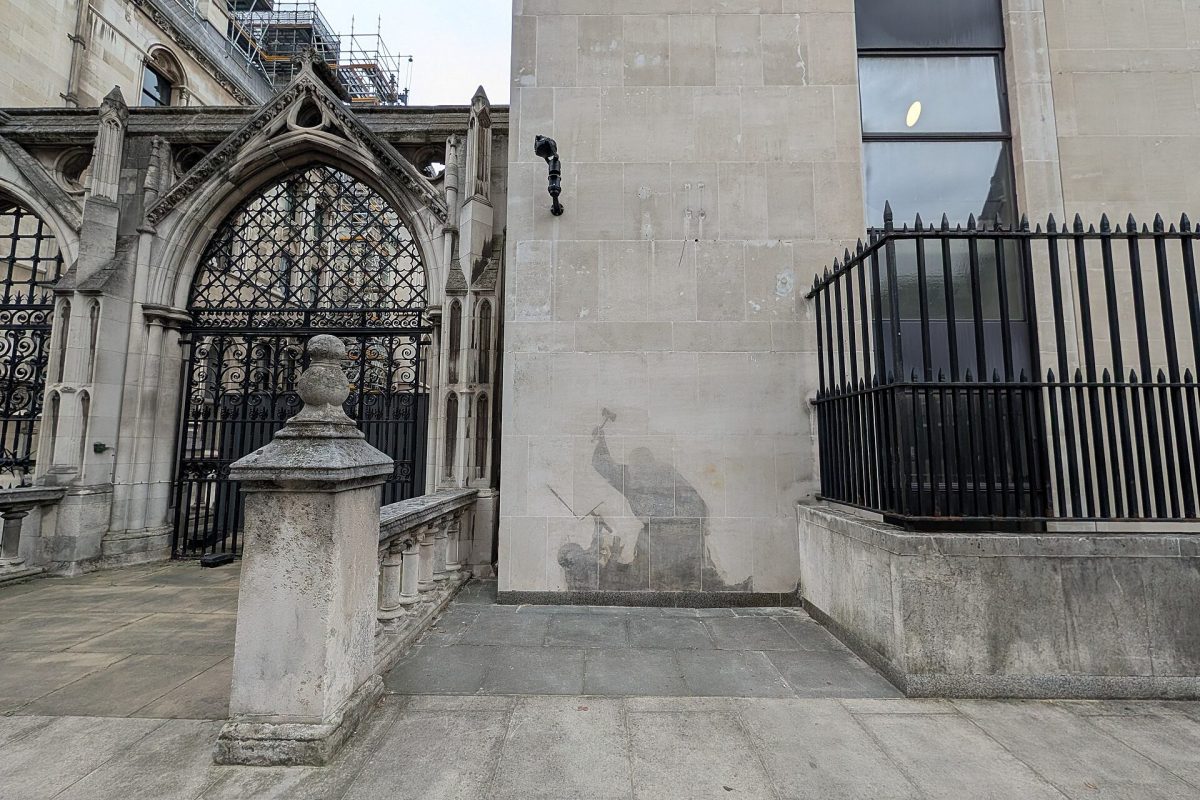
The subject of Reuters’ report is the person behind Banksy, who was not known to the public. Revealing his name not only discloses a private fact, but it destroys the distinction between person and persona that gave his work its social and political force. From activists to whistleblowers, anonymous authorship has a long tradition of enabling speech that would otherwise attract retaliation (Asenbaum, 2023, pp. 103-105; Barendt, 2016, pp. 56-80). In Banksy’s case, anonymity also carries a direct legal dimension. His recent work Royal Courts of Justice: London (September 2025) was a response to the arrest of 890 protesters following the UK government’s proscription of Palestine Action under the Terrorism Act 2000, which makes support for a proscribed group punishable by up to 14 years’ imprisonment (s. 12). By producing an artwork widely read as an endorsement for Palestine Action’s cause (at a time when the ban’s compatibility with Articles 10 and 11 ECHR was contested, and ultimately rejected by the English High Court (Greene, 2026)), Banksy was operating in legally charged territory. Without anonymity, the act of authorship would have constituted prosecutable evidence. This is the paradigmatic situation in which, in the ECtHR’s own language, compelled identification produces a chilling effect on expression at the core of democratic debate (Halet v. Luxembourg [GC], 2023, para. 152).
3. Prior Conduct Vis-à-Vis the Media
Banksy has never disclosed details of his private life and has taken deliberate legal steps to prevent others from doing so, including non-disclosure agreements. He declined, through his lawyer, to confirm or deny his identity. His authentication office, Pest Control, publicly mocks speculation about his actual identity (FAQ No. 9). In formal transactions, such as auctions and other formal settlements, he used a legally changed name, David Jones. This pattern of deliberate, consistent, and legally enforced resistance to disclose his identity grounds a “legitimate expectation” of protection under Article 8, a factor that the ECtHR explicitly recognized in Axel Springer AG v. Germany (para. 101), and one that is reinforced here by the concurrent interest under Article 10 in preserving the conditions of artistic expression.
4. Consequences of Publication
Revealing a name ordinarily has limited consequences: a name just becomes known. However, in Banksy’s case, the consequences extend to the possibilities of his entire artistic practice. His lawyer noted that he had previously “been subjected to fixated, threatening and extremist behaviour”, and that Reuters’ report risks exacerbating those threats. The disclosure is also irreversible: once his name has been published and widely shared online (see, e.g., here, here, and here), it is virtually impossible to remove it from the collective memory.
A Right to Artistic Anonymity?
The case of Banksy raises the question of whether there is (or should be) a right to artistic anonymity. In S. and Marper v. UK [GC] (2008), the Grand Chamber confirmed that “private life” under Article 8 encompasses a person’s social identity, including the name (para. 66). This protection, available to any private individual, is reinforced by two additional layers, already highlighted: first, anonymity is constitutive of Banksy’s artistic practice (and Article 10 protects the conditions that make that expression possible); and second, his anonymity enables his political activism, channelled through his art and the public engagement with it. Here, the interests of Articles 8 and 10 converge, given that Banksy’s message is at the core of what the ECHR is meant to protect: public debate on government action, the right to peaceful protest, and the exercise of fundamental freedoms. It follows that the more clearly an artist’s anonymity enables their expression within the democratic debate, the higher the standard to justify its disclosure.
One last appreciation: the ECHR binds states, not private actors. This means that Reuters, as a private media outlet, did not violate the ECHR by publishing Banksy’s actual name. The relevant obligation falls on the UK as a state party. States bear positive obligations to ensure that Article 8 and Article 10 rights are respected even between private parties (Von Hannover v Germany (No. 2) [GC], para. 98; Özgür Gündem v Turkey (2000), para. 43, respectively). This duty raises the question of how much regulation of private actors (i.e., media outlets) is justified in a democratic society when the rights of politically engaged artists are at stake. As Stoyanova (2023) observes, any positive obligation upon the state to protect one party’s rights implies restrictions upon another’s, and the resolution depends on the relative importance of the concrete interests invoked (pp. 104-107).
In the case at hand, the positive obligation could outweigh the negative obligations the UK could have under Article 10 for two main, cumulative reasons. First, Banksy’s interest in anonymity is jointly grounded in Articles 8 and 10, while Reuters’ interest rests only on Article 10. Thus, Banksy’s side holds greater combined normative weight. Second, the harm to Banksy is concrete and irreversible: once his name has been published, both his artistic freedom and private life are permanently affected. By contrast, any regulatory burden on Reuters is speculative and diffuse, an indeterminate harm that Stoyanova identifies as carrying lesser weight in the competition between obligations (p. 119). Crucially, this tension does not create an irresolvable conflict. States can frame protective obligations narrowly enough to remain minimally intrusive to press freedom. A domestic mechanism preventing gratuitous disclosure of an artivist’s identity, whether through UK GDPR or otherwise, need not amount to a disproportionate restriction on the press generally. If Reuters’ approach remains uncontested before UK courts, however, any artivist who attracts public attention risks losing their anonymity to the media. To prevent this chilling effect on politically engaged art, states must create mechanisms that prevent such disclosure.
Conclusion
The Reuters’ report raised a new problematic the ECtHR has not yet had occasion to address: the scope of the ECHR’s protection when anonymity is both desired and constitutive of an artistic and political practice. While Banksy is a public figure for the purposes of Article 8, and could therefore bear a reduced expectation of privacy, Article 10 reasserts itself in an unusual way. Banksy’s artistic persona depends entirely on the separation between the work and the person, and anonymity is the condition, not the incidental feature, of his artistic expression. Revealing his identity does not disclose a private fact about a public figure; it irreversibly destroys his artistic agency. Within ECtHR’s proportionality framework, Reuters’ disclosure seems disproportionate to any legitimate aim pursued. The absence of an adequate domestic mechanism to deal with this kind of situation is not a gap in Banksy’s case alone, but a structural failure to protect the conditions under which politically engaged art can exist in democratic societies.
I would like to thank Philip Nedelcu, the anonymous reviewer, and Emīlija Branda for their thoughtful review and feedback on this post.

Dr. Vanesa Menéndez Montero is a Postdoctoral Research Associate at the Jacques Delors Centre (Hertie School) and an Associate Lecturer at the European University of Madrid. She provides pro bono legal aid to civil society associations and artists. Her research interests include International Cultural Heritage Law, Human Rights, International Criminal Law, and Decolonial Studies.