
The Law’s Apocalypse or the Law of Apocalypse?
On the (Counter-)Theatrical Perversion of Legality
In the early post-Cold-War years, writing about the “funeral march” of the twentieth-century history, Hungarian philosopher Ágnes Heller penned, “Man-inflicted apocalypse is the parody of apocalypse. […] Men are envious of apocalypse; their ambition is to do it better. Why should angels kill off one-third of the human race when the strongest (or most progressive) human beings are also capable of doing it?” (p. 1173). More than one year into the second Trump administration, nothing could more aptly resonate with the depraving state of international legality than Heller’s portrayal of man-made apocalypse. The U.S.-backed international order, already on the path of terminal decline for years, is now breathing its last breath. If this order had ever been destined to perish, who could have been in a better place to bring it to an apocalyptic moment than the one actor who led its construction in the first place?
Amidst this chaos, disciplinary voices have come to terms with the end times of the rules-based liberal order (e.g. here, here, and here). Yet, many have remained attached to formalistic diagnoses of legality, relying upon “renormalization” formula to utter why and how some legalistic requirements were either absent or partially met in a given instance of normative violation. Some even suggest that alternatives to the old (dis)order may not envisage “a world without international law”, perhaps implying that the survival of law may still amount to its partial triumph. Yet, inasmuch as man-made apocalypse is nothing but a parody of apocalypse, the question of legality “in the time of monsters”, irreducible to a diagnosis of compliance and breach, is fraught with what I call “(counter-)theatrical perversion of legality”.
“Seen to Be Done”: Law, Perversion, and (Counter-)Theatricality
As a descriptive signifier, perversion may evoke not just the distortion of law through recurrent misuse but, as Mohammed Bedjaoui noted five decades ago, an effect of how preaching “law for law’s sake” (p. 101) thwarts law’s adaptation to social realities. Yet, this notion, as I encode it in my analysis, is reduced neither to these narratives nor to individual aberrations of those preaching or denouncing law. I elaborate on this idea of perversion following the Lacanian theory.
À la Lacan, perversion points towards “a structure (which is to say something irreducible to a personal style or pathology of individual perverts) that enables an insight into how power works today” (p. 208). A perverse individual is situated in “a particular structural position in relation to the Other” in which he “has undergone alienation but disavowed castration, suffering from excessive jouissance, and a core belief that the law and social norms are fraudulent at worst and weak at best” (p. xii).
Castration refers to the symbolic process, tied to the Freudian “Oedipus complex”, whereby the child’s identification with maternal parent is challenged by paternal figure representing the symbolic (social) order. In his alienation from maternal parent, the perverse subject acknowledges the “Name-of-the-Father” (p. 115) – the signifier of the symbolic order – and, yet, “‘disavows’ knowledge” of it (p. 170). This order, the Other (capitalized), is “the unconscious, the place of parents, culture, and language” (p. 140). Law – which, per Lacan, is not synonymous with a formal system of rules but encompasses what “‘demarcates’ the unattainable for desire” (p. 59) – finds home in this category.
Integral to this revisited idea of legality is the notion of jouissance. Beyond its literal meaning as (erotic) pleasure, Lacanian jouissance signifies “an excess intolerable to pleasure, now a manifestation of the body closer to extreme tension, to pain and suffering” (p. 14). By way of illustration, pleasure is sexual gratification, while jouissance is sexual compulsivity or breaking the taboo of incest. Law essentially entails “the regulation of the restrictions imposed on the jouissance” of transgression. Yet, this effect remains complex as “it is thanks to the law […] that a certain act provokes the jouissance which the drive aims at” (p. 108).
The jouissance of transgression, primarily subjective, may amount to “objective transgression” – i.e. once the (subjective) guilt of transgression is sublimated by “the perverse self-instrumentalization of the subject” for a (collective) “higher good” (p. 280) – as seen in populist mobilization and totalitarian systems (here and here). The breach of law, a source of subjective guilt, becomes the virtue of “the restoration of ‘law and order’ itself” (p. 268), making the transgression of law almost “indistinguishable from its preservation” (p. 271). Law and its subjects are mutually constitutive as “neither one wholly or unidirectionally determines the other” (p. 140). Since law “cannot banish the pathological” and may only pose limits to jouissance, perversion is an ever-present possibility, often surfacing in linguistic and symbolic practices (p. 48). As an “unconscious order which envelops and shapes the destiny of the subject” (p. 74), language exposes the perverse subjectivity. At this juncture, the law’s theatricality becomes intermingled with Lacanian perversion.
The enforcement of law as an expressive performance is linked to its “aesthetic power”, including its lexicon, procedures, and symbols. Law is “not merely to be done but ‘seen to be done’” (pp. 5-6). Correspondingly, in manifesting his disavowal of the symbolic order, the perverse subject resorts to “counter-theatricality”, a (non-exhaustive) range of performative possibilities from vulgar speechcraft and gestures, to ornamental, or even paradoxical, appropriation of legal form for “some grander [good] that only [he] alone can perfect” (p. 171). Counter-theatricality is the mark of perversion. Unlike other Lacanian diagnostic structures (neurosis and psychosis), perversion assumes an “in-between-ness” via-à-vis the law. The perverse subject does not blindly reject the latter but retains a performatively disavowing posture toward it. One cannot but behold this in-between-ness in Trumpism’s parody of international legality.
“My Own Morality. My Own Mind. It’s the Only Thing That Can Stop Me.”
As Maria Aristodemou puts it, “Public international law, like all law, prohibits what is most desired […]. Access to unbridled enjoyment would be unbearable for the subject so law acts as a limit, not to our freedom, but to limitless, and therefore unbearable, enjoyment” (p. 49). The normative expansion of international law over the past decades, while posing further constraints on its subjects’ enjoyment, exposed, what Matthew Nicholson describes as, “international law’s ‘phallic’ complex—an expression of its unfulfillable ‘wish for completeness’” (p. 505). This expansion never effaced what critical strands of scholarship have identified as “structural biases”, “legalized hegemony” and “interests of dominant social forces” (p. 26) in the design of international law – a signifier of normative porosity allowing most powerful subjects to enjoy lesser degree of restraint on their jouissance. More parochial precepts such as “American exceptionalism”, devised to constantly adjust the barriers to political enjoyment, also revealed the insatiability of imperial “phallic complex”.
While framed as antithetical to the rules-based order, Trumpism’s “political perversion” feeds on such possibilities that the liberal order offered. After all, “public international law, no more than any law, cannot escape the pathological” (p. 53). If “international law is the continuation of politics by other means”, the perversion of politics would directly bear upon how law is “enunciated” in the Latourian sense. To equate the perversion of legality to its violation, however, misrepresents how the perverse subject identifies with the Other (here, the “woke” international legal order).
Same as perversion in general, Trumpism unfolds “in destroying more than in conserving” and only “manifests itself in transference and relation to others” (p. 108-109). Why would it wish to dismantle international law, if it could ever do so, if it may simply enjoy the former’s disavowal and denigration? Unsurprisingly, even in one of his most antagonistic remarks about international legality – “I don’t need international law. […] My own morality [is] the only thing that can stop me” – Trump did not “deny the binding effect of international law”. This is precisely why the counter-theatrical belittlement of what counts as the symbolic Other (liberal international order) takes center stage in the expression of perverse subjectivity.
One could trace this counter-theatricality, in its symbolic and linguistic representations, in the Trump administration’s warmongering in the Middle East: From its Secretary of War, a former TV host with “puerile displays” in his press conferences, and the White House’s social media accounts using internet memes (on memeifying warfare, see here) and references to Hollywood movies to boast about waging an unlawful war on Iran, to Trump himself being “at his most animated when describing the bloodied and mangled bodies of other people”. The use of force – endorsed by “demonstrably rubbish justifications” and portrayed as “part of God’s divine plan” to retribute “barbarians” and “animals” – has not only recycled the language of colonial wars but has degenerated life-and-death decisions into the choice of “more fun” options or a “feeling based on fact”. Excessive restraint on the jouissance of violence, as the perverse subject may utter, only leads to “politically correct wars”.
The disavowal of the symbolic order may involve magnifying the latter’s flaws for “some [deliberately ambiguous] grander (second) Other”, leading the perverse subject to “speak prophetically, declaring either a new or renewed path to law and order” (p. 171). Any compliance with the proscriptions of legality is conditioned on the future, if ever, actualization of these “higher goods”. After all, why should one “let international law get in the way of peace and prosperity”? Trump’s so-called “Board of Peace” brazenly embodies this.
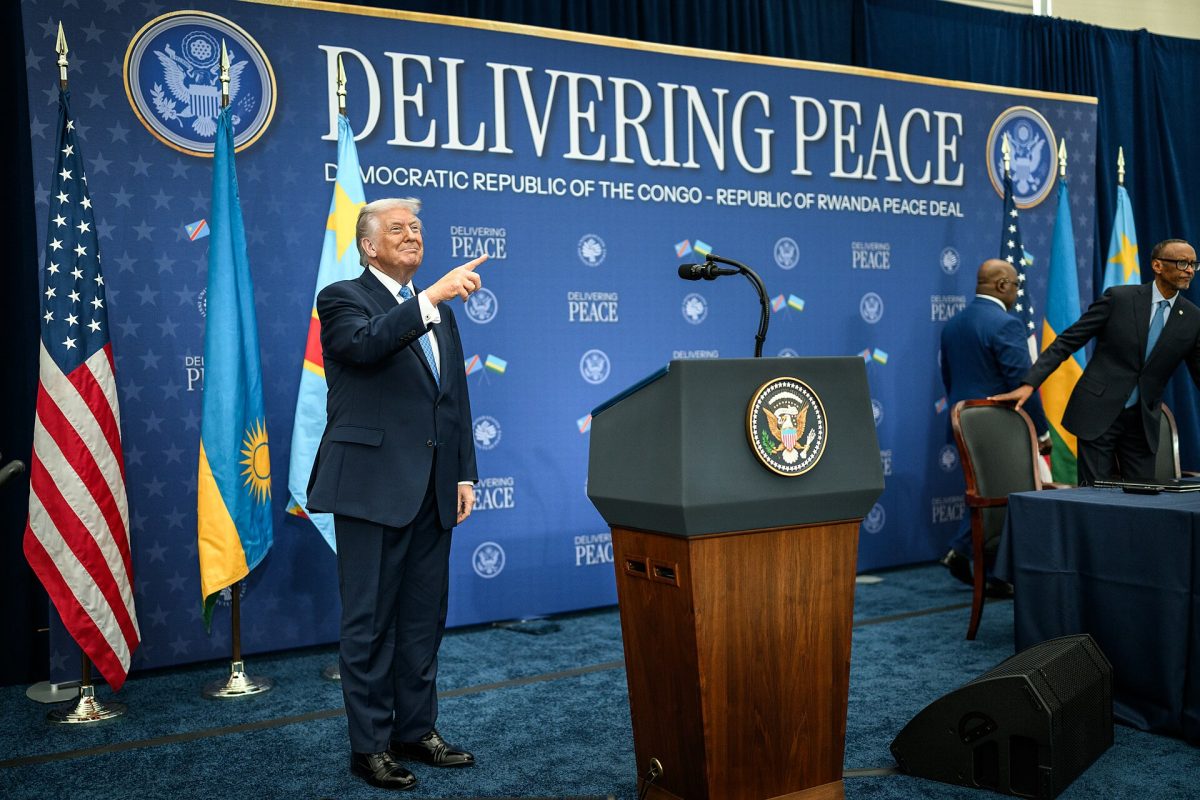
With its inaugural meeting on 19 February 2026 becoming a musical charade, the Board, as its Charter provides, is constituted as a technocratic international organization and pays lip service to international law as its normative framework. Yet, nowhere in its Charter does the Board engage with standard terminologies of peacebuilding, from self-determination to human rights and development. The Board’s aesthetic angles unclothe the perverse subject’s “demand for recognition” (p. 114). Its logo is centered almost exclusively on an outline map of the United States; its official website is replete with Trump’s quotes on “beautiful, everlasting, and glorious peace”; and its administrative center is based at the “Donald J. Trump Institute of Peace”. The perverse subject stands at the center stage of his scripted play where (the parody of) legality operates as no more than a visual enactment of perverse jouissance.
Trumpism’s disavowal of legality indeed lives off the margin of enjoyment that the rules-based order reserved for the American empire. In this sense, it lays bare but the endurance and dilation of extant power asymmetries of a “global caste” (p. 812). Yet, this parody of legality – the law of apocalypse, to resonate with Heller’s allegory of man-inflicted apocalypse – might underline backstage shifts in the political configuration of subjectivity. What one witnesses in Trumpism is, in Aaron Schuster’s words, the amplifying impulse that “the State should ultimately become part of the Trump brand—American democracy is the new Trump Steaks, grilled to a crisp at Mar-a-Lago—and a worldwide platform for his ongoing reality show.” This is what the discipline, with its oblivion to the intricacies of subjectivity, has terribly missed.
An Unfinished Epilogue
Agamben once postulated that “politics has suffered a lasting eclipse because it has been contaminated by law” (p. 88). Similarly, against the perverse aberrance that Trumpism has unleashed on international law, our legal imagination has been no less spinelessly crippled by the ruinous arrogance of formalism. Painfully slow to cope with the scale of recurrent disavowal of legality, formalism has taken solace in that it can exist as the guardian of “authentic international law” and of its “long memory”. It has remained blind to the logic that jouissance “carries within it its own reason” (p. 108) irreducible to, although not irrelevant to, legal enunciations. What proves most perilous is less the characterization of Trumpism as rupture or continuity than the bitter recognition of how little we still know about it. Perversion is a lingering possibility in the life of legality. Trumpism – perhaps not international law – might eventually wither away but perversion would always be reborn beneath our formalistic naiveté, as long as, in Pierre Schlag’s words, subjectivity does not become “part of the story” (p. 1743).
Soheil Ghasemi is a PhD candidate in international law and a teaching assistant at the Geneva Graduate Institute. His research spans the history and theory of international law and the sociology of legal expertise.