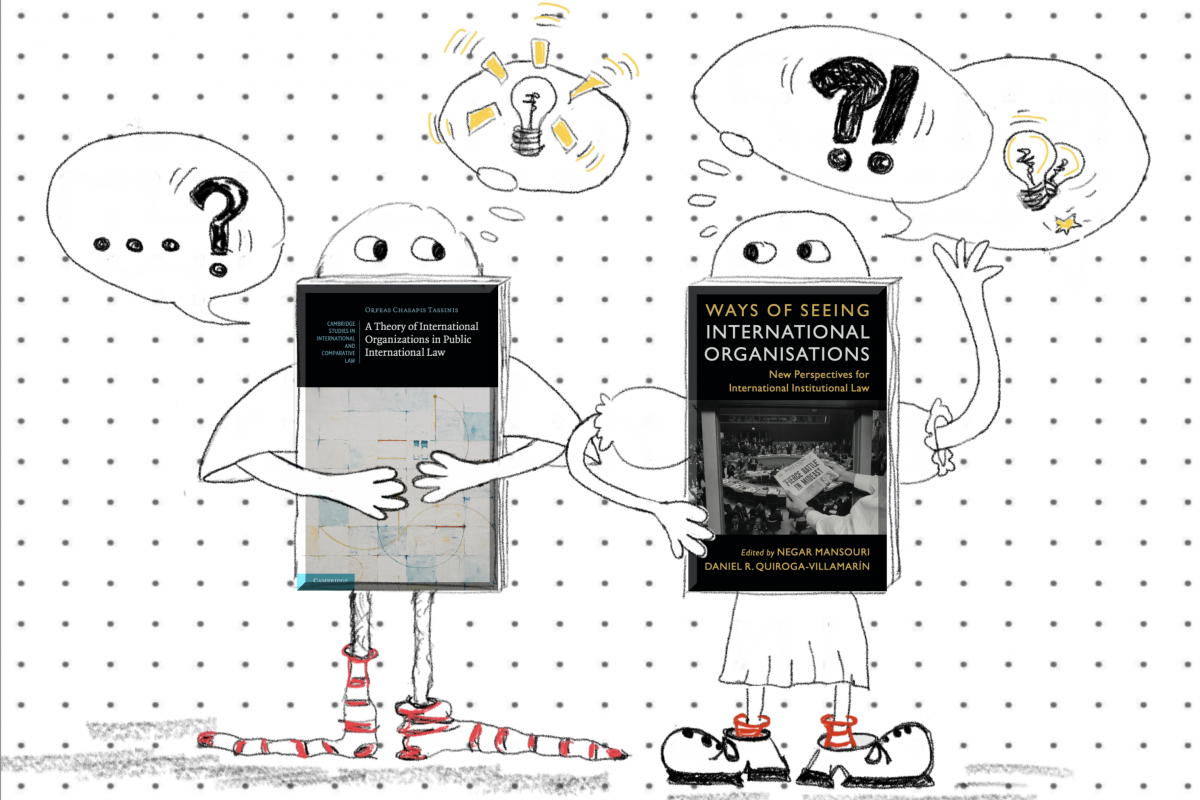
Reimagining Public Power
A Dialogue Between Two Theoretical Approaches to International Organizations
Introduction: Diagnosing the Impasse from Different Angles
International organizations law has long been dominated by what B.S. Chimni terms ‘mainstream international institutional law scholarship’ (MIILS)—a primarily doctrinal approach focused on the legal status, structure, and functioning of organizations while leaving questions of power and politics to political scientists. Within this tradition, a fundamental tension persists: some view organizations as instruments of state will, while others see them as independent subjects with their own authority. This unresolved dichotomy—rooted in nineteenth-century concepts treating states as natural, primary subjects and organizations as artificial, derivative entities—has produced what Jan Klabbers in his chapter under Ways of Seeing International Organisations (WSIO) observes that ‘the law of international organizations is stuck in a rut’ (Klabbers, p. 38).
Both Chasapis-Tassinis and the WISO contributors respond to this paradigmatic impasse, though through fundamentally different strategies: Chasapis-Tassinis attempts to dissolve this divide through ontological unification, while WISO embraces critical pluralism in theoretical responses. Understanding their divergent responses—and their ultimate convergence on reimagining organizations as forms of public power—requires first recognizing the shared diagnosis that motivates both works. The following explores this contrast by first examining their shared diagnosis of international organizations law’s theoretical impasse (Part I), then analyzing their divergent solutions (Part II) before considering how both approaches, despite their theoretical elaboration, neither explicitly address coordination mechanisms for the practical realities of contemporary governance challenges (Part III).
In their introduction, Mansouri and Quiroga-Villamarín, the editors of WSIO add a critical dimension by quoting Chimini arguing that international law scholarship has ‘largely been confined to the rules of law which govern their legal status, structure and functioning, with matters of power and influence left to political scientists’ (Mansouri & Quiroga-Villamarín, p. 5). They argue that scholars should not be ‘reduced to merely finding “legal” answers to “legal” questions’ but should instead ‘investigate the ways in which IOs serve as sites of struggle for remaking the world order’ (Mansouri & Quiroga-Villamarín, p. 7).
From a theoretical perspective, the monograph by Chasapis-Tassinis diagnoses the problem differently. He argues that international organizations have become ‘a field lacking in sustained theoretical reflection and riddled with paradoxes’ (Chasapis-Tassinis, p. 1). The root of this theoretical poverty lies in what he identifies as ‘an unrefined understanding of the state’s legal personality’ that views ‘the state as roughly analogous to the natural person’ and aligns with ‘the also popular “billiard ball” metaphor’ (Chasapis-Tassinis, p.97). This nineteenth-century conceptual framework creates a hierarchical dualism: states as natural, primary subjects versus international organizations as artificial, derivative entities. Accordingly, he argues that international organizations remain theoretically unstable, perpetually caught between being dismissed as mere treaty arrangements or awkwardly elevated to quasi-state status.
These diagnoses prompt fundamentally different response strategies. Chasapis-Tassinis promises that ‘the theory developed in this book overcomes this dichotomy’ through systematic theoretical reconstruction (Chasapis-Tassinis, p.4). The WSIO contributors instead pursue multifaceted critique, examining international organizations through diverse critical lenses without seeking theoretical unity.
Yet remarkably, both paths converge on a shared insight: both works ultimately reconceptualize international organizations as forms of power exercise rather than as peculiar legal subjects. Chasapis-Tassinis concludes that ‘international organizations should be thought of—normatively as well as analytically—as what they most truly are: forms of exercising public power’ (Chasapis-Tassinis, p.248). Similarly, WSIO explores how ‘IOs serve as sites of struggle for remaking the world order’ (Mansouri and Quiroga-Villamarín, p.7).
This convergence is significant—yet it still raises a practical, and eventually theoretical question: how does this reconceptualized public power operate when currently states must coordinate between diverse domestic constituencies and international commitments regarding operation and content of the IOs?
Part I: Two Strategies, One Destination
Chasapis-Tassinis: Ontological Reconstruction through Foundational Inquiry
Chasapis-Tassinis’s strategy begins with a radical diagnosis: the problem lies not with international organizations themselves but with our understanding of states – as ‘billiard ball’ conception. This conception is anthropomorphic presenting states as opaque, closed-off, unitary entities—essentially irreducible atoms of the international system. He argues ‘however helpful state anthropomorphism may be for pedagogical purposes, if it entails some sort of natural or soulful existence for the state, then it rests on unproved, and probably unprovable, theoretical assumptions’ (Chasapis-Tassinis, p.161). More critically from his view, this framework forces international organizations into an impossible position: they must be conceptualized either as artificial and therefore somehow less real than states, or as natural entities equivalent to states.
Chasapis-Tassinis’s solution rejects both and instead involves reconceptualizing states themselves. He argues that ‘the state is…(u)nless otherwise shown, it is itself, if anything, an artificial, corporate entity’ (Chasapis-Tassinis, p.161). This move — from natural to artificial — fundamentally alters the theoretical starting point. States are no longer privileged natural entities but constructed institutions, ‘neither inherently open nor closed’ (Chasapis-Tassinis, p.181).
This reconceptualization enables Chasapis-Tassinis to identify a common foundation for both states and international organizations. He locates this in ‘the continuous line that connects all these entities to a common ontological core, namely the status-generative capacity of certain communities of human beings’ (Chasapis-Tassinis, p.176). This concept also draws on social philosophical insights including those of Searle, particularly the notion of collective intentionality and institutional facts. States and international organizations are members of the same family, ‘public institutions, because they are ultimately anchored to what international law recognizes as public authority in its most elementary sense’ (Chasapis-Tassinis, p.185).
WSIO: Critical Deconstruction through Multiple Lenses
The WSIO volume adopts a fundamentally different strategy. Rather than seeking theoretical unity, the editors embrace multiplicity of critical perspectives. Their methodological choice is well-suited to the edited volume format, which allows multiple theoretical perspectives to coexist without demanding artificial consensus.
The contributors reveal power’s multiple dimensions: Annabelle Littoz-Monnet demonstrates the importance of ‘taking the study of IOs away from international secretariats, member states, and formal negotiating structures’ (Littoz-Monnet, p.61) and instead to focus on how the production of ‘expertise is central to the assertion of IOs’ authority’ (Littoz-Monnet, p.63). Juanita Uribe explores how international organizations exercise power through their capacity to define governance objects, and illustrates this by problematizing ‘hidden hunger’ (Uribe, pp.101-102). Jan Eijking emphasizes that authority needs to be produced in the interaction among diverse organizational actors through ongoing (re)authorization processes, rather than as a pre-existing ontological given. (Eijking, pp.190-191). These all point to the shift of attention from formal legal structures of IOs to the networks and processes through which authority (whatever that means for each author) is actually constructed.
Where Unity Meets Multiplicity
Both strategies lead to a fundamental reimagination of international organizations. Both reject the subordination of international organizations to states. Both recognize that power operates through multiple channels beyond formal legal structures. This convergence from different directions marks significant theoretical progress. But they have even more on offer jointly.
Interestingly, where Chasapis-Tassinis provides theoretical unity, WSIO offers empirical richness—and vice versa. Chasapis-Tassinis’ ontological foundations could ground WSIO’s diverse power manifestations, while WSIO’s processual insights could provide grounds for testing Chasapis-Tassinis’ abstract framework empirically. Yet neither fully engages with what the other might offer. Questions remain about how this reconceptualized power operates in practice—questions that become visible when examining actual multilateral negotiations.
Part II: Theorizing Public Power
The Sources and Nature of Public Power
Chasapis-Tassinis approaches public power through ontological inquiry. His concept of ‘community’ possesses what he calls a ‘status-generative capacity’—the ability to create institutions through self-description (Chasapis-Tassinis, p.176). The exercise of this capacity generates public power: when a community changes its self-description (for instance, by recognizing a new government). This is public power in its most elementary form—the capacity to alter legal relations through institutional self-description. Crucially, Chasapis-Tassinis argues that ‘the distinction between them [states and international organizations] is a practical distinction that should not be taken ipso facto to reflect the deeper structure of customary norms’ (Chasapis-Tassinis, p.229).
The most of WSIO contributors approach public power not as an ontological given but as a social processual production. For example, Eijking adopts ‘a relational position that sees authority as an ever-contested relationship arising from interaction’ (Eijking, p. 190) emphasizing ‘the central role of “constant (re)authorization” ’ (Eijking, p.191). In his view, authority doesn’t exist in institutions. Santer, drawing on Zürn, describes how ‘reflexive authorities “depend on the epistemic constructions that identify the limits of subordinates and the realm of superiority of an authority” ’ (Santer, p.160). Public power here is not grounded in community self-description but constructed through knowledge frameworks that define who has authority over whom and in what domains. Littoz-Monnet shows how we must examine ‘the processes, boundary sites, and infrastructures of knowledge production’ to ‘understand how the co-production of science and politics operates in practice’ (Littoz-Monnet, p.79). Public power emerges from the intersection of expertise and political authority, neither purely technical nor purely political but always both simultaneously.
These approaches could be used in a complementary fashion: Chasapis-Tassinis explains why public power exists (communal self-organization), while WSIO shows how it operates (through expertise, interaction, knowledge production). Read together, they suggest public power has both ontological foundations and processual manifestations. The puzzle is not choosing between them but understanding their relationship.
Legitimacy: From Whence Authority?
Chasapis-Tassinis grounds legitimacy in the very source of public power itself. He argues that ‘international law should be theorized to possess a single norm that just refers back to the capacity of certain types of communities to organize in a manner that they see fit’ (Chasapis-Tassinis, p.197). As he puts it, ‘institutions and social facts always remain grounded on what human beings do. International law is such a fact’ (Chasapis-Tassinis, p.248). His approach elegantly dissolves the hierarchical relationship between states and international organizations. If both derive legitimacy from the same source—communal self-organization—then neither is inherently superior.
The WSIO see legitimacy not as something possessed but as something continuously produced. The edited volume’s various chapters demonstrate that this contestation happens through multiple channels: through expertise claims (Littoz-Monnet), through legal argumentation (Santer), through institutional design (Eijking). Legitimacy becomes not a solution to the problem of authority but an ongoing question that must be continuously addressed.
The Architecture of Theoretical Divergence
These are not merely different answers to the same questions but different ways of understanding what the questions mean. For Chasapis-Tassinis, ‘what is public power?’ is a question about essential characteristics. For WSIO contributors, it is a question about social processes. For Chasapis-Tassinis, ‘why is it legitimate?’ seeks a foundational justification. For WSIO contributors, it seeks to understand mechanisms of legitimation.
Yet, Chasapis-Tassinis’ concept of ‘community’ that exercises self-organizing capacity appears to embed particular assumptions about collective decision-making. For both Chasapis-Tassinis and also for many contributors to WSIO, the question arises when communities with fundamentally different self-descriptions interact—as inevitably occurs in international relations— as their arguments so far provides no principle for resolution beyond an idea of an abstract ontological unity. The transformation from horizontal deliberation to binding international norms remains theoretically opaque.
Part III: Achievements and Horizons
Convergence and Its Limits
The convergence on public power beyond the state marks genuine theoretical progress. Both works have successfully challenged the monopoly of state-centric analysis. Chasapis-Tassinis’ theoretical achievement is profound. By reconceptualizing states as artificial entities and tracing both states and international organizations to a common source in communal self-organization, he dissolves the conceptual hierarchy that has plagued international organizations law for a century. His conclusion that ‘international organizations should be thought of (…) forms of exercising public power’ (Chasapis-Tassinis, p.248) provides a new foundation for theorizing these institutions.
The WSIO volume achieves something different but equally valuable. By approaching international organizations through multiple critical lenses, the contributors reveal dimensions of institutional power invisible to traditional doctrinal analysis.
The editors’ vision of ‘interdisciplinary dialogue as a two-way street’ (Mansouri & Quiroga-Villamarín, p.9) opens international organizations law to insights from anthropology, sociology, history, and political economy. This methodological and epistemic openness is itself an achievement, breaking the disciplinary isolation that has contributed to theoretical stagnation.
Yet the convergence also illuminates what remains untheorized: not whether public power exists beyond the state, but how its multiple manifestations can be coordinated toward collective action. The following sections explore these productive tensions within each work’s own theoretical terms.
Internal Critique: The Self-Limitations of Theory
Both works make crucial theoretical advances—Chasapis-Tassinis’ ontological unity and WSIO’s processual insights fundamentally reframe international organizations law. Yet precisely these innovations reveal new theoretical puzzles worth exploring further.
From Old Hierarchies to New Binaries
Both works achieve a fundamental breakthrough by transcending the nineteenth-century binary of states as natural entities versus international organizations as artificial constructs. This dissolution of traditional hierarchies opens new theoretical terrain, though it also generates different analytical challenges. Chasapis-Tassinis, having unified states and IOs under communal self-organization, adopts a necessarily comprehensive framework where ‘there is no third possibility’ (Chasapis-Tassinis, p.30). WSIO, embracing critical diversity, pursues multiple critical perspectives without demanding their synthesis into a unified theory. This does not mean abandoning construction for pure critique; rather, as Van Den Meerssche shows, critique can itself be ‘assembling’ rather than merely ‘debunking’ (Van Den Meerssche, p.245).
These approaches reveal different theoretical strategies—unified ontological foundation (Chasapis-Tassinis) and critical multiplicity (WSIO) — contribute to a shared theoretical challenge: the difficulty of theorizing difference within unity. Given that Chasapis-Tassinis seeks to explain everything through the same ontological foundation, the framework seems unable to fully account for why states, unlike IOs, might uniquely (suitable to) mediate between domestic democratic processes and international coordination (or any alternative mechanisms to fill out the authority gap). Similarly, WSIO’s methodological pluralism—enriched by perspectives like Van Den Meerssche’s notion of critique as ‘assembling’—offers valuable insights into how power operates, yet leaves open questions about coordination mechanisms between these diverse critical perspectives and existing institutional frameworks.
Theoretical Dismissal of State Mediation
This theoretical elegance comes with a trade-off. This manifests most clearly in both works’ treatment of state functions.
Chasapis-Tassinis reduces states to artificial corporate entities, placing them on equal ontological footing with international organizations as ‘members of the same family’ (Chasapis-Tassinis, p.185). Klabbers advances this reconceptualization by characterizing states as ‘conduits’ lacking inherent interests (Klabbers, p.44). While these views valuably challenge state anthropomorphism, they raise shared questions about the complex internal processes—the very processes that produce ‘consent’ — operate within these flattened ontologies?
While this theoretical move helpfully dissolves arbitrary hierarchies, it invites further theorization of how states’ unique position as translators between domestic democratic legitimacy and international coordination operates within this new framework. In this regard, Chasapis-Tassinis acknowledges the diversity of communal self-organization forms and recognizes that international law imposes no abstract requirements on community types (Chasapis-Tassinis, p.190), yet his theory does not articulate the case of communities with incompatible self-descriptions and how they might reconcile their differences. The appeal to common ontological foundations, while theoretically elegant, leaves unaddressed the concrete mechanisms through which conflicting community self-descriptions might be coordinated or resolved.
The practical consequences become apparent in multilateral negotiations. When communities with incompatible self-descriptions interact—as inevitably occurs in climate negotiations where many parties—can be as close as 200—must reconcile vastly different economic conditions and cultural approaches—the framework offers no mechanism for resolution beyond asserting common ontological foundations. Yet, practically speaking, it is likely to be rendered inoperable by a culture of irresponsibility in coordination and incessant partisan squabbling. The practical work of aggregating diverse domestic interests—businesses, workers, NGOs—and translating them into internationally negotiable positions continues regardless of theoretical categorization. This iterative process, observable in various UN multilateral treaty processes and negotiations (e.g. UNFCCC) or the other IOs’ decision-makings for approving outcomes, suggests ‘states’ must continue to perform distinctive mediating functions that persist.
Persistent Vertical Imaginaries
Interestingly, both revolutionary approaches retain one traditional assumption. Despite rhetoric about horizontal relations and pluralism, both works remain wedded to vertical conceptualizations of authority. Chasapis-Tassinis grounds public power in what ‘international law recognizes as public authority in its most elementary sense’ (Chasapis-Tassinis, p.185), implying a foundational hierarchy even while claiming to dissolve state/IO distinctions. Authority flows from a source—communal capacity—rather than emerging through interaction.
WSIO contributors emphasize process—for example, ‘constant (re)authorization’ (Eijking, p.191), deliberately eschewing synthesis as a methodological choice to deconstruct mainstream doctrinal approaches. While this successfully reveals power’s processual nature beyond formal structures, the volume leaves open the question of reconstruction: how might these horizontal processes generate binding outcomes or alternative ordering principles? This is not a failure of their deconstructive project but points to the next theoretical challenge.
The Implementation Gap
Theory meets practice in revealing ways. While both works seek to transcend the state-centrism of traditional international law and presuppose the existence of complex contemporary coordination challenges, neither explicitly articulates concrete mechanisms for achieving coordination among diverse actors. Climate governance, pandemic response, and data flows exemplify precisely such domains that require this coordination. Chasapis-Tassinis’ ‘single norm referring back to communities’ capacity to organize’ (Chasapis-Tassinis, p.197) cannot explain how conflicting community self-descriptions are reconciled. WSIO’s processual descriptions of authority emergence cannot answer the fundamental question posed by domestic constituencies: ‘Why should we accept this proposal?’ The theoretical elegance of both approaches faces challenges when confronting the practical necessity of generating binding, implementable outcomes from diverse inputs—what might be termed the implementation gap between theoretical possibility and practical necessity.
Practitioners are already exploring various institutional responses to this gap, particularly in domains where traditional state-centric mechanisms prove inadequate. For example, data governance offers an instructive case: facing the challenge of regulating cross-border data flows that involve diverse stakeholders beyond states, the G7 developed a novel concept of institutional framework in 2023. Their ‘Institutional Arrangement for Partnership’ (IAP) for Data Free Flow with Trust represents one attempt to operationalize the coordination mechanisms both theoretical works struggle to articulate. The IAP was subsequently operationalized through the OECD, featuring a two-layer structure that proves instructive in this context. The first layer consists of a ‘DFFT Community’—comprising multiple issue-specific working groups—where businesses, technical communities, and civil society horizontally generate solutions to concrete challenges of cross-border data flows. Here, states’ monopolistic authority recedes as actors with implementation capacity and specialized knowledge directly participate in solution buildings and norm formation. Yet in the second layer, these proposals undergo verification and approval through the OECD’s intergovernmental body.
This design suggests that neither Chasapis-Tassinis’ ‘communal self-organization’ nor the ‘processual authority’ advanced by some WSIO contributors suffices alone. What emerges from such practical experiments is insight into how ‘organizing’ actually functions in contemporary governance. While Chasapis-Tassinis invokes communities’ capacity to ‘organize’ as a foundational norm, such experiments reveal how organizing actually functions through continuous reorganizing. As Fleur Johns notes, international legal frameworks are continually subject to ‘organising and reorganising’—though Johns questions how this should proceed when communities rarely align and amid ‘a mass of worlds colliding,’ when the authority for resolving such conflicts, is not made entirely clear. This processual yet structured understanding reveals an overlooked dimension: states’ mediating functions—often dismissed as mere gatekeeping—may constitute precisely the institutional transparency that diffuse reorganizing processes lack. The examples referred to in this post exemplify this, showing how states could translate between horizontal knowledge generation and vertical democratic authorization, thereby organizing authority across different operational logics.
While distributed knowledge indeed generates solutions—and through them, authority (echoing WSIO’s insights)—transformation into actual policies and norms still requires democratic authorization through states (the practical necessity Chasapis-Tassinis overlooks). The IAP can be understood as an institutional arrangement mediating between horizontal knowledge generation and vertical authority structures.
The Changing Landscape of Power: A Contextual Note to Conclude
The conversation between Chasapis-Tassinis and the WSIO contributors represents international organizations law at a crucial juncture. Both works perform essential diagnostic work—Chasapis-Tassinis by revealing the arbitrary nature of state/IO hierarchies, WSIO by exposing power’s multiple manifestations beyond formal structures. Their shared recognition that international organizations exercise genuine public power, not merely aggregated state preferences, marks a theoretical advance that should not be understated.
The WSIO contributors’ kaleidoscopic approach captures this heterogeneity brilliantly, revealing power dynamics invisible to doctrinal analysis. Their deliberate eschewing of synthesis—a justified methodological choice for deconstructive work—successfully challenges mainstream approaches. Yet the path from critical deconstruction to institutional reconstruction, from rich description to navigational principles, remains the next frontier for theorizing international organizations.
Beyond internal tensions, both works function within theoretical frameworks that emerging conditions are beginning to transcend. Contemporary governance experiments reveal institutional innovations that neither theoretical framework fully anticipates. Authority increasingly operates through non-territorial channels—data flows, technical standards, network effects—that escape both state and organizational frameworks. These transformations do not invalidate the theoretical contributions of Chasapis-Tassinis and WSIO but rather underscore the urgency of their project while revealing its temporal boundaries. The paradox emerges clearly: as authority becomes more distributed, the need for coordination mechanisms becomes more, not less, essential.
These works succeed precisely by revealing the limits of current theoretical frameworks—a necessary prelude to the reconceptualization international organizations law urgently requires. The challenge ahead is neither to choose between unity and plurality nor to transcend the state, but to theorize forms of power that are simultaneously networked and mediated, distributed and coordinated. Perhaps most significantly, both works leave untheorized the practical work of coordinating between governance levels with distinct operational logics. States’ role as aggregators of domestic diversity and facilitators of international cooperation—not as a matter of sovereignty but as functional necessity—awaits theoretical elaboration. In continuing the conversation these books begin, we honor their contributions while recognizing that our transformed world demands theoretical resources yet to be fully developed.

Maiko Meguro is a research fellow at the Amsterdam Center for International Law and currently leads cross-border data flows initiatives at an international organization, combining academic work on international law-making processes with extensive practical experience in trade, digital, and environmental negotiations—including roles with Japan’s METI, the Digital Agency of Japan, and the European Commission, as well as serving as co-chair of the G7 Digital Technology Working Group during Japan’s 2023 G7 Presidency.