Freeing International Organisations from the Shadow of State-Centred Legal Theory?
Critical Scholarship Confronted with the Limits of Modern Law*
Fairy tales do not tell children the dragons exist.
Children already know that dragons exist.
Fairy tales tell children the dragons can be killed
International Organisations and the Limits of International Legal Theory in ‘Time of Monsters’
In an age of ‘naked imperialism’, unilateralism, and the restructuring of the global order around few(er) hegemonic actors, theorising the law of international organisations (IOs) may at first sight appear a futile and abstract endeavour, akin to the telling of a fairy tale. This feeling is especially strong for those who subscribe to a traditional functionalist logic, which sees IOs merely as the main institutional manifestation of a supposedly pacified, largely technocratic international order, made of rules of sometimes ambiguous legal bindingness and devoted to addressing problems of common concern among their members. Starting from this long-contested but persistent premise, the disheartening reality of international affairs, which blatantly contradicts that picture, would likely turn most scholars into disenchanted and potentially hopeless realists.
However, this feeling is reinforced by certain broader legal-theoretical starting points. Despite everything, Euro-Western legal theory still provides the conceptual bedrock of that specific ‘law of encounter‘ that is modern public international law (PIL), as conceptualised between the nineteenth and early twentieth centuries. Still today, PIL is centred around the largely ‘blackboxed’, anthropomorphised state-subject and – thanks to the self-immunising formalism of its underlying legal theory – keeps itself at a reassuring distance from the potentially destabilising effects of social sciences.
By contrast, one fascinating aspect of the legal fields dealing with organisations is their physiological proximity to social sciences and, therefore, critique. When it comes to organisations, both public and private law discourses – where this distinction is actually relevant – show their socio-anthropological assumptions, hypotheses, and biases more clearly. Or, put differently, the narratives, framings, and solutions of the legal discourses centred around abstract individuals or ‘blackboxed’ social persons more easily conceal those assumptions. Insofar as it offers a privileged entry point into actual societal processes, (international) organisations law is therefore simultaneously more open and more vulnerable to critique and interdisciplinarity. This may help explain why legal scholars from different backgrounds and normative orientations, yet equally interested in interdisciplinary work, often end up dealing with organisations.
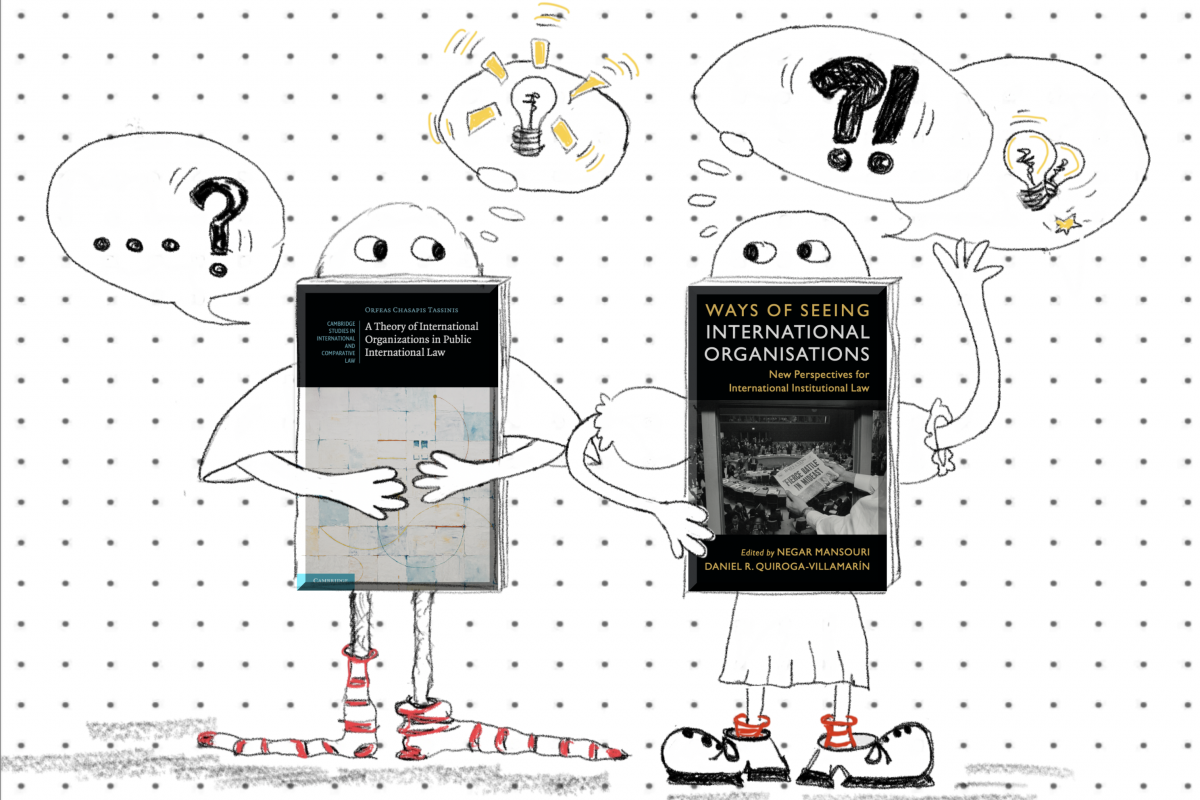
For these reasons, if international legal scholars manage not to surrender to resignation in this time of monsters, the current state of international affairs allows us to see more clearly how long-established frameworks help hide and reinforce old and new forms of (imperial) domination, and the historical role of IOs within them. In other words, the perceived inadequacy of longstanding legal-theoretical frameworks to interpret and govern the reality may at least open an opportunity for actual paradigm shifts. As tragic and painful as they may be, current events may represent a – for once, real?– ‘contingency‘ in PIL: a moment in which paths towards different histories may unfold. This offers normative and critical scholarship a possibility not only to deconstruct and debunk but, for a change, to replace those frameworks. Far from futile, then, theorising IOs law, especially in this time, appears more crucial, more necessary than ever. This is why conceptual and theoretical works like Orfeas Chasapis-Tassinis’ A Theory of International Organizations in Public International Law (TIOPIL) and Ways of Seeing International Organisations edited by Negar Mansouri and Daniel Quiroga-Villamarín (WSIO) are particularly needed.
After Deconstruction, How to Re-assemble? Forms of Normative Legal Scholarship and the Potential Contribution of Sociological Thought
Despite their different languages, methods, and red threads, TIOPIL and WSIO share a fundamental concern: the need to build legal theories and understandings of IOs that are better suited to the socio-political issues underlying such institutions and, more generally, to the current phase of PIL, international relations (IRs), and global governance. In different ways, they both deconstruct or at least call into question the persisting centrality of formally equal, anthropomorphised states as the actors of PIL. This assumption entrenches states as both the main analytical objects and the main normative sources of legitimacy, while simultaneously rendering invisible countless forms of power and social relationships that are also relevant to IOs law.
In that sense, despite its declared doctrinal-analytical orientation (pp. 29-32), TIOPIL is no less normative than WSIO. While the latter explicitly builds on interdisciplinary and critical methods and epistemologies, the former deconstructs and questions anthropomorphic models of the state, which distort theorisation of IOs.
In particular, TIOPIL’s endeavour is ambitious – perhaps even more ambitious than Chasapis-Tassinis himself acknowledges – because it does not only concern our understanding of IOs, but more generally, our understanding of communities, the processes of their self-description, and their interactions for the purposes of law. Although Chasapis-Tassinis does not frame it this way, TIOPIL, at its core, is an attempt to reshape the general theory of the state and public authority, especially as it was built by Euro-Western – and, more generally, Global North-thinkers – between the nineteenth century and the first decades of the twentieth century. Put differently: in shifting the focus ‘from a discourse that revolves around trying to define as accurately as possible certain platonic types of institutions (such as statehood or international organizations) back to the continuous line that connects all these entities to a common ontological core, namely the status-generative capacity of certain communities of human beings’ (TIOPIL, p. 176). In that sense, Chasapis-Tassinis too proposes a new ‘way of seeing’ IOs.
Chasapis-Tassinis’ ambition, however, is ultimately reined in and kept instrumental to addressing two main problems: (the opposability of) IOs’ international legal personality vis-à-vis non-members and the relationship between IOs and customary international law (CIL). TIOPIL ‘un-blackboxes’ the state just enough to claim that IOs are by default subjects of PIL, also in respect to non-members and are bound by, and contribute to, CIL in their own name. However, despite the counterarguments made in that regard (TIOPIL, pp. 49 ff.), it is not entirely clear that objective personality or other institutionalist theories would not have sufficed, especially if one was to explore more deeply the sociological preconditions of ‘autonomy,’ pluralist jurisprudence, and corporate personification. In this regard, the counterarguments directed against objective personality theories – largely based on positive law and case law – sound somewhat paradoxical in a work that seeks to re-theorise IOs by overcoming one of the features of PIL most deeply entrenched in positive law. That feature is the ‘billiard ball’ conception of states, enshrined in the principles of equal sovereignty, anthropomorphised will and consent for PIL’s formal sources, and non-intervention in domestic affairs.
Chasapis-Tassinis acknowledges that the two main practical issues addressed in TIOPIL, despite their great importance, do not exhaust the analytical and normative problems associated with IOs today. One of these problems lies in the differentiation – also in legal terms – between IOs and other forms of inter- and transnational cooperation and in the way their relative legal invisibility in PIL helps perpetuate the role of international institutions in sustaining a particular vision of world order, as Halme-Tuomisaari reminds us, referring to Chimni’s work (WSIO, p. 217). TIOPIL touches on this problem but explicitly assigns it limited significance, just as with defining IOs (pp. 196 ff.). Yet one of the major problems of IO law lies precisely in how to expand the range of PIL collective subjects while providing analytically sound concepts capable of capturing their legal differences. This problem is particularly acute when it comes to distinguishing full-fledged IOs from other forms of cooperation, such as intergovernmental networks, treaty bodies, standing committees, public–private partnerships, supply chains, or even expert networks (for some attempts, see here and here).
To be sure, TIOPIL opens up the possibility of making new infra- and supra-state entities visible under PIL. Nevertheless, its centre of gravity remains the more or less classic political, national community (TIOPIL, pp. 201-204). Chasapis-Tassinis argues that IOs enjoy their legal distinctiveness because their existence is rooted in the capacity of a community to self-describe through institutions, in much the same way as states do (TIOPIL, p. 14). PIL, he adds, defers by default ‘to self-descriptions of institutional reality by a community’ (TIOPIL, p. 176). IOs and states are thus pooled together as species of a genus of entities bound, as a matter of principle, by customary PIL. Through this move, Chasapis-Tassinis ultimately re-centres the self-descriptions of institutional realities that coincide with states or state-like entities as the traditional subjects of PIL, especially when discussing those that are not formally recognised international legal personality (TIOPIL, pp. 190-195 and pp. 196 ff.). In this holistic theory, the anthropomorphised will of states – expelled through the door of deconstruction – seems to return through the window of self-description. As Chasapis-Tassinis himself notes, ‘if an analogy must be sought in domestic law, this should be with those independent non-territorial public persons of domestic law that enjoy distinct legal personality but still form part of the state’s apparatus in the broad sense – consider, for example, the legal set-up of independent competition or consumer protection authorities in most European jurisdictions’ (TIOPIL, p. 186).
This theory, then, offers limited guidance on the problem of the exact definition and legal treatment of forms of international and transnational cooperation that do not gravitate around national communities, a problem largely left to case-by-case assessment or future conceptualisations. While Chasapis-Tassinis admits the potential relevance of this issue – for example in the field of responsibility for wrongful acts, the law of treaties, or the settlement of disputes – he argues that ‘the need for such norms lies in working out how more abstract principles apply with respect to certain real or perceived peculiarities of the respective phenomena, rather than with any inherent singularity of the state such that would require new and separate norms every time we move away’ (TIOPIL, pp. 197-198). This raises the question of whether too much is left to this process of ‘working out how more abstract principles apply with respect to certain real or perceived peculiarities’ (TIOPIL, p. 198).
First, if these entities always counted as PIL subjects in their own name – as Chasapis-Tassinis’ theory implies – why should they be bound by CIL rules whose content was determined without taking into account their practice and opinio in the first place? Second, why do communities such as indigenous peoples, some large transnational business enterprises with their own policies, independent central banks, global cities, hegemonic political parties ‘occupying’ state structures, some hybrid networks, or even some expert networks – just to name a few liminal examples – not fall within the same genus of entities directly bound by (customary) PIL? Are we sure that none of these communities is effectively capable of putting in place a rule of recognition that prioritises certain descriptions over others (TIOPIL, p. 212)? Third, why should the derivation of authority from, and representation of, ‘some institutional aspect of one or more national communities as a whole’ be decisive in distinguishing IOs from ‘familiar non-state actors such as corporations or NGOs’ (TIOPIL, p. 229)?
If one takes Chasapis-Tassinis’ ambitious theory seriously, as it deserves, these allegedly secondary problems become even more pressing. At what level, and for what reasons, do communal self-descriptions become relevant to PIL and therefore make some entities ‘public’ (TIOPIL, p. 229)? Which entities’ ‘publicness’ actually matters for the purposes of PIL? How to decide this? How to police this boundary, and who gets to do the policing? In this regard, Chasapis-Tassinis is cautiously sympathetic to the global administrative law (GAL) approach (TIOPIL, pp. 32-33 and 185) but ultimately relegates it to the realm of ideas of public law supplying ‘mostly normative inspiration rather than alternative analytical models’ (TIOPIL, pp. 93, 104). But these are questions with which TIOPIL may ultimately stand or fall, precisely because ‘the success of a legal theory rests on the degree of analytical insight it can provide into the juridical and societal relationships that it seeks to capture’ (TIOPIL, p. 33). These are also questions that international legal scholars have increasingly sought to address in recent years (see, e.g., here, here, and here).
TIOPIL ‘unboxes’ the state as a precondition for re-theorising IOs. Once this pandora’s box is open, however, one might expect an ambitious theory of this kind to engage in more sustained sociological work, capable of integrating the newly visible angels and demons into a more structured analytical framework. While TIOPIL advances a holistic theory that elegantly combines doctrinal legal method, analytical moral philosophy, and philosophy of mind, it largely refrains from engaging with sociological approaches. The book does not shy away from extensive discussions of Plato (spec. pp. 147-148), Korsgaard (spec. pp. 147-151), or notions of non-causal dependence (spec. pp. 122 ff.). Yet, it could have been productively complemented by more ‘partial’ sociological, anthropological, and ethnographic approaches of the kind at the core of many contributions to WSIO.
In particular, in TIOPIL the sociological dimensions of ‘communities’ and ‘institutional reality’, as well as their normative consequences, remain underexplored. Authors such as Luhmann, Foucault, Giddens, MacCormick, Jepperson and Meyer, Bourdieu, Castells, Latour – and, more generally, constructivist theories of causality and organisations, whether critical or not – are left aside. Chasapis-Tassinis’ understanding of self-description still relies on an anthropomorphised version of collective will and this reliance ultimately keeps his theory chained to statehood. As a potential alternative, one could explore the admittedly counterintuitive idea that not flesh-and-blood individuals but rather communications attributed to socially constructed persons are the basic units of any social system (Luhmann in Morgner, et al. (eds.), 2022). From this perspective, personification and institutionalisation themselves – both in society and in law – may be conceived of as emergent phenomena that arise within specific contexts from social contingency and functional needs (e.g., attributing responsibility, generating conflict over problems, stabilising presuppositions of consensus over contested issues, adopting collectively binding decisions) rather than from any specific, ‘real’ psychological will. While such constructivist strands do not exclude the relevance of voluntaristic action or of autonomy, agency, and consent in PIL, a broader sociological exploration in this direction might have productively been linked to the objective personality theory that TIOPIL rejects.
Turning more directly to its relationship with WSIO, Chasapis-Tassinis claim that IOs derive their authority from and represent ‘some institutional aspect of one or more national communities’ (p. 229) invites engagement with several strands of scholarship developed in that volume. These include works inspired by constructivism (Soave in WSIO, pp. 122-141), analyses emphasising that ‘contemporary global governance is characterised by the deterritorialised production of law – a process in which IOs play an increasingly important role’ (Santer in WSIO, p. 142); and explorations of Latourian actor-network theory (ANT) (Clements and Van Den Meerssche in WSIO, pp. 81-100 and pp. 227-246, respectively; for ATN in IOs law, see also more generally here). To be sure, this is not about ranking theories or authors in a competition. Rather, it is about ‘taking ‘careful note of the insights these scholars have to offer on, among other things, power, expertise, and social capital, as their insights can help us understand the topic of our study’, as Klabbers suggests (WSIO, p. 55).
This point becomes even clearer when one looks at the more specific case studies developed in WSIO through ethnographic, anthropological, and IR methods. As Uribe shows, the shifting relevance attributed to a particular functional problem – hidden hunger – rather than the self-description of underlying communities, shaped the identity and contours of certain IOs (WSIO, pp. 101-120). Santer describes how IOs’ transnational authority materialises through on-site hierarchies of legal norms in transnational legal conflicts (WSIO, pp. 142-165). Eijking illustrates how the creation and evolution of the ITU responded less to functional-executive needs than to the political and ideological priorities of the hegemonic actors of the time (WSIO, pp. 186-207).
Taken together, the issues left open by TIOPIL – especially those concerning its socio-legal assumptions – are precisely those where it could have benefited most from the approaches developed in WSIO, particularly in the integrated fashion advocated by Chimni (WSIO, pp. 16-37). The way TIOPIL selectively mobilises non-legal disciplines such as moral philosophy highlights the intrinsic difficulty – and the limits – of interdisciplinary work, as Klabbers notes (WSIO, pp. 38 ff.). Likewise, building a general legal theory of IOs is undeniably challenging, given the multiplicity of legal forms, membership criteria, operational scopes, sometimes elusive social and legal effects. This difficulty likely makes the task easier for social scientists, as Halme-Tuomisaari reminds us (WSIO, p. 214).
WSIO’s ‘re-assembling differently’ approach helps make several issues in IO law visible as problems and, potentially,legal problems. Even ‘only’ highlighting social dynamics (e.g., the role and functions of expert networks within international institutions) unveils potential power relationships, reveals different kinds of communities, and thematises issues related to (the absence of) legal responsibility. Still, the range of methodologies and disciplines deployed is narrower than it may initially appear. While the authors dive deeply into ethnography, anthropology, and micro-politics, most of them leave communication theories of society and theories of ‘law beyond the state’ (of the kind recalled above or associated to Nelken and Cotterell works, for example) aside.
At the same time, WSIO could be more open towards TIOPIL’s problem-solving thinking, despite the explicit challenge against its dominance (Mansouri and Quiroga-Villamarín, WSIO, p. 3). Any critical, non-instrumental scholarly project must confront the fact that IOs are also a product of law and, when faced with questions of justice, must operate within the functional constraints of modern legal systems (in this sense, see again Van Den Meerssche in WSIO). Any critical theorisation, debunking, and/or re-assembling of IOs law must consider three constraints of modern law. These are decision-making constraints (the need to resolve disputes according to the legal/illegal code), cognitive constraints (the need to filter external societal claims about justice in order to frame them in legally recognisable terms), and the relative poverty of law’s instruments (the fact that legal intervention operates mainly through formal acts and rules structured around procedures and accepted argumentative forms). One cannot overestimate the disciplinary effects that these three constraints exert on any legal pursuit of justice and, ultimately, on normative legal scholarship. Theories that aim to escape these constraints may continue to function as philosophical or socio-legal theories of justice. Over time, however, the ‘pain’ they inflict on the flesh of law tends to fade and, often, eventually ceases to be registered. In the medium to long-term, critique without a substitute proposal loses traction, and juridical negativism or planned obsolescence can only persist as temporary phenomena or rhetorical devices.
Starting from this point, it seems to me that WSIO actually shows that problem-solving thinking is not an enemy of critical scholarship as such but becomes problematic when it is used to narrow institutional imagination selectively and to render relevant issues or power relations invisible. What matters instead is the ability to force – taking also the opportunities offered by contingent events or by new readings of past ones – new or hidden problems to emerge and to adapt concepts, definitions, theories, and legal regimes to analytical and normative demands. In this respect, one can distinguish between the deconstruction of ‘technocratic’, problem-solving framings underlying some functionalist and depoliticising narratives, on the one hand; and the problem-solving thinking of normative legal theorisation, on the other hand. The latter asks how IOs should be conceptualised not as X but as Y, closer to their socio-political reality, in order to, first, understand and analyse them better; second, confront and tackle the visible and invisible forms of arbitrary power that surround them. This distinction remains crucial especially when one follows Mansouri’s call to engage ‘with the broader landscape of production relations, and elements such as the structure of the world order, processes of capitalist expansion, and hegemony, amongst others’ (Negar Mansouri, WSIO, p. 249). In this sense, the ‘re-assembling differently’ approach developed in several WSIO contributions moves in a productive direction, one that, despite the explicit challenge, is not mutually exclusive with it. It is a direction that avoids legal escapism and continues the search for and the mobilisation of law’s transformative and humanising potential, however limited and elusive it might be. In this regard, WSIO’s declaration of intent against problem-solving thinking could have perhaps been directed against to the kinds of problems normally thematised in mainstream international institutional law.
Furthermore, while many of the theories/approaches highlighted in WSIO expose relations of power as neither stable nor fixed in legal forms, they rarely thematise them in conjunction with modern law’s inner constraints explicitly. One could argue that modern law creates systems of formal rules, procedures, compliance systems, and so on with internal constraints only so as to be set aside when power meets law. But this is one more reason to delve into the micro-level of modern law’s constraints – into the process of reproduction of legal authority – and to explore their relation to the reproduction/accumulation of power, knowledge, money, faith, with their own specificities.
In the end, moving beyond the admittedly narrow realm of law to grasp the role of international institutions within power relations, economic reproduction, science, or other social dynamics is necessary. It allows scholars to expose the hegemonic nature of many accepted legal doctrines and framings. Yet this move does not free normatively oriented – or openly activist – legal scholarship from the burden to return to law, to some kind of law – even a radically rethought form of law –, at least if it aims at mobilising the social surplus of the legal system for social change, that is, for exercising power and redistributing wealth, resources, knowledge differently.
Searching for the Humanising Potential of (International Organisations) Law
I find this task particularly demanding, especially for scholars who admit that law, as a mode of social regulation with its own internal logic, has a humanising ambition. Yet law is not simply a meaningless technique, or only a set of mechanical procedures. It ‘is a Word [sic!] that imposes itself on everyone and intervenes between each person and their representation of the world. (…) It is a technique of inter-diction, which interposes a realm of shared meaning transcending the individual and carrying obligations with it, between people, and between people and the world, and so transforms each of us into a link in the human chain.’ (Supiot, 2017 [2006)). As a ‘technique of prohibition’, (modern) law recognises the agency, autonomy, and, potentially, responsibility towards oneself, the others, and the (social) world. It shapes autonomous, relational persons who are recognised the capacity to break the law and, therefore, made human. Although in the selectivity of this recognition lies much of the dark side of Western humanism (Osamu in Sakai and Solomon eds., 2006) and of modern law’s problematic relationship with capitalism, law contributes to continuously create and re-create social subjects and, in that sense, it does have a humanising orientation. To be sure, this orientation must be explored with constant awareness of law’s inner limits as well as its exclusionary and disciplinary effects. From this perspective, as stressed above, IOs law provides a privileged entry point to interrogate several dynamic dimensions of social reality. On the one hand, it brings into focus the interaction – and often the tension – between the collective and the individual. On the other hand, it highlights the interaction – and occasional slippage – between the institutional and the functional. These two axes resonate strongly with both TIOPIL and WSIO, albeit in different ways.
I have argued elsewhere that, within global governance, the social construction, mobilisation, and legal relevance of the individual are closely tied to the variable need for conflict-based production of legal meaning, or ‘jurisgenesis’. I explore this process unfolding through patterns of symbiosis, oscillation, and strategic subjectification. Humans, rivers, animals, algorithms, ecosystems become social or even legal persons not only because of some inner biopsychic quality but also because of the contingent need of different, overlapping or even conflicting functional and institutional sites to produce legal meaning. From this angle, IOs appear not simply as institutional actors operating above or alongside individuals, but as sites in which social and legal subjectivities are actively shaped, fragmented, and reassembled. At the same time, insofar as IOs are ‘individualised’ for the purposes of global legal processes, they may themselves be understood as social persons, that is, partners in social communication in their own name. This is not necessarily a problem of theories reifying ‘thinking’ in anthropomorphic terms or relying on corporate law theories for their accounts of legal personality of IOs. Rather, this phenomenon may be linked to the emergent qualities of collective actors recognised as partners in social communication and therefore personified according to pre-existing schemes.
This observation helps bridge TIOPIL’s concern with the ontological and normative foundations of IOs and WSIO’s insistence on epistemic plurality and critical reflexivity. TIOPIL’s effort to move away from anthropomorphic and statist conceptions of authority opens conceptual space to understand IOs as emergent institutional realities grounded in patterns of societal communication. These practices are never neutral with respect to subject formation as they continuously reconfigure individuals’ positions in relation to authority, responsibility, and agency. In this sense, the ‘individuals’ and ‘communities’ that matter in global governance are not only those capable of institutional self-description, but also those whose claims acquire social and legal salience. Entities and movements such as Fridays for Future offer powerful – and still underexplored – examples in international legal theory. To be sure, here, too, there is a problem of drawing a line somewhere with a view to salience, but it is a problem that remains hidden if one links the capacity of self-description only to state-like, ‘national’ communities.
At the same time, WSIO’s contributions remind us that any theory of IOs, however refined, inevitably privileges certain perspectives while marginalising others. Thinking in terms of strategic subjectification seeks to translate this insight back into law’s internal vocabulary. It shows how doctrinal categories, procedural arrangements, and accountability mechanisms function as techniques that selectively render individuals visible or invisible as legal subjects. From this standpoint, WSIO reinforces the need for legal analysis of IOs to remain attentive to the micro-level effects of institutional design, even when it aspires to general theory.
In this regard, conceptualisation cannot be disentangled from (general) theorisation. Theorising in law always implies, at some level, conceptualising, and any legal concept (of IO) is inevitably normative. That is why concepts are unavoidable in law, but they must be treated as provisional, contestable, and open to revision in light of their social and distributive effects. Choices about what counts as an IO, and what does not, have tangible consequences for inclusion, responsibility, and legitimacy in PIL and, more broadly, in global governance. This insight speaks directly to TIOPIL’s reluctance to engage in definitional exercises and, more generally, to its preference to defer to case-by-case applications of general principles. While the concern about reifying rigid categories is understandable, one should not forget that conceptual indeterminacy is itself a site of power (see, e.g., Tzouvala, 2020, Chapter 1 on the standard of ‘civilization’). Leaving definitions under-theorised risks reproducing the very hierarchies and exclusions that normative scholarship seeks to expose. We offered a probably unsatisfactory solution elsewhere, by advancing a ‘cluster concept’ of IO. Clearly, however, much more work remains to be done in this direction.
From this perspective, both TIOPIL and WSIO stand to gain from sustained engagement with conceptual work as a specifically legal practice, as Fiti Sinclair emphasises in his concluding contribution (WSIO, pp. 311-322). TIOPIL demonstrates how far one can push the rethinking of international institutional law without abandoning doctrinal reasoning. WSIO shows, in turn, how much is lost when law’s epistemic and political blind spots are not continuously interrogated. These two moves – normative/critical destabilisation and conceptual reconstruction – are not alternatives but can be mutually reinforcing. Together, they lie at the core of any attempt to guide the evolution of law and to preserve its transformative and humanising potential.
Both books invite readers to reassess their own positions. TIOPIL offers a powerful reminder of the need for internal coherence and argumentative discipline, stressing that critique must eventually engage with law’s own forms if it is to produce lasting effects. WSIO, by contrast, highlights the value of methodological pluralism and the necessity of situating legal analysis within broader structures of power, knowledge, and material reproduction. Taken together, the two works convey an important lesson: theorising IOs today requires not only sharper concepts or richer descriptions, but also a constant movement between abstraction and context, between institutional form and lived experience, and between law’s promises and its inevitable ambivalence. If we truly live in a time of monsters, and if theorising IOs law sometimes resembles a fairy tale, then the fairy tales told by these books do more than confirm that monsters exist. They also show us ways to potentially face them.
*I am indebted to Kanad Bagchi and Anna Sophia Tiedeke for their thoughtful comments, suggestions, and criticisms.
