- Symposium
- Interview
- Arms Exports Unbound? The German Federal Constitutional Court’s Gaza Case in Perspective
“The Law Can Open Doors, but Movements Force Them Open”
An Interview with Lea Kayali
We are honored to have Lea Kayali join us for a conversation on grassroots movements against arms trade.
Lea, you are a community organizer, writer, and movement lawyer specializing in civil rights advocacy. You hold a J.D. from Harvard Law School. As a Palestinian organizer and a lawyer, you manage to bring not only a rare perspective to your work, but also a deeply grounded sense of responsibility and commitment to human rights and justice.
Thank you for your time, Lea!
It is great to be in conversation with you and thank you so much for engaging with our work.
To begin, could you tell us about your organizing at Harvard University and about Palestine-related organizing more broadly?
I am an organizer with the Palestinian Youth Movement (PYM), which is the largest collective of Palestinians and Arabs in the far diaspora. During my final year at Harvard, I was also involved in organizing alongside students during the wave of student encampments that emerged across the US and around the world.
At Harvard, and across campuses around the world, we witnessed an unprecedented wave of student action. Students were identifying financial, academic, and political relationships their universities had with Israel and corporations profiting from the occupation. We demanded transparency, accountability, and divestment. Through encampments, demonstrations, and teach-ins, students challenged the complicity of universities in sustaining systems of violence through its economic relations with weapons industries and Israel itself.
These mobilizations resonated with a core belief shared by PYM, which is that young people have historically played a leading role in movements for liberation, and that Palestinians in diaspora have a responsibility to contribute to end this brutal and ongoing genocide. Palestinians in diaspora are descendants of those displaced from Palestine during the Nakba of 1948. The term Nakba, which means catastrophe in Arabic, was coined to describe the expulsion of 800,000 Palestinians, the destructions of hundred villages, and the erasure of Arab Palestine following Israel’s creation.
Campuses were catching fire as the streets were rising up. Youth around the world were taking lead of the movement for a free Palestine. Our people in Gaza were being massacred on a daily basis in the most brutal and grotesque ways imaginable. For many Palestinians in diaspora, this live-streamed horror-show is a reality our families were resisting every day.
Many historians have described Israel’s war as a “new stage” in the ongoing Nakba, while international lawyers have argued the case for genocide in 2023–2025 by tracing Israel’s systematic attacks back to 1947–1949. Bearing witness to this ferocious Nakba places a grave responsibility on our shoulders to continue the struggle, which is a core founding principle of the PYM.
Our goal is to transform our people in the diaspora from passive observes into active agents in the struggle for freedom, justice, and equality for the Palestinian People throughout the territory from the river to the sea. Although our people have been dispersed across the world, we believe that diaspora communities can become a strategic force by organizing in the very countries that fund, arm, and politically support Israel.
Based on your organizing experience, how do you understand the growing public and student interest in arms transfers to Israel? What contributed to the increasing focus on the arms trade as a central issue within advocacy and solidarity movements for Palestine?
As students and youth, we are battling an ideological war with power.
Media giants, university administrators, and even the US Congress, spun an intentionally misleading narrative, built upon layers of fabrication. In 2023 and 2024, the national discourse had quickly shifted away from the genocide, and refocused on debate of our language, our form of protest, and false allegations of anti-semitism. As a result, conversations about Palestine were moved away from the grounded reality in Palestine. The martyrs of Gaza (see here), the destroyed universities, and the villages in rubble became irrelevant to a debate about the permissibility of chants and tents.
Every day was like living an absurdist plot, unravelling by the minute. So as youth, we realized we needed to recenter the narrative on the material conditions rather than shadow-boxing politicians and chancellors. This is part of what led to the shift to focus on arms embargo work. The other major contribution to this pivot in the movement, which is relevant especially today, was seeing the total failure of the international community to enforce a ceasefire. What became obvious was that, as long as states continued to supply weapons to Israel despite mounting evidence of the catastrophe and genocidal violence in Gaza, those weapons would contribute to the military campaign and the systemic violence inflicted on Palestinians in Gaza.
Every single day, Israel violates their ceasefires with Gaza and Lebanon. A ceasefire is an essential first step, but it cannot be the end goal. If the flow of weapons continues uninterrupted, the violence does not. Rather it is merely deferred. A lasting effort to stop the destruction requires a global arms embargo that cuts off the means through which it is carried out. As grassroots organizers, we know that this task is ultimately up to us. We have an obligation to build a people’s arms embargo. Unlike a formal embargo imposed by governments, a people’s arms embargo relies on collective action to disrupt the political, economic, and institutional networks that sustain arms transfers (see here and here). Where states have failed to restrict the flow of weapons, grassroots organizing, divestment campaigns, labor actions, and public pressure can raise the political and economic costs of continued support, creating the conditions for meaningful change from below.
What strategies has your organization employed to challenge the global arms trade network and military profiteering?
In May of 2024, the PYM launched our inaugural transnational campaign: Mask Off Maersk. The campaign elevated the call for an arms embargo by focusing on a single corporate target, AP Moller Maersk (Maersk).
Maersk, one of the largest shipping and logistics companies in the world, is responsible for shipping millions of tons of military cargo to Israel during the genocide. Our grassroots researchers were able to expose this, and our movement coordinated with organizers along the supply route to mobilize people of conscience, including dock workers, civil society organizations, and community members, to confront complicit Maersk vessels. In two years since the campaign was launched, Maersk has been called out by the UN Special Rapporteur on Palestine, been added to the BDS list, which serves as a tool of enforcing and changing international law; been turned away from Spanish and French ports; and been confronted at dozens of other locations around the globe.
We quickly realized that we could not stop with Maersk. At the same time, inspiring organizers were reaching out to us from around the world to identify arms embargo targets in their own communities. This led for us to transform our initial slogan into an organizing hub, that is, the People’s Embargo for Palestine (PEP). The goal of PEP is to inspire and coordinate local campaigns to confront the cogs of the death machine and concretely isolate Zionism.
The Embargo has three primary focuses:
- Ending the use of public infrastructure to transport weapons and military cargo to Israel.
- Ending contracts or investments in companies that enable the manufacturing or transportation of arms to Israel.
- Divesting from war profiteers, and demanding investigation, disclosure, and policy change from complicit institutions.
PEP campaigns, from Oakland to cities and ports across the world, have galvanized progressive forces towards tangible campaigns that can impose a material, diplomatic, or reputational cost on Israel. The goal is to create accountability from the grassroots.
How is movement organizing in this context different from legal strategies such as litigation against arms exports? How do you understand the relationship between grassroots mobilization and legal advocacy in confronting these systems, particularly in the context of Palestine? Do you think legal actors and institutions should engage more seriously with grassroots movements? How could this look like from your point of view?
At the end of the day, our ability to hold Israel accountable is a question of power.
Legal tools are a powerful lever, but they are most effective when paired with strong grassroots pressure. As a lawyer, I know the legal profession sources its strength in the cleverness of a legal argument, the relevance of a precedent, or the particular facts of a given case. Wise human rights lawyers understand that popular consciousness is also a source of power in legal advocacy. The law does not operate independently of society. It is shaped by the political conditions in which it functions.
The grassroots, including the marches, the campaigns, the sit-ins, are what directs the trajectory of social movements. Legal activism can help consolidate victories, create new avenues for accountability, and impose costs on the perpetrators. However, it is rarely a means that drives political transformation on its own. Legal institutions often pride themselves on objectivity, but they do not exist in a vacuum. Throughout history, many of the most influential legal decisions have emerged under the pressure of strong social movements that shifted public consciousness and change the political terrain on which legal institutions operate (see, here and here). Judges and legislators are human beings influenced by their environments.
Collaboration between grassroots movements and legal strategies can also be very practical. Organizers have already identified complicit corporations, mapped military supply chains, tracked specific vessels and cargo, and documented the links between arms transfers and acts of war crimes and genocide in Palestine. Grassroots movements generate knowledge, evidence, relationships, and political leverage that can strengthen legal interventions. They are sources of expertise and leadership.
For those reasons, I do believe that litigation movements should engage more with grassroots movements. The law can open doors, but movements produce expertise and create the pressure that forces those doors open in the first place.
In the UK and Germany, groups such as Palestine Action have faced bans, prosecutions, and criminal convictions related to direct actions targeting arms manufacturers and defense companies, often involving allegations of property damage. Critics argue that such actions fall outside the boundaries of “peaceful protest”. What do you think of these criticisms? How should we think about disruptive forms of resistance in the face of ongoing violence and structural complicity?
I think that the term “terrorism” has been used throughout history to use law and dismantle righteous resistance against oppression by the very systems they challenge. To give a few examples, the Haitian Revolution was viewed as terrorism by the French colonial in 1803; the Warsaw Uprising was labelled as terrorism by the Nazi occupation in 1944; and the African National Congress were proscribed as terrorists by the apartheid South African government and the list goes on.
Today, as I mentioned above, democratic levers and international mechanisms of accountability have failed to stop Israel from burning hospitals to the ground, eviscerating whole chapters of Gaza’s civil registry of families, and violating “ceasefire-deals” on a daily basis. Israel’s ongoing assault against Gaza, Lebanon, and Iran necessitates fervent grassroots disruption.
It is important to remember that protest is intended to be disruptive. Even symbolic marches and demonstrations are intended to disrupt daily life and force our governments to listen to the streets. Disruption is valuable because one of the purposes of social movements is to create crisis for agents of oppression. The student encampments caused more crisis for universities invested in Israel than the cumulative meetings, petitions, and tabling that we had done all year. Similarly, Palestine Action has created a material and public relations crisis for Elbit Systems, that has made the arms trade to genocide a household issue, especially in Britain.
The severe repression of direct-action activists across the globe, including, most recently, the sentencing of the Filton 4 of Palestine Action, is a predictable, if dangerous, move to quell a rising grassroots movement to end a genocide. It is predictable because it follows a broader pattern of efforts to suppress Palestine solidarity organizing across Europe, the US, and the UK. A trajectory that started well before 2023. It is dangerous because the attack on activists and critics of the government accelerates the slide towards fascism that will not stop at those taking action for Palestine.
Ultimately, the question is not whether resistance should be disruptive or be acceptable. The real question is whether societies are willing to tolerate meaningful dissent when that dissent challenges powerful interests and exposes forms of violence that institutions would rather keep invisible.
This brings us to the final question. You already mentioned the crackdown on Palestine solidarity organizing. When looking at litigation and advocacy efforts challenging arms exports to states such as Russia, Saudia Arabia, and Israel, do you think we are witnessing an expansion of what has often been described as the “Palestine Exception” beyond academia and free speech debates?
The legal framework regulating the arms trade, which includes most notably the Arms Trade Treaty, places the onerous for responsible trade in the hands of states. Across the world, and especially in Europe, arms trade litigation has proliferated in domestic courts and against state governments. Each resulting in different rulings on the permissibility of continued arms transfers (see, here, here, and here). Therefore, the viability of legal challenges to the supply chains to Israel are highly political questions. This subjects Palestine-related claims to an uphill battle in jurisdictions that maintain political and economic alliances to Israel.
In this sense, the “Palestine Exception” in the legal sphere is manifesting because it reflects a broader political reality. Legal institutions do not operate independently of state interests, and courts are often reluctant to intervene where questions of foreign policy, national security, and strategic alliances are implicated.
With that said, however, I think framing of the “Palestine Exception” is slightly misleading in its entirety. What I think Palestine has exposed is that the liberal world order was never espousing the values of equality, human rights, and democracy, in the first place. A growing contradiction emerged between Western liberal democracies’ professed commitment to human rights and their response to Gaza. Their continued military and diplomatic support for Israel, coupled with a persistent unwillingness to reckon with mounting evidence of atrocities, functioned as a form of deliberate ignorance that enabled the continuation of the violence. What Palestine shows us is that these states will utilize “human rights” as a cudgel against political opponents without any consistency.
In this sense, Palestine is the rule, not the exception to it. Our organization has published reports detailing arms trade complicity in at least the US, Spain, Britain, Canada, Poland, the Netherlands, France, Italy and Denmark. The entire NATO arms trade is embedded with weapon delivery to Israel, such as the F-35 supply chain. Ultimately, Palestine challenges the alliances and economies constructed around global imperialism and imperial dominance must be abandoned if we hope to construct a future where human rights and sovereignty are respected writ large.
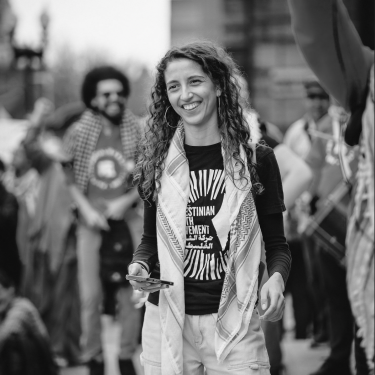
Lea is an organizer with the Palestinian Youth Movement and a former student organizer with the Harvard Law Students for Justice in Palestine. She also works as a public defender.