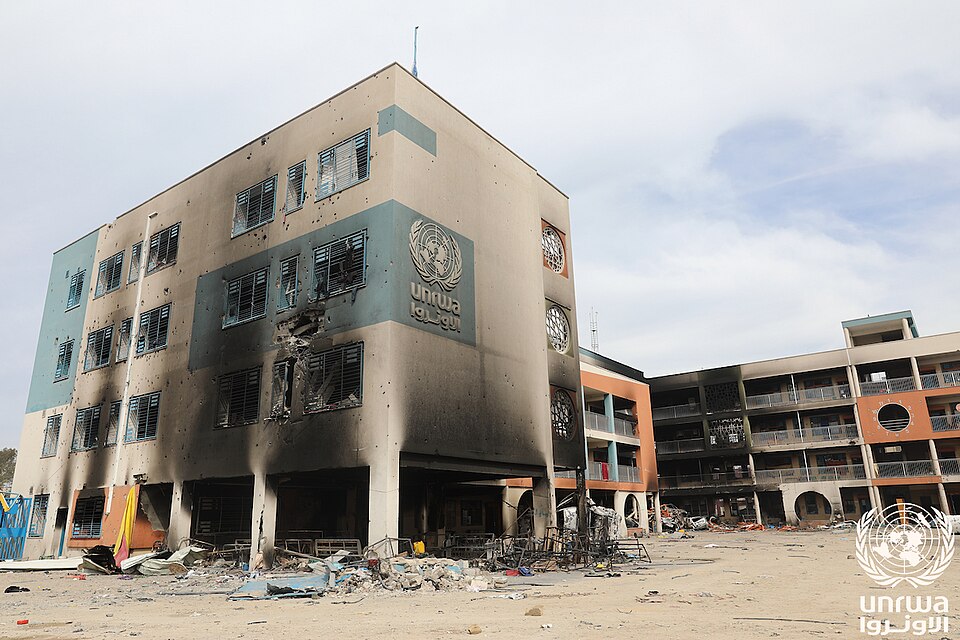

On 22 October 2025, the International Court of Justice (ICJ) published the long-awaited Advisory Opinion on the Obligations of Israel in relation to the Presence and Activities of the United Nations, Other International Organizations and Third States in and in relation to the Occupied Palestinian Territory (hereinafter ‘the AO’). The United Nations General Assembly (UNGA) requested the Opinion to ‘ensure the necessary conditions’ for humanitarian operations in Gaza (A/79/PV.54, p. 45-46) and, more specifically, to protect the United Nations Relief and Works Agency for Palestine Refugees (UNRWA).
Notwithstanding the nearly unanimous final decisions, is the AO truly a victory for the protection of UNRWA? This blog post argues that the AO does not fully address key legal controversies, including Israel’s withdrawal from the Comay-Michelmore Agreement and the alleged abuse of UNRWA’s privileges and immunities. Apart from the legal perspectives, the post will further discuss whether an ICJ Advisory Opinion is actually the appropriate measure to ‘protect’ UNRWA.
The Unilateral Withdrawal of Consent
The consent of the Host State is a prerequisite for the operations of UNGA’s subsidiary organs, as confirmed by UNRWA’s own opinion (UNJYb 1968 p. 183). Surprisingly, the AO does not address the effect of Israel’s unilateral termination of the 1967 Comay-Michelmore Agreement, where Israel pledged to facilitate UNRWA’s operations by ensuring its security, movement, and logistical support (UNJYb 1968 pp. 47-48). Instead, the AO confirms that Israel cannot withdraw the consent, as Israel lacks sovereignty over the Occupied Palestinian Territories (OPT) (AO para 184). The AO thus regrettably fails to address the legal consequences of Israel’s withdrawal of consent to UNRWA’s presence in Israeli territory, even though the entry of humanitarian aid and UNRWA staff into Gaza inevitably pass through the territory of Israel and rely heavily upon the border control measures of Israeli authorities (2023 UNRWA Report, paras. 70-71, 79-80).
In the author’s view, the unilateral termination of the Comay-Michelmore Agreement is incompatible with treaty law. While the text stipulates that the Agreement should ‘remain in force until replaced or cancelled’, it confers no explicit ‘right to’ denounce (A/CN.4/156, p. 64). Consequently, it constitutes a treaty containing no provision for ‘denunciation or withdrawal’ under Article 56(1)(b) of the Vienna Convention on the Law of Treaties. As noted by Judge Sebutinde, if the provisional nature of the Comay-Michelmore Agreement was ‘apparent from the terms’, (A/CN.4/156, p. 69), Article 56(1)(b) would indeed permit Israel to denunciate the treaty. Such a right, given ‘ample time to make necessary arrangements’, would allow Israel to terminate UNRWA operations within its territory (Sebutinde, para. 49-50; Israel, para. 50). However, such a provisional character was not apparent in practices concerning the Comay-Michelmore Agreement. While the agreement was initially a temporary effort to settle the feeding programme after the 1967 Six-Day War and may have constituted a treaty merely for the purpose of establishing a modus vivendi (1967 UNRWA Report, para. 46), it turned out to be quite durable (Christakis and Merkouris, paras. 61-62). Given the frequent invocations by the parties to voice support for humanitarian missions or to settle compensation disputes long after 1967, the Comay-Michelmore Agreement transcended its original character as a mere description of modus vivendi. It would therefore be untenable to maintain that the agreement, which has served as a major pillar supporting UNRWA’s mandate in Israeli territory and OPT for over five decades, remains provisional and revocable.
Nor does the prerequisite of consent offer Israel the sovereign right to terminate UN operations in its territories. Indeed, an international organisation’s power of decision is ‘no more absolute’ than the sovereign power of a Host State (Agreement between WHO and Egypt, para. 37). This approach is echoed in the AO, which states that ‘within the territory of Israel, the presence and activities of the United Nations and its entities are subject to the consent of Israel’ (AO para. 184). However, the phrase ‘no more absolute’ indicates that neither of the parties shall enjoy an unconditional power to withdraw, and the operation of an international organisation in the territory of the Host State must reflect a ‘common action based on mutual consent’ (Agreement between WHO and Egypt, para. 43). As UNRWA has previously stated, the obligation of a Member State of the UN may supersede its consent; while the Host State may ‘refuse its consent’, the UNGA is similarly empowered to authorise ‘the Agency to take certain measures… unilaterally’ while attaining cooperation from the Host State becomes impossible (1967 UNRWA Report, para. 16). Consequently, the consent of a Member State only entails a right to request, rather than the power to decide, the termination of a UN mission within its territories (AO para. 178), and Israel remains bound by the Comay-Michelmore agreement.
Moreover, even if Israel has the right to unilaterally terminate the Comay-Michelmore Agreement, it does not extinguish the privileges and immunities enjoyed by UNRWA. UN practices reaffirmed that agreements with Host States and the Convention on the Privileges and Immunities of the United Nations (hereinafter ‘General Convention’) are to be treated as ‘complementary’ treaties; the local organs are entitled to the privileges and immunities of UN regardless of whether Host States have concluded an agreement recognising the applicability of General Convention (1985 Practices Report, paras. 1-4).
The Alleged Abuses of Privileges and Immunities of UNRWA
Another defence raised by Israel is the accusation that UNRWA abused its privileges by shielding armed personnel. The Written Statement of Israel devoted nearly half its length to the allegation that ‘UNRWA could no longer be trusted to fulfil its humanitarian objectives’ (Israel, para. 49). This ground indicates an alternative interpretation to Section 21 of the General Convention stipulating the obligation of the UN to cooperate with the Host State and to avoid the abuse of privileges and immunities by its personnel. From Israel’s perspective, such obligations, in reciprocity, confer on the Host State the power to revoke these privileges and immunities, analogous to the circumstances under Article 9 of the Vienna Convention on Diplomatic Relations.
The AO fails to fully rebut the exception invoked by Israel. The AO relies on the procedural obstacles in Section 21 of the General Convention. By reaffirming the requirement that allegations from the Host State must be confirmed through internal administrative investigations, the AO circumvents the substantive issue of whether a right of unilateral revocation exists at all (AO paras. 213-215). Furthermore, unlike previous advisory proceedings where facts concerning alleged abuses by UN personnel were examined (Immunity of Special Rapporteur, paras. 47-56), the AO offers no clarification regarding UNRWA’s relationship with Palestinian armed groups or other alleged violations of neutrality.
In the author’s view, a substantive refutation of the alleged exception should be based on a teleological interpretation of Section 21. Privileges and immunities were conferred in the interest of the UN as a whole, not only for the agent or individual Member States. Therefore, to ensure the independent performance of these missions free from interference, the UN provides ‘adequate protection’ to its personnel, including the privileges and immunities under the General Convention (Reparation of Injuries, p. 183; Immunity of Special Rapporteur, paras. 51-52). The protection thus excludes the issue of immunities from domestic jurisdiction (Secretary-General, para. 4), so that it could prevent a Host State from unilaterally deciding upon the existence of abuses or reacting to allegations of abuses. Consequently, UN personnel carrying out their mandates are not analogous to the diplomatic representatives serving the interests of their own State, and the prevention of abuse of privileges and immunities is secured through ‘administrative means’ within the UN (1967 Practices Report, para. 338).
The practices of the UN have repeatedly denied that the Host State can declare UN staff as persona non grata despite alleged abuses of privileges and immunities. Early practice involved the UN military observers, where the Office of Legal Affairs rejected the applicability of persona non grata even in circumstances of alleged abuses (1964 UNJYb pp. 261-62). Similarly, when WHO staff in the Philippines were accused of abuse of privileges and were issued a search warrant, the Philippine Supreme Court revoked the warrant, ruling that the Department of Foreign Affairs, not domestic courts, is the appropriate organ to take actions (1985 Practices Report, para. 232). Likewise, in a case concerning unlawful searches of the residence of an ILO expert in Ecuador, ILO maintained that the organisation’s property and experts’ premises remain inviolable despite alleged abuses (1985 Practices Report, para. 231). Ethiopia’s unilateral expulsion of UN officials in 2021, invoked as a practice supporting a power to withdraw consent when UN experts ‘meddle in internal affairs’ (Sebutinde, para. 60), was subsequently characterised as a ‘violation of international law’ in UNSC meetings. Even in cases where Host States may annul privileges and immunities due to their abuses, as exemplified in agreements with the United States and France, this power derives from those special agreements, not the General Convention. Overall, these practices reinforce that the common interest in upholding UN privileges and immunities overrides the sovereign power, unless explicitly recognised by special agreements.
Finally, even if the Host State can unilaterally deny abused privileges and immunities, this power does not allow Israel to prohibit all UNRWA activities. The deprivation of privileges and immunities, as established in these state practices, is limited to individual staff involved in the abuse. None of these practices, including those under special agreements, authorise the Host State to expel the UN organ as a whole simply due to abuses by several individuals. Therefore, even if Israel were to deprive the individual UNRWA staff accused of supporting armed activities of their privileges and immunities, such deprivation cannot be extended to UNRWA in its entirety.
Overall, neither the interpretation of ICJ decisions nor subsequent practices support the Israeli position on this exception. Still, the AO is not inclusive enough to refute the unbased allegations regarding UNRWA’s abuse of privileges.
Can an ICJ Advisory Opinion Really Protect UNRWA?
The insufficient responses raise the further question of whether seeking an advisory opinion to ‘protect UNRWA’ is the appropriate course of action. While the ICJ has historically reshaped political realities in the North Sea Continental Shelf or Namibia, its efficacy became rather limited in Tehran Hostages and Preah Vihear, where parties refused the international legal framework altogether (Giladi and Shany, 114-15). Context, therefore, remains the primary determinant of judicial impact. In this case, the ICJ’s legal authority is overshadowed by a distinct political landscape governed by the rhetorics of ‘survival’ and ‘revenge’, which displaces the discourse of legal obligations. Consequently, the AO cannot substitute for the failure of the political organs of the UN, and a purely legalistic approach fails to address the true political causes behind the legal reality (Tladi, para. 13).
Therefore, an Advisory Opinion may not be the optimal strategy to protect UNRWA. The AO issues isolated and prescriptive directives demanding Israel to take certain actions. In this way, Israel’s conduct in the OPT became nothing but a mere violation of certain legal provisions. Omitted from this legalistic process was the factual background of Israel’s policies and practices in the OPT: the legislation against and defamation towards UNRWA are not isolated breaches of this or that legal norm, but a component of its policies to weaponise humanitarian aid and annex Gaza. Through these fragmented and prescriptive directives, the AO overlooks the coercive environment and expansionist policies underlying Israeli actions towards the humanitarian agencies in the OPT.
Conclusion
Based on the foregoing analysis, the AO insufficiently elaborates on Israel’s obligations. Legally, it failed to adequately address the issues of unilateral withdrawal from the Comay-Michelmore Agreement or successfully refute all Israeli contentions regarding the abuse of privileges. Politically, the AO has neither ‘protected’ nor possessed the capacity to ‘protect’ UNRWA. Anyhow, the AO likely represents the greatest extent of compromise achievable within the ICJ, as the abundance of separate opinions and declarations reveals more divergence than consensus. As put by Philippe Lazzarini, Commissioner-General of UNRWA:
UNRWA was always intended to be a temporary agency. Its continued existence reflects long-term failures to reach a political solution (2024 UNRWA Report, p. 5).

Wang Sijie is a LLM student at the London School of Economics specialising in public international law.