Who Gets to Protest, and Who Gets to Live
The Instrumentalisation of People’s Struggle in Iran and the Hollowing Out of International Law
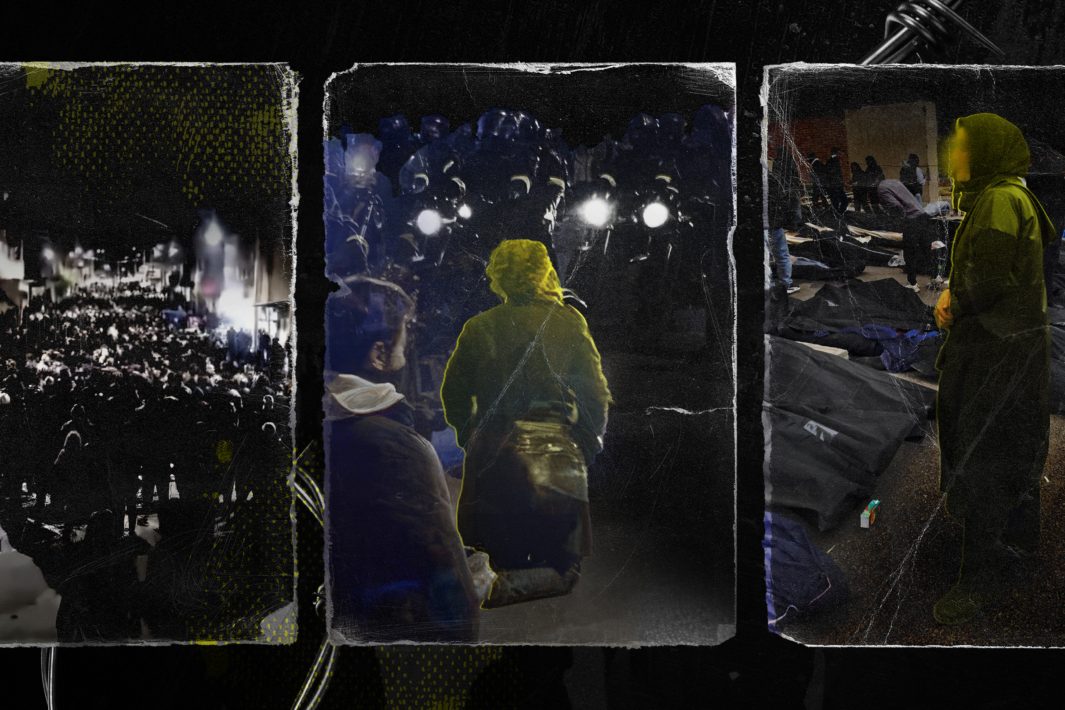
Mass protests in Iran are not isolated eruptions but recurring political events in a cycle of repression and resistance. Domestically, these protests have been met with escalating state violence, whereas internationally, they have been subjected to polarized ideological framings that often marginalize the protesters’ voices. This post argues that these framings also operate within international legal discourse, and are reproduced by both orthodox as well as critical strands of scholarship. As a result, they sideline individuals as rights-holders. In doing so, they not only hollow out the already fragile accountability mechanisms under international law, but also foreclose the emergence of new possibilities to respond meaningfully to mass atrocities. Drawing on the case of Iran, this post calls for a more reflective critical international legal scholarship that moves beyond entrenched binaries and recentres individuals’ rights to protection and their call for accountability. The post was written prior to the outbreak of the current war on 28 February 2026, which has once again laid bare the progressive weakening of the international legal order.
Escalating Dissent, Entrenched Repression
Over the past two decades, Iran has experienced recurring waves of mass protests that each began with a different immediate trigger: the contested election in 2009, the worsening economic situation in 2017–2018, a sudden increase in gas prices in 2019, the death of Mahsa Jina Amini in police custody and the “Woman, Life, Freedom” movement in 2022, and the collapse of national currency in the 2025–2026 uprising. Despite their differing starting points, these protests increasingly converged around calls for an end to an oppressive regime characterized by systematic human rights violations.
In response, the Iranian authorities have consistently employed severe repression, including nationwide internet shutdowns under the guise of emergency derogation, mass arrests, harsh sentences – including executions – and the use of lethal force against protesters. These measures led the United Nations Human Rights Council (UN HRC) to establish the Independent International Fact-Finding Mission on the Islamic Republic of Iran (FFM Iran), which subsequently investigated the State’s response in the context of the 2022 protests and concluded that many violations amount to Crimes against Humanity. The government’s response to the latest uprising (2025-2026) has been exceptionally severe and widespread, featuring the longest and most restrictive internet shutdown to date, which has obscured the true scale of killings and detentions. The reports of lethal force and mass arrests prompted an emergency meeting by the UN Security Council and, amid growing international concern over serious human rights violations, led the UN HRC to convene an emergency session on 23 January 2026.
The Instrumentalisation of Protest in Geopolitical Discourse
While the protests revealed a consistent pattern of domestic resistance and state violence, they also exposed fractures in the international community. Iran’s geopolitical positioning has increasingly polarized international responses to protest movements and state violence. This polarization was particularly evident during the 2022 “Women, Life, Freedom” movement, when many states’ responses reflected geopolitical agendas rather than the protesters’ demands. These international responses tended to follow one of two paths: They either portrayed Iranian women as victims in need of rescue, deploying women’s rights rhetoric to justify external, and at times explicitly imperialist approaches. Or they aligned with the Islamic Republic’s narrative, at best through silence and inaction, or at worst with implicit justification of repression, framing hijab and women’s rights as issues of cultural relativity, rather than human rights. These competing narratives crystallized during the negotiations establishing the FFM Iran in November 2022. While many member states, such as Germany and Iceland, who requested the HRC Special Session, supported it as a mechanism for accountability, others depicted it as an exercise of colonial power against state sovereignty and “internal affairs”. They abstained from or opposed the resolution invoking geopolitical grievances that obscured the underlying human rights violations.
This polarized confrontation and dispute of narratives has intensified during the current wave of mass protests and the violent crackdown that followed. Recent geopolitical developments, including the genocide in Gaza, the 12-day war between Israel and Iran in June 2025, the reimposition of UN sanctions against Iran in September 2025, and the renewed “maximum pressure” policy of the current US administration against Iran regarding its nuclear program, have further exacerbated this discursive fragmentation at the international level. This has deepened the clash between the dominant and hegemonic powers versus the geopolitical challengers (more here).
Within this context, the narratives around the protests are camped under two dominant voices: on one side, the US and Israel are using this occasion – again and more amplified – to push for military intervention for their own geopolitical interests, including weakening the Islamic Republic’s military and nuclear capacity as well as containing its regional power. On the other hand, states more critical of international powers and their hegemony question the validity of the protests, portray them as externally orchestrated efforts by foreign actors who seek to undermine Iran’s sovereignty, or blame the international sanctions, specifically the ones imposed by the US, as the sole cause for the economic grievances, and the main driver of the protests.
International Law and Its Critiques: Different Paths, Same Binaries
Although such polarized debates over repression and human rights violations are particularly pronounced in the case of Iran, they are hardly unfamiliar to international law. Similar conflicting narratives and competing approaches have long developed within the discipline, shaping both the discourse within and practice of international law institutions. Critical traditions such as Third World Approaches to International Law (TWAIL) have long argued that international law is not a neutral framework but a system shaped by colonial legacies, power asymmetries, and selective universalisms (e.g., Kapur 2013; Anghie 2012; Mutua 2002). On this account, international law does not merely reflect global hierarchies but also legitimizes political, economic, and military domination under the language of legality or humanitarianism.
These dynamics are visible in the legal and political narratives accompanying interventions in Afghanistan, Iraq, and Libya, as defining examples of contemporary international intervention. In each instance, appeals to human rights or humanitarian necessity were invoked to justify the use of force, whether pursuant to Security Council authorization, as in Libya, or absent such authorization, as in Iraq. Critics of these interventions have underscored the extent to which political interests informed their justification and implementation. They point to severe civilian harm and prolonged instability as evidence of the disjunction that exists between the stated objectives of promoting peace and human rights and the actual outcomes of interventions.
While such critiques rightly expose structural inequalities in international law and the ways hegemonic powers instrumentalize legal mechanisms, they can also sideline individuals living under forms of oppression that do not fall under the contested imperial or colonial projects. Much critical international legal scholarship remains framed by enduring binaries – “West versus Third World”, universalism versus cultural relativism, sovereignty versus coercion. Madhok, for instance, in her analysis on the origins of human rights, shows how India invoked the claim of human rights as “Western discourse” to justify some violations of women’s rights in the name of cultural difference. It illustrates that such blind spots are not incidental; rather, they have been present from the outset, as anti-imperial critiques were mobilised to deflect scrutiny of domestic repression.
Such exclusive focus on international law as a tool of geopolitical power can obscure the substantive violations of rights at stake, especially when the alleged perpetrating state is assumed to be in opposition to dominant global powers. Appeals to state sovereignty – frequently advanced as a corrective to imperial interventionism – can deflect attention from the international community’s responsibility to ensure accountability for international crimes and to protect those facing systematic violence (based on UN accountability mandates, universal jurisdiction and the Responsibility to Protect). In this sense, some critiques risk reproducing the very same selectivity (on whose rights to defend and which violations of rights to condone) they contest, assigning reductive moral roles that determine who is deemed a legitimate subject of protection and accountability, often obscuring gendered, localized, and non-imperial forms of harm.
In the context of post-revolutionary Iran, Mokhtari shows that critiques of Western-dominated human rights politics can be reappropriated in ways that reinforce authoritarian power. She draws on Mutua’s arguments in Savages, Victims, and Saviors that mainstream human rights discourse often portrays non-Western societies as “savages”, oppressed populations as passive “victims” and Western actors as heroic “saviors”. Mokhtari argues that when this critique is combined with states’ anti-imperialist rhetoric and uncritical forms of solidarity with the anti-imperial regime, it can generate “Reverse Savages, Victims, Saviors” through reactionary politics. In this reversed configuration, the state recasts itself as the victim of imperialism, while portraying human rights discourse as the real “savage,” and anti-imperialist actors as “saviors”. This reversal draws attention away from domestic repression, transforming a critique originally aimed at exposing the selective universalism and colonial legacies of international law into a resource for state legitimation. In practice, interventionist states instrumentalize accountability mechanisms to legitimize their externalist agendas, while the opposing actors invoke sovereignty to reject engagement with them altogether.
This limitation becomes even more evident in narratives that attribute popular unrest primarily to international sanctions, focusing on global power asymmetries rather than the repression of protesters. Although sanctions have exacerbated economic hardship, framing them as the principal driver of protest obscures the fact that these movements are fundamentally directed against the regime’s authoritarian governance, corruption, and systematic human rights violations, including one of the world’s highest rates of executions. During the UN HRC Special Session on Iran in January 2026, several member states (Iraq, Ethiopia, Pakistan among others) used sanctions, or invoked the principle of sovereignty, alleged selectivity, and double standards by institutions such as the UN HRC itself to deflect scrutiny from state repression and recast the protests as an internal matter.
People Lost in Binaries: The Strain on International Law
These binary analytical frameworks limit responses to human rights violations by reducing debates to geopolitical alignments. They sideline institutional accountability and allow interventionist narratives aligned with dominant powers to appear as the only viable options, selectively invoking human rights only when they coincide with strategic interests. As protection mechanisms become sites of geopolitical contestation, their legitimacy and normative authority erode, in turn weakening principled engagement with international human rights law. This leads those seeking protection to view foreign, or even military intervention, as the only remaining option despite its political motivations. To move beyond the entrenched binary frameworks shaping mainstream debates in international law, as Madhok suggests, a methodological rethinking of human rights scholarship is needed. Without denying global power hierarchies, this approach seeks to shift the focus toward individuals whose claims cannot be captured within geopolitical opposition, preventing them from being rendered invisible within international legal discourse.
Binary analytical frameworks within international law operate alongside and amplify the deeper structural feature of state-centrism. States continue to be the primary subject of international law, and the enforcement of international norms remains in the realm of intergovernmental institutions, rendering the architecture of accountability still largely dependent on states’ political will (e.g., Mamdani 2010; Phillips 2015; Rajagopal 2009). This structure often constrains accountability for mass abuses occurring within states, particularly when enforcement mechanisms under Chapter VII of the UN Charter are subject to geopolitical calculation and the veto power of the permanent members of the Security Council. They are mainly a reflection of strategic alignment rather than consistent imperatives for the protection of the population.
The aforementioned challenges raise fundamental questions about the capacity of international law to recognize people as right-holders beyond states’ interests, particularly in a moment marked, even by certain actors close to hegemony, by a fading rule-based international order. What concrete pathways exist for those mobilizing for freedom under systemic repression – pathways that neither recode protest as an invitation to military intervention nor securitize dissent as terrorism or foreign manipulation? How can international law and its critiques avoid abandoning such movements? A meaningful response requires a critical perspective that interrogates global power asymmetries without allowing them to eclipse claims to accountability. This approach seeks to recalibrate these demands by identifying both the structural constraints of state-centrism and the openings that remain within existing legal frameworks. Acknowledging these structural limitations allows international legal institutions to develop more consistent, protection-oriented, and less asymmetrical forms of accountability in an increasingly fractured global order.

Shiva Sharifzad is a Gender Analyst at the UN and International Organisations. She has obtained her Master’s in Advanced Studies Degree in Transitional Justice, Human Rights and Rule of Law from Graduate Institute in Geneva. She also holds an LL.M in Human Rights from Shahid Beheshti University, Iran.
Shima Esmailian (she/her) is a PhD Candidate at the Faculty of Law of the University of Geneva and a Teaching Assistant at the Geneva Academy of International Humanitarian Law and Human Rights. She also consults with civil society organizations on gender and transitional justice issues. Shima holds a MAS in Transitional Justice, Human Rights, and the Rule of Law from the Geneva Academy, a Bachelor of Law, and an LLM in Human Rights from Shahid Beheshti University in Iran.