Theories in Practice
Rethinking How to Think about International Organizations
In Book VIII, Chapter 10 of Physics, Aristotle offered a detailed explanation of projectile motion. He theorised that throwing a stone involved different types of forces, and upon the exhaustion of the original violent force of throw, the stone would simply end its horizontal motion and drop dead to the ground. Its trajectory would look like a straight triangle. It is unlikely, however, that Aristotle ever actually attempted to throw a stone, as his mere observation would have shown that while his theory worked in theory, it did not work in practice. What does one do, then, upon realising that something might work in theory but not in practice?
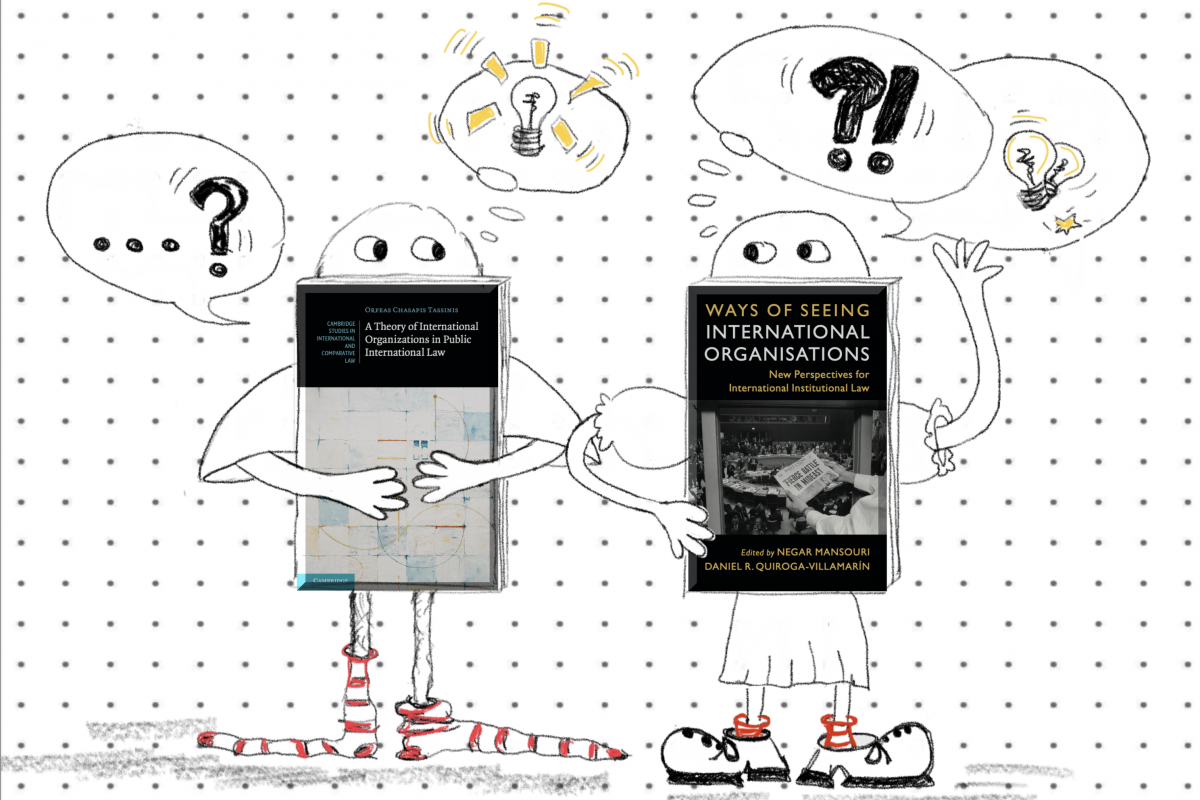
Indeed, both Ways of Seeing International Organisations and A Theory of International Organizations in Public International Law have a similar issue to the Physics. While they are often in binary contradiction, this is one way in which both books strike a similar chord: they are far too interested in showing their own theoretical advantages, and far too little in the relationship between such theory and practice. While the former is explicitly uninterested in a theory that can affect practice, the latter is uninterested on whether practice will be affected by new theories.
And yet extremely different they remain, not least because one of them is an edited volume and the other is a doctoral monograph. As such, I want to put these works in conversation around the role of theory and its relationship with practice, rather than their radically different approaches to international organizations law.
What Does Theory Have to Do with It?
Both books seem to agree on the departure point: that IO scholarship is in some sort of theoretical crisis (Quiroga-Villamarín and Mansouri call it ‘a state of theoretical complacency’, p. 5, Chasapis-Tassinis considers there’s a lack of ‘firm theoretical grounding’, p. 2), and thus the way forward involves more and better theorisation.
The goal of theorisation, however, remains elusive. The editors of Ways of Seeing have a bone to pick with what they call ‘problem-solving thinking’ (pp. 7-9) or even the quest to find “‘solutions’ to global challenges’ (p. 10). The best chapters in the book, however, reject this invitation with subtlety. B.S. Chimni, for example, pitches ideas to make institutional critique stronger (p. 20), even with specific and well-known suggestions like Security Council reform (p. 26). Dimitri Van Den Meerssche echoes his well-developed sociological approach to IO’s, suggesting that ‘critical interventions should focus not only on the biases of solitary “people with projects” but also on how the professional postures and routines […] are shaped by shared criteria of competence’ (p. 241). For his part, Jan Klabbers proposes a ‘supra-functionalist’ account (p. 38).
This robust normative commitment is not shared in every chapter of the book. There are, indeed, many chapters that answer the call to remain disengaged with practical problems of global governance. Annabelle Littoz-Monnet makes a familiar call for attention to the role of expertise in governance, Richard Clements does a similar move for the specific case of ICC reform, and Juanita Uribe recasts nutrition programs of the WHO and FAO as ‘hidden governance’. And yet, is it really plausible that the authors are neutral about whether governance is indeed more expertly steered, whether the ICC can successfully bring people to justice, or whether children are adequately fed? Is the mere change of vocabulary or, in the editor’s terms, a new way of seeing IO governance, sufficient incentive for theory?
Indeed, for a book entitled Ways of Seeing International Organisations, there are remarkably few different perspectives. It is safe to say that most of the authors in the book are heavily influenced by Bruno Latour, who appears in every single chapter despite Klabbers’ warning to limit the amount of energy devoted to this very enterprise (p. 55). Intentionally or not, once compiled, the book works more of a symposium on Science and Technology Studies than as a collection of heterodox approaches to international organisations.
Conversely, A Theory of International Organizations seems to be largely uninterested in the social role of legal rules. It is set up precisely in the same way as the Physics: as an attempt to know a concept, much like Aristotle wanted to know reality (p. 21). Naturally, this is anchored in a scientist understanding of law: Chasapis-Tassinis uses Hans Kelsen’s definition of what a theory is, seemingly uncontroversially, to explain how theorising is itself a practical given. That it is ‘born out of the actual need for an ever more accurate conceptual map to help fill gaps in our understanding and guise us forward when new questions arise’ (p. 21). It is an invitation to a heaven of legal ideas where one can meet ‘many concepts of jurisprudence in their absolute purity, freed from all entangling alliances with human life’.
In this way, Chasapis-Tassinis sets out to correct the theoretical mistakes in the different ways international organizations are conceived in legal literature. In a preliminary discussion of what an organization can be, he makes reference to a treaty/subject dichotomy where the organization is either (merely) a set of rules laid down by contracting states or a full subject in its own right. The former flies in the face of day-to-day organisational practice, while the latter would presume a legal personality that exists beyond the will of the contracting states. Following earlier and similar theory, Chasapis-Tassinis dismisses the latter because it would require the existence of a ‘rule of incorporation’, that is, a permissive rule of general international law that allows for organizations to enter the legal community in their own right.
But Chasapis-Tassinis is not content, like his predecessors, with assuming the existence of this rule in order to have a better rationalisation of institutional life. The fact that he cannot identify the relevant state practice and opinio juris is unsurmountable, even if it is ‘normatively appealing’ (pp. 59-60, 85). Instead, his own theorisation leads him to conclude that the best conception of international organisations is one that recasts the international community entirely. In his words, that ‘the correct analysis should be that there is a spectrum of ‘public’ entities in international law, and that states, confederations, international organizations, as well as any other entity that exists on that spectrum, are part of the same family tree of legal persons’ (p. 185). We could well ask whether this rationalisation has a higher cash value than simply assuming a rule of incorporation but, to be fair, Chasapis-Tassinis has told us from the beginning that his understanding of legal theory finds value not in practice but on ‘the degree of analytical insight it can provide into the juridical and societal relationships that it seeks to capture and not on its moral desirability per se’ (p. 33).
And so, in their own ways, both books offer their attempt at bridging the theoretical dearth of their field. And while they take radically different routes, this is in itself a testament of the many ways theory can operate. Whether it is better to do it through principled stance against pragmatism, or by exclusive reference to legal concepts, will be the decided by the field itself.
Ships Passing in the Night
Independently from any judgment on their jurisprudential merit, both works make an honest attempt with their discipline. The dedication to philosophy is strong. Having this meta-similarity, it makes their lack of mutual conversation even more stark. Ways of Seeing is largely uninterested with what Chasapis-Tassinis has to say; and A Theory of International Organizations banishes any critical sociology from its domain (Latour or Bourdieu, the two intellectual lodestars of Ways of Seeing are not referenced once). Having poured intense energy into theorising organisations, both books run the risk of passing each other as ships in the night.
Chasapis-Tassinis sees his as a definitive ‘analytical’ work (the word ‘analytic’ and its variants, particularly as an adverb, appears on average once every two pages). Whether IOs are bound by general international law is a question without ‘analytical closure’ (p. 3), contemporary scholarship is all similar when thinking ‘analytically’ about states and IOs (p. 17); and the analogy between states and IOs requires an ‘analytical’ redefinition of international law (p. 228). For their part, the editors of Ways of Seeing see their work as having a ‘destabilizing ethos’ (p. 12), and privilege ‘thinking’ about IOs instead of ‘doing’ IOs (p. 4).
A meaningful first step toward a two-way dialogue would require the authors to clarify what they mean by these terms. If the editors of Ways of Seeing draw a line between thinking and doing, it remains unclear how they conceive the relationship between the two. Likewise, when Chasapis-Tassinis calls for ‘analysis’, some clarification would be helpful, since the volume contains little, if any, logical analysis of language in the sense familiar to the analytical tradition in philosophy and jurisprudence. This difficulty is reinforced by the Wittgensteinian call to ‘do away with all explanation’ in the introduction to Ways of Seeing: an approach closely associated with meta-analysis in the analytical tradition, yet one that bears little relation to the substance or style of the contributions that follow. In the same vein and perhaps underscoring the lack of conversation between the two works, A Theory of International Organizations exemplifies an approach that privileges ‘thinking’ about international organizations over ‘doing’ them, precisely as the editors of Ways of Seeing would prefer it.
A great place for these ships to dock would be in a world where they are both uncomfortable: the port of pragmatism. This is not to say that all the different authors ought to abandon their own philosophical temperaments, but rather add an argumentative burden: how would things be different to flesh-and-blood human beings if one was to take their approach seriously? In other words, what is the difference in practice that demands further theoretical insight?
Are We All Really Talking about Different Things?
At this point, it is worth reconsidering whether these two works truly inhabit such distant scholarly neighbourhoods as their authors seem to imply. Both are, after all, books about international organisations in international law. Their differences in tone, style and ambition may obscure the fact that they share a core preoccupation with how IOs should be understood, evaluated and situated within legal thought. When read together, it becomes harder to maintain that they address fundamentally separate questions. Instead, they appear as two distinct attempts to tackle the same object from different angles: one through a sociological and critical reorientation of how IOs are seen, the other through a conceptual reconstruction of how IOs are legally conceived. The apparent distance between them may thus say less about the substance of their accounts than about the disciplinary habits that keep such conversations apart.
A related point concerns how each book pre-casts the boundaries of international law itself. They diverge not only in style but also in their sense of what counts as a relevant source or form of reasoning. One treats international law as a field enriched by materials, practices and insights that sit partly outside the discipline, especially those drawn from sociology, anthropology and science and technology studies. And while Chasapis-Tassinis has no problem borrowing form the philosophy of mind and language (in particular through the work of John Searle), the priority remains in maintaining systemic coherence. These choices of emphasis shape not only their arguments but also their capacity to speak to one another. It may be that their divergence on the meaning of international law, rather than their views on IOs, is what keeps them apart.
In the end, both Ways of Seeing International Organisations and A Theory of International Organizations in Public International Law circle around the same gravitational centre: a shared dissatisfaction with the state of thinking about international organisations. Yet, they do so from opposite poles. The first insists that theory must unmoor itself from problem-solving and embrace a more reflexive, sociological, even aesthetic posture. The second doubles down on the analytic purity of law, conceiving theory as a precise instrument of conceptual clarification rather than a critique of governance. Neither is naïve about the limits of their enterprise, but both are perhaps too comfortable within them. Their apparent opposition, between critical sociological imagination and Kelsenian conceptualism, reveals less about the actual divisions of the field than about its entrenched habits of separation.
What unites these books, more than their authors might admit, is a concern with what theory is for. Both are motivated by an anxiety that international organisation law risks becoming a purely administrative or managerial field: one devoid of intellectual depth or self-awareness. Yet neither quite bridges the distance between theory and practice that animates their critique. In this sense, they reproduce the Aristotelian paradox with which this discussion began: an elegant explanation that falters when confronted with the motion of the world.
Perhaps this is the lasting lesson of reading them together. The field’s future will not depend on choosing between analytical rigour and critical reflexivity, but on learning how to let them speak to each other. Theory, to be useful, need not always be practical; but to be meaningful, it must reflect on its relationship to praxis. Both books remind us, in their own style, that thinking about international organisations still requires rethinking how we think altogether.

Sebastian Machado Ramírez is Postdoctoral Researcher at the University of Helsinki, where he works on the PRIVIGO project examining private governance and international law. He holds a PhD from the University of Melbourne, where his dissertation analyzed interpretive approaches in the law governing the use of force.