The Xinjiang Cotton Conundrum
When Human Rights Sanctions Meet WTO Free Trade Rules
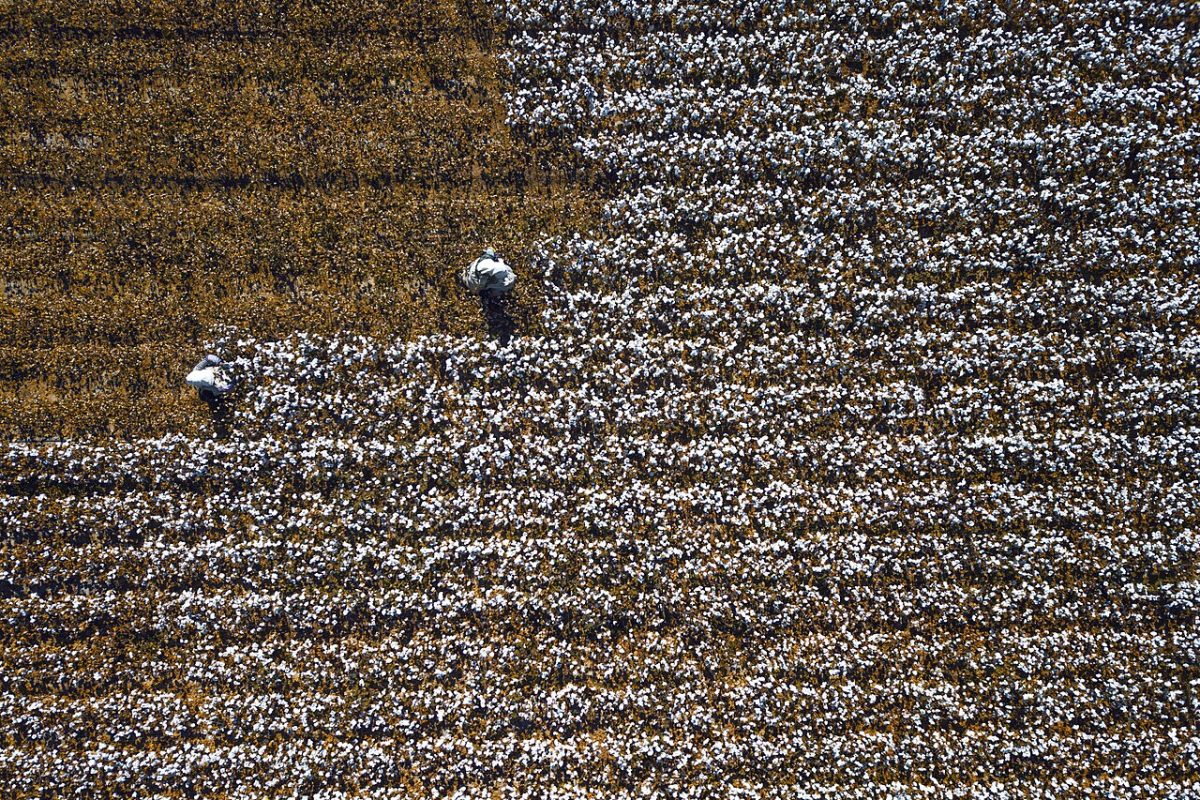
The t-shirt you have on now? It might have begun its journey in Xinjiang, China, an area embroiled in geopolitical and legal controversy. Over the years, there have been countless reports from governments and human rights organisations about the Uyghur forced labour regime in the region and its production of over 20% of the world’s cotton. Now, countries are taking action beyond mere criticism. The United States, with its Uyghur Forced Labour Prevention Act (UFLPA), and the European Union, which has similar regulations under development, are effectively prohibiting imports associated with that region.
These steps are praised as the right thing to do. However, in doing so, they set these major trading partners on a path of direct conflict with the core values of the World Trade Organisation (WTO). The matter, however, goes beyond cotton; it is to determine if a 75-year trade rulebook can incorporate new trade demands around human rights for the 21st century.
How the Laws Work
With the UFLPA going into effect in 2022, this regulation stands out because of its severity and its focus on a specific region. It determines a so-called “rebuttable presumption” for any good stemming from the Xinjiang region. Therefore, all products connected with the aforementioned region are recalled to have been manufactured under forced labour schemes and, for this reason, should not be allowed by any means to be imported into the United States.
This is an extraordinarily effective legal measure. It changes the narrative entirely. Under previous regulations, the government was required to demonstrate that forced labour was used, but now the importer is responsible for disproving it. Importers must show “clear and convincing evidence” that their supply chain is untarnished, which is exceedingly complex to achieve due to the lack of transparency of supply chains in that region. In terms of proof within world supply chains, these developments are worthy of particular note because of how they are described and in the absence of any first-hand source documentation. Importers are given the ‘world’s hardest puzzle’, attempting to establish the unprovable. The regulation seeks to eradicate the practice of forced labour in its entirety. It creates a rebuttable presumption that all goods produced or manufactured, whether wholly or partially, in the Xinjiang region of China are prima facie presumed to involve forced labour, unless importers furnish clear and convincing evidence to the contrary. The approach used here is of a deliberate total embargo, since the reduced access and widespread state of forced labour in the area make it difficult for many importers to supply the required proof, which often exceeds their capacity.
This confirms that the EU is pushing through its own set of restrictions related to products made from forced labour, which points to a wider consensus across the Atlantic.
A Breach of Core Principles?
These import bans would seem to violate the laws set forth by the WTO. The most important part of the General Agreement on Tariffs and Trade (GATT), which is the WTO’s rulebook for goods, is Article XI, which is the only part that explicitly prohibits “prohibitions or restrictions other than duties, taxes or other charges” on imports.
A state cannot just decide to disallow products from another WTO country. While a state can impose tariffs or other taxes on another country, it is not permissible to simply say, “No, that product cannot be sold here.” The EU’s proposed ban and the UFLPA is, in essence, just that: a quantitative restriction equal to zero.
Assuming that China is willing to bring these bans to the WTO, the claim against the EU or U.S. would look exceedingly simple. However, the matter is more intricate than that. Other than a straightforward Article XI claim, China’s WTO challenge will likely be based on multiple aspects. Legal commentators anticipate arguments that would extend to the General Agreement on Trade in Services (GATS). The UFLPA’s strict due diligence requirements resulting from bounding maintenance habits significantly constrain logistics, insurance, and financial services attached to a specific supply chain. In addition, China might argue that the prohibition contravenes the national treatment principle, de facto discriminating against all undifferentiated Chinese goods under GATT Article III. Even though the law itself seems to be even, it places an almost unachievable burden of compliance on Chinese firms and foreign firms operating inside China, and treats them less favourably than comparable foreign-produced products. These levels of legal argument would lead a panel to consider not only whether there exists a quantitative restriction, but also what the nearly universal discriminatory effects are throughout the entire system of trade.
The Precedent Problem
The implications of this conflict extend far beyond mere cotton or even US-China relations and attack the very essence of the rules-based trading system. A successful, or at least unchallenged, application of the public morals exception here threatens to open the floodgates to a new generation of fragmented trade. Other nations would be able to unilaterally impose bans according to their own moral definitions, illustrated in such practices as environmental policy (e.g., carbon-heavy products) or agriculture (e.g., genetically modified foods). This could create a disordered and disintegrating system of trade barriers that would shatter supply chains and substitute a simple, multilateral code for might-makes-right power politics. The Xinjiang case is therefore of paramount significance: it demonstrates that if the WTO exemptions are intended to be used to enforce human rights, then they become loopholes so vast that they devour the entire rulebook.
The ‘Public Morals’ Defence
GATT Article XX provides a list of “General Exceptions” that allow countries to break the rules under specific circumstances, such as clause Article XX(a), which permits measures “necessary to protect public morals.” Almost without a doubt, the US and EU would claim that eliminating forced labour from their supply chains is related to their own “public morals” under GATT Article XX(a). They would argue that their consumers find it morally disgusting to consume products that are made under such inhumane conditions. This framing under XX(a) is preferable to XX(b), which is about human, animal, or plant life or health protection, since forced labour mainly raises ethical concerns about exploitation and dignity and not so much about health (though it surely harms the well-being of workers). Conversely, Article XX(b) might apply in cases of severe health risks.
However, the focus is here on the moral standards of a society and on not being part of moral wrongs, hence the alignment with the EC-Seals case. In this context, the EU banned seal product imports to address public moral outrage regarding the inhumane killing methods used during seal hunt. Canada and Norway contested the ban, arguing it violated WTO non-discrimination rules like the Most-Favored-Nation (MFN) obligation, i.e. animal welfare is considered a public moral. The critique concerning the inherent subjectivity of the “public morals” exception, namely, that it affords Member States an unduly broad discretion in interpretation, holds diminished validity in the present scenario. This is because forced labour constitutes an objectively recognised violation under established international legal instruments, such as ILO Convention No. 29, thereby mitigating the potential for arbitrary or culturally contingent application. Still, raising this exception is not a “get out of jail free” card.
WTO dispute panels would conduct a rigorous two-part analysis, looking at whether:
- The measure was genuinely aimed at the protection of public morals. The US and EU would argue strongly in the affirmative, citing modern slavery’s near-global condemnation.
- The measure was “necessary.” The question arises whether the imposition of a total import ban, coupled with a reverse burden of proof, constitute the least trade-restrictive measure available for achieving this moral objective. Here, China argues that other approaches exist, including product labelling, targeted sanctions on specific companies, or even multilateral diplomatic pressure.
The Chapeau
Even though a country might find a way to legitimatize its action through Article XX(a), the chapeau laid down in the introductory paragraph to this Article would still represent a requirement to be met. This clause stipulates that the measure should not be enforced in a way that would be regarded as “arbitrary or unjustifiable discrimination” or a “disguised restriction on international trade.” This could very well turn out to be the most significant challenge for the UFLPA’s “rebuttable presumption.” China could assert that the presumption of all goods from an entire territory considered impure, and the placing of a massive burden of proof on the importers is nothing less than unjustifiable discrimination. Importers may argue that the latter is a form of discrimination disguised as human rights law not meant against China’s economic interests. The panel set up for the US – Import Prohibition of Certain Shrimp and Shrimp Products (US–Shrimp), sets the interpretative value for the application of the Chapeau.
As regards the first case, US-Shrimp, the Appellate Body in paragraph 177 discerned discrimination in the US, insisting on the identical environmental programs without allowing local conditions to be taken into account through comparable alternatives (US-Gasoline case). Venezuela and Brazil challenged the US Clean Air Act’s gasoline standards, which imposed stricter baselines on imported vis-à-vis domestic gasoline, thus violating GATT Article III:4. The claim alleged that a lack of effort in seeking joint arrangements may mask trade restrictions. The UFLPA’s tough regional focus, coupled with no graduated enforcement or bilateral consultations, makes it prone to similar challenges. Nonetheless, supporters might claim that the measure is applied uniformly across the board, rests on strong evidence of the widespread occurrence of forced labour, and allows a rebuttal process. Whether the US proves that the measure has been executed transparently and with no protectionist stance is what ultimately decides the application of the Chapeau.
Conclusion: A System at a Crossroads
China has so far preferred to use retaliatory sanctions rather than going through an actual WTO dispute. China would risk having its human rights practices judged by a global tribunal. Meanwhile, the US and the EU were defeated in such a case undermining a cornerstone of their foreign policy. They would have to choose whether to abide by the ruling or to ignore the WTO outright, thus weakening it even further.
The Xinjiang cotton problem is more than a simple trade dispute. It is a foundational crisis for the global trading system. It forces a question that the WTO was never really meant to answer: what happens when the moral imperatives of sovereign nations clash with the cold, hard text of free trade law? The world is watching to see which bends first.

Anwesha Divya Charan is an undergraduate law student at UPES School of Law, Dehradun. Her academic interests include international law, international trade law, and corporate law, with a particular focus on legal research and drafting.

Hargun Dang is a BBA LL.B. (Hons.) student at UPES, specializing in International Trade and Investment Law, with research and moot court experience in WTO and trade remedies.