
#54 Publish, Parent, Perish? Making Space for Mothers in Legal Academia
Motherhood sits uneasily within the institutional imagination of international legal academia. Academic career paths are still commonly structured around expectations of uninterrupted productivity, geographic mobility, and “always-on” availability – assumptions that collide with pregnancy, postpartum recovery, and the ongoing realities of care. This episode takes that tension seriously, treating motherhood not as a private contingency to be managed individually, but as a question of academic culture and institutional design.
In this episode, Sissy Katsoni and Polina Kulish sit down with Michelle Staggs Kelsall, Joyce De Coninck and Tania Ixchel Atilano to discuss the realities of motherhood in modern legal academia, the anxieties many women academics experience when considering whether and when to have children, as well as practical steps needed to make academic legal spaces more inclusive.
Before the interview, Céline Chausse introduces the discussion by reflecting on the ‘Women in International Law’ symposium and the importance of bringing mothers’ experiences into conversations about legal academia as a workplace. Rishiti Choudaha then sets the stage with key facts and frameworks on the struggles facing mother and non-mother academics in contemporary legal academia and on how institutional practices continues to fall short.
At a moment when many early-career scholars weigh parenthood against professional survival, this episode speaks directly to the anxieties that shape those choices and to the structural changes needed to make legal academia workable for caregivers.
This special episode is part of the ‘Women in International Law’ symposium and was therefore produced in English.
Have thoughts to share? We’re all ears! Whether it’s applause, reflections, or a dash of helpful critique, reach us anytime at podcast@voelkerrechtsblog.org. Be sure to subscribe via RSS, Spotify, or wherever your favorite podcasts live. And hey, if you love what you hear, a five-star rating goes a long way!
Background information (all Open Access):
- Völkerrechtsblog, Women in International Law Vol. 5 (2026)
- Lutiana Valadares Fernandes Barbosa, Pandemic, Maternity, and International Lawyers from the Global South: a Call for an Intersectional Approach (2024)
- Olof Ejermo, Research or Family: How Does Becoming a Parent Affect Academic Productivity? (2024)
- Christy Ebert Vrtis, If you’re a mother doing a PhD, expect to be ignored and undermined (2022)
- Karen Ramsay and Gayle Letherby, The Experience of Academic Non-Mothers in the Gendered University (2006)
- Xiang Zheng, Haimiao Yuan and Chaoqun Ni, How Parenthood Contributes to Gender Gaps in Academia (2022)
Moderation: Céline Chausse
Interview: Dr. Tania Ixchel Atilano, Dr. Joyce De Coninck, Dr Michelle Staggs Kelsall, Dr. Sissy Katsoni, Polina Kulish
Background information: Rishiti Choudaha
Cut: Daniela Rau
Credits: Opening with Michelle Staggs Kelsall’s quote during the post-episode recording discussion.
Background music: ‘Gravity of Tenderness’ created by The Fabler.
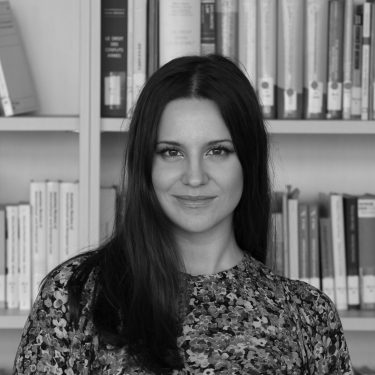
Dr. Joyce De Coninck is a Max Weber Fellow at the European University Institute, and an FWO postdoctoral researcher at Ghent University.
Michelle Staggs Kelsall is an international legal scholar and practitioner whose work spans human rights, business and human rights, and the genealogy of international law. She applies a critical approach to practice while exploring how law, institutions and theory intersect to support dialogue, understanding, and answerability.
Polina Kulish is a PhD candidate and a research associate at the Friedrich Schiller University of Jena. Her fields of research encompass the law of international organisations, law of international security, and media law. In her current research project, she is exploring the nature of member states’ compliance in international organisations. She is a Managing Editor at Völkerrechtsblog.
Céline Chausse is a PhD candidate within the State Silence Research Project (ERC funded) at University College London (UCL). Her current research focuses on non-appearance in inter-state disputes before international courts. Her main fields of interest cover public international law, international adjudication, human rights, and EU law.
Rishiti studied law in UK and Netherlands and holds an LLM Cum Laude in Public International Law. Her academic research centres on digital rights, gender discrimination studies, feminist legal scholarship, and critical approaches to International and European law. She works in ethics of AI and human rights, privacy, and sustainable development.