Seeing International Organizations in a Shifting Landscape
Law, Practice, and Authority*
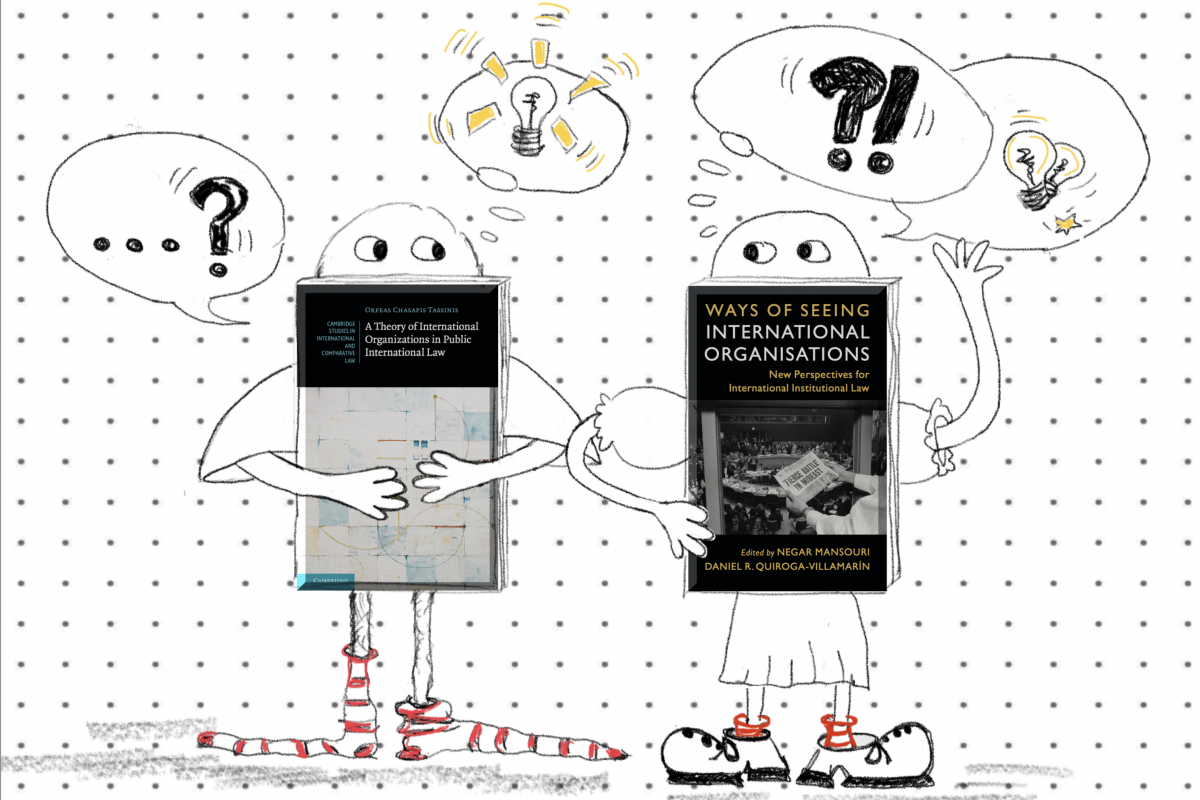
This book review symposium comes at a moment of visible strain in the postwar legal order. As of this writing, Canadian Prime Minister Mark Carney has described a ‘rupture’ in the rules-based world order, warning that multilateral institutions and the architecture of collective problem-solving are under threat. Notably, Carney issued that warning at the World Economic Forum in Davos, before an audience of ‘companies and countries.’ The setting underscores a broader shift in global governance, in which states, firms, and philanthropic actors increasingly occupy shared institutional spaces, unsettling assumptions about law and power at the international level. The books under review—A Theory of International Organizations in Public International Law, by Orfeas Chasapis-Tassinis, and Ways of Seeing International Organisations, edited by Negar Mansouri & Daniel R. Quiroga-Villamarín—offer distinct ways of thinking about what international organizations (IOs) are and how international law decides which collective actors count as public authorities in this altered landscape. This essay first puts these works in conversation with my recent edited volume, States, Firms, and Their Legal Fictions, as invited by the symposium editors, to compare the lenses each use to rationalize human association through groups. Then I consider how these differing rationalities constitute international organizations as entities against the backdrop of a changing world order.
Rationalizing Human Association
Before turning right to the books, it is useful to step back and consider how law organizes and renders legible different forms of human association. Humans organize themselves in many ways and for many purposes: religious communities, advocacy groups, service providers, governance bodies, firms, and research collectives. These forms of association vary widely in scale and formality, from informal neighborhood groups to institutions such as the United Nations, the Catholic Church, or Exxon Mobile.
Lawyers and scholars, in turn, organize these associational forms according to our analytic purposes. Some literatures rely on a now-familiar three-legged schema—government, market, and civil society (see Cohen & Arato, 1994) —or on a public–private divide (e.g. Goldmann, 2016). Domestic law assigns meaning by imposing legal forms: nonprofits, corporations, LLCs, GmbHs, and other entities. These forms do not confer ontology in the sense of physical existence, but they do establish legal existence, assigning consequences such as tax treatment, jurisdiction, separate legal personality, and entity shielding (cf. Pistor, 2019).
International law has traditionally viewed human association primarily through the lens of the sovereign state, relegating other activity to the subnational or inter-state. That picture has become increasingly unstable, unsettled by forms of global governance that blur the lines between states and other actors, and by ever-increasing transnational engagement by all kinds of groups beyond the state.
The point is that human association occupies a densely crowded terrain. Law is one lens through which that terrain is organized. It renders certain forms of association legible as legal entities by attributing status, powers, rights, and responsibilities. Each of the books under review applies a different version of this lens to make sense of international organizations within that broader field.
Lens 1: Law Attributes Duty and Responsibility to Entities
I must credit symposium editor Anna Sophia Tiedeke for the generous and generative suggestion to put the books under review in conversation with my recent volume, States, Firms, and Their Legal Fictions. In that volume the contributors explore how international and domestic law, read together, render the state and the firm legible as entities. Law does not discover these actors as natural facts, but constructs them by attributing rights, duties, authority, and responsibility. Because these attributions are contingent, states and firms can strategically expand or contract their legal identities—claiming rights in some contexts while avoiding responsibility in others.
One of the central concerns of the volume is how these attributional choices can be used strategically. Law can function as a sword, enabling states and firms to claim rights, protections, and immunities. It can also function as a shield, allowing those same actors to avoid responsibility for harm. The result is a recurring pattern of responsibility gaps, where entities claim the power to act without legal consequence. The broader takeaway is that these arrangements are not inevitable: law itself is constructed, and its rules can change.
Viewed through this attributional lens, entity law appears as a strategic tool that powerful actors can use to claim rights and avoid consequences. States, Firms, and Their Legal Fictions did not take up international organizations directly, its analytic framework can travel to other entities. I will turn now to how the Chasapis-Tassinis and Mansouri & Quiroga-Villamarín volumes conceptualize the relationship between law and this particular constructed entity—the international organization—before returning to comparing these approaches with the attributional lens of State, Firms.
Lens 2: Humans Use Entities to Represent Themselves Through Law
Chasapis-Tassinis begins where States, Firms does, by assuming that entities are constructed against this broader range of human associational activity. Rather than foregrounding how law attributes and assigns duties, consequences, and responsibility, Chasapis-Tassinis focuses on how law assigns ontology—how it brings certain collective actors into being as entities that can exist, act, and matter in international law. His conclusion is striking: there is no reason to grant ontological priority to states, as opposed to international organizations, as legitimate authors of public authority.
Chasapis-Tassinis is absolutely right to insist that states and international organizations can be grouped together, at least initially, as forms of human association—as ways in which groups of individuals organize themselves and represent themselves as a collective. This insight resonates with other work on international organizations. Samantha Besson argues that international law has developed legally recognized ways of ‘in-stituting,’ or ‘representing ourselves by law,’ and these include international organizations as well as the state (Besson, 2021, p. 311). The ‘same peoples’ can be ‘different publics’ instituted ‘by many public institutions of international public law at the same time, including States but also … IOs’( Besson, 2024, p. 369). Catherine Brölmann’s recent work highlights that international law has both contractual and communal modes. Authority is not just conferred through Westphalian sovereign consent (the contractual mode), but also emerges through institutionalized, collective practices, such as consultation and decision-making processes that include a wide variety of non-state actors (see also Brölmann in Besson (ed.) 2023, pp.100-116). On this view, international organizations are both conduits for aggregated state consent and sites in which a more communal form of legal authority is produced and exercised.
Building on this lineage, Chasapis-Tassinis concludes that international organizations should not be understood as abstractions derived from the state, or as mere functional instruments of their members. They are, instead, another organization—another institutional form through which human communities act and represent themselves in international law. This is an ontological turn in the sense that Chasapis-Tassinis is concerned with the kind of thing an IO is in international law, not merely what it does or how it should be regulated.
One of the main payoffs of this move is Chasapis-Tassinis’s doctrinal claim that the practice of IOs should count as relevant for purposes such as the formation of customary international law. From his priors, this conclusion follows naturally. If IOs are properly understood as non-derivative public authorities alongside states, then their practice should matter in the same way as those of states. Of course, this also rests on some priors about the nature of customary international law itself: that it remains practice-based and a meaningful site of legal authority and that doctrinal coherence is both possible and desirable.
What I find myself wondering in the context of public authority, though, is how this logic translates to other forms of human organization. What about sub-state units like cities (cf. Aust, 2015)? What about investors speaking through multinational corporations (cf. Lo Giacco, 2023)? What about advocacy groups, religious organizations, or other transnational collectives (cf. Besson & Martí, 2018)? Are international organizations fundamentally distinct from these other forms of human representation, or are they privileged by legal choice rather than by any deeper ontological difference?
That question quickly reveals how much work law is doing behind the scenes, which brings us back to the idea that legal choices are contingent. Analytically, one might distinguish between law’s role in recognizing certain collectives as entities and its role in determining how those entities are treated. But in the context of customary international law, the stakes of both moves collapse into a single question: which collective actors are authorized to participate in the generation of international law, and which are not?
In principle, one could imagine (as a sort of techno-solutionist thought experiment) an elaborate system in which many forms of human association participate in norm generation (the UN, the Catholic Church, the investors in Exxon Mobile…), perhaps through some super-computed, algorithmic governance mechanism that ensures everyone counts not too much and not too little. (Chasapis-Tassinis suggests that we have to ensure that parallel law-generating practice of an international organization and its member state is not double-counted for the sake of establishing a customary legal rule.) Of course, this sort of complex assessment of the practice of individuals through diverse associational forms is not currently realistic, and probably not desirable (cf. Deeks & Hollis, 2025).
So, we reach for something simpler: Perhaps just states? Perhaps states and international organizations, carefully defining which IOs count and subtracting out duplications, as Chasapis-Tassinis proposes? My point is that these choices are ultimately arbitrary in the technical sense. There is nothing inevitable about them. This observation sits uneasily with Chasapis-Tassinis’ ontological ambition—and productively so. If entity recognition is ultimately a matter of legal choice rather than ontological necessity, then the appeal of ontology lies less in discovering what IOs are than in disciplining how we justify treating some collective actors, but not others, as authors of international law.
‘The law of international organizations is stuck in a rut,’ as Jan Klabbers declares in the Mansouri & Quiroga-Villamarín volume (p. 38). Chasapis-Tassinis’ book shakes the trees in the right way. It pushes us to think beyond the ossified account of IOs that imagines billiard-ball states and functional necessity, and also sidesteps the idealistic indeterminacy of constitutionalism. Instead, it forces us to confront the contingent and constructed conceptual choices that underwrite international institutional law.
Lens 3: Entities Are Products of Social Practice
As for the Mansouri & Quiroga-Villamarín Ways of Seeing volume, it too shakes the trees, though from a different angle. The editors aptly note that much of the law of IOs has been generated by practitioners working in a problem-solving mode. Thus, rather than working from first principles, in this area solutions drive theory: a paste-and-staples approach.
This has produced the Frankenstein of functionalism, developed ‘in piecemeal fashion and through mimicry or comparison’ (Mansouri & Quiroga-Villamarín, p. 4), which remains the dominant explanatory frame for the law of international organizations. As many contributors to the Mansouri & Quiroga-Villamarín volume underscore, functionalism increasingly struggles to account for how authority is actually produced and exercised within international organizations (see, e.g., chapters by Mansouri & Quiroga-Villamarín, Chimni, Klabbers, and Sinclair). Functionalism presumes delegation and consent as the sources of institutional power yet offers little purchase on authority that emerges through practice, expertise, interpretation, or institutional routine. Nor does it readily explain how international organizations exercise power, manage inequality, or govern through knowledge in ways that extend well beyond their formally assigned functions. Alongside functionalism sit more idealistic theories like global constitutionalism, which are normatively appealing but descriptively unmoored.
Against this background, the Mansouri & Quiroga-Villamarín volume proposes a different move. Rather than trying to solve doctrinal problems, it asks us to look more carefully at how international organizations are actually constituted and sustained, making use of diverse lenses drawn from anthropology, sociology, political economy, history, and critical theory. The different vantage points of the contributors bring into view practices that doctrinal accounts often obscure: the production of expertise, circulation of data, performance of authority, management of capital, and informal routines through which IOs carry out work on a daily basis.
With such a diversity of perspectives, it can be hard to grasp the volume as a whole. And perhaps this is exactly the point. Guy Fiti Sinclair very effectively scopes out in the last chapter with an evocative allusion to the parable about blind men and the elephant, suggesting that the volume’s project is instead about experience: the contributors show, in necessarily partial and situated ways, how IOs are touched, inhabited, navigated, and lived. These accounts are both ‘deconstructivist’ and ‘(re)constructivist,’ as Sinclair says (Ways of Seeing, pp.314 – 315). I would also add that the project, taken as a whole, unsettles the assumption that the primary task of international institutional law is to tidy up doctrine or render it more coherent. Instead, the volume foregrounds the ways in which international organizations are lived, enacted, and reproduced through mundane practices, with various effects on the allocation of power, resources, and normative authority.
This is a third way of describing the constitution of artificial entities. Where States, Firms, and Their Legal Fictions emphasized that law constructs identity, authority, and responsibility by attributing characteristics and duties and rights, the Mansouri & Quiroga-Villamarín Ways of Seeing volume demonstrates that entities are constructed through the everyday patterns of social practice. The protagonist for States, Firms is law, with powerful states and firms in the background pulling strings, and for Ways of Seeing it is social practice, as carried out by everyday human practitioners.
Putting Mansouri & Quiroga-Villamarín in conversation with Chasapis-Tassinis is to try to bring the volume back into conversation with public international law itself. Ways of Seeing treats legal categories as one institutional method within a broader ecology of practices that constitute international organizations. Where Chasapis-Tassinis seeks to secure IOs as entities through ontological and doctrinal argument, the Mansouri & Quiroga-Villamarín volume suspends that question to examine how organizations are continually made and remade in practice in ways that can be orthogonal to doctrine.
Entities Against the Backdrop of Shifting World Order
To end at the beginning, this review symposium appears at a particular moment in world history—almost certainly a different moment than the authors of these projects anticipated when they began their work. Ways of Seeing critically observes that a central feature of the neoliberal, postwar legal project has been its orientation toward ‘problem-solving.’ Yet many of the problems international law has tried to address are not solved—climate change being the most obvious example. Nor does international law come out well using a rule-abiding lens. How do we study the institutional architecture of the post-war international legal system in these conditions?
At a recent workshop, Andrea Bianchi said something like this: even though the postwar order is being supplanted by something else, we are not turning back to a pre postwar order. Instead, the postwar order will continue to function in its semi-defunct state right alongside whatever order is coming next.
There is work here for a great metaphor. Is the postwar order zombie governance, running on autopilot, or in an institutional afterlife? Most importantly, for the purposes of this essay, the two books shed different light on our possible futures.
The Mansouri & Quiroga-Villamarín volume shows that, regardless of head-of-state geopolitics, international organizations remain sites of intense human activity. Expertise is produced. Authority is performed. Capital is managed. Norms are enacted through routines, rituals, and everyday institutional practices. Even if international law appears irrelevant to power at the highest geopolitical registers, IOs continue to operate as dense social and organizational spaces.
Chasapis-Tassinis’ book exhibits a more exposed, and in some ways more vulnerable, optimism about the classic project of international law. It wagers that international law’s primary rules about how law is generated retain enough purchase to matter even as law’s discipline over states appears to be eroding. The book wants to believe that IO agency matters because classic doctrines still matter; that whatever world order is coming, humans speak through IOs just as they speak through states. The optimism is timely in that this theory resists the idea that the only relevant actors are the (sometimes flamboyantly isolationist, legally backsliding) executive officers of sovereign states.
If Chasapis-Tassinis’ optimism is legal, the Mansouri & Quiroga-Villamarín volume’s optimism is epistemic and methodological, with exposure, critique, and methodological rigor the tools for transformation. From the States, Firms attribution perspective, to think about law as artificial and constructed is also to recognize that it can be reconstructed. In a moment when international law appears simultaneously persistent and powerless, that capacity for reconfiguration may be one of the most important resources we have. Each form of optimism carries its own risk: legal optimism risks irrelevance in the face of power, epistemic optimism risks critique without traction, and faith in law’s plasticity risks capture by the very actors best positioned to reshape it.
Taken together, the projects suggest that the resilience of international institutional law lies less in problem-solving or institutional robustness than in its capacity to furnish vocabularies, authorities, and forms through which humans can represent themselves and organize communal life, even as in other realms power shakes off legal restraint.
*Thanks to Harlan Grant Cohen and Anna Sophia Tiedeke for helpful feedback.