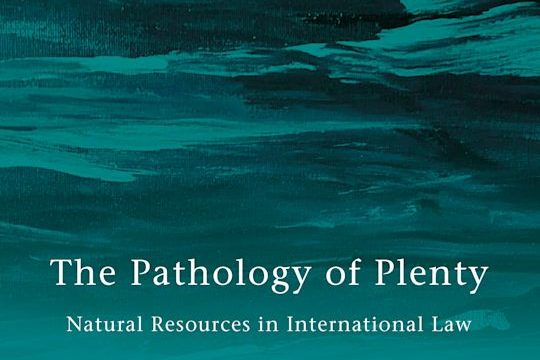
Introducing the Book Review Symposium on ‘The Pathology of Plenty: Natural Resources in International Law’
The current moment in West Asia is marked by a profound and escalating destabilization. Entire urban areas are being flattened through sustained bombardment. This material destruction is accompanied by increasingly unrestrained political rhetoric. The Israeli Finance Minister Bezalel Smotrich warned that Beirut’s southern suburbs could ‘soon resemble Khan Younis’, a city in the Gaza Strip that has been effectively flattened by the Israeli Defense Forces. U.S. President Donald Trump, in the context of escalating tensions with Iran, threatened that ‘a whole civilization will die tonight, never to be brought back again’. Read together, these statements reflect a broader discursive shift in which the destruction of entire populations is articulated as a conceivable outcome.
These developments reverberate through the global political economy, particularly in relation to energy. The Strait of Hormuz, a central artery of global oil transit, has once again become a site of instability, exposing the fragility of a system dependent on uninterrupted resource flows. These flows follow a long-standing pattern from the periphery to the center. The instability surrounding Hormuz reveals how the circulation of resources remains inseparable from the organization of power.
Western Asia, long positioned at the center of the global energy economy, exemplifies how the management of territory and population remains deeply intertwined with the imperatives of resource control. The large-scale violence in this region is part of a longer trajectory in which destruction clears land, reorganizes territory, and enables new forms of economic valorization.
This logic becomes particularly evident in post-war reconstruction. Initiatives envisioning Gaza as a luxury ‘Riviera’ reframe the territory as a site of economic value, abstracted from its population, history, and legal status. Land, infrastructure, and coastal geography are recast as assets for tourism, investment, and profit. Similarly, governance models such as the ‘Board of Peace’ position reconstruction as an opportunity for capital growth. In this framework, the destruction of critical infrastructure constitutes a moment that resets the conditions of ownership and control over the territory at issue. Reconstruction projects, financed and executed through transnational public-private partnerships, investors, contractors, and development institutions, enable the re-entry of capital under newly defined terms, prioritizing large-scale investment projects, privatized service provision, and market-oriented urban redevelopment. In this sense, reconstruction reorganizes space in ways that align with global circuits of capital, embedding new forms of dependency and control. Destruction and reconstruction thus operate as successive moments within a single economic logic of genocide – one that transforms devastation into opportunity, and in doing so, renders violence productive of accumulation.
It is precisely this entanglement that The Pathology of Plenty: Natural Resources in International Law brings into focus. Lys Kumadayil’s central contribution is to show that the relationship between resource wealth, inequality, and violence is not incidental, but in fact legally structured. The book traces how international law governed the transition of control over natural resources from colonial to post-colonial contexts, demonstrating that doctrines such as permanent sovereignty over natural resources and economic self-determination, while articulated in emancipatory terms, frequently operated to stabilize and reproduce existing global hierarchies. Thus, this symposium engages with Lys Kumadayil’s intervention by examining how these entanglements of international law, political economy, and natural resources continue to shape contemporary configurations of power.
Priya Gupta engages with The Pathology of Plenty to highlight how international law is deeply implicated in structuring the unequal distribution of natural resource wealth. Her piece emphasizes the book’s central insight that the so-called ‘resource curse’ is not merely a matter of governance failure, but rather a product of legal and political-economic arrangements that both constrain and enable Global South sovereignty. By tracing these dynamics across doctrinal contexts, the piece underscores the relevance of Kulamadayil’s analysis for understanding contemporary forms of extraction, power, and inequality.
In their contribution, Francesca Romanin Jacur and Roberta Ezechia explore The Pathology of Plenty through the lens of contracts, transparency, and collective rights. They highlight how extractive agreements and investment frameworks play a central role in shaping the distribution of resource wealth, often entrenching long-term inequalities. Their analysis also considers emerging efforts, such as transparency initiatives and the recognition of indigenous and minority rights, that seek to address these imbalances, while emphasizing their limitations.
Juan Auz builds on The Pathology of Plenty to argue that extractive inequality has expanded beyond territorially bounded resources into the atmosphere itself. By conceptualizing the atmosphere as a natural resource, his contribution shows how its exclusion from international legal frameworks has enabled its disproportionate appropriation, transforming localized extraction into a global condition of carbon metastasis. The result is a form of climate apartheid, in which historical patterns of accumulation continue to shape the uneven distribution of environmental harm.
Ameed Faleh situates The Pathology of Plenty within the context of the political economy of West Asia, linking its insights on resource governance to contemporary dynamics of war, energy politics, and global inequality. In doing so, he highlights how international law has both enabled and constrained struggles over resource sovereignty, and ultimately question its capacity to deliver emancipatory outcomes. His discussion of historical debates on dependency and decolonization with present-day geopolitical shifts underscores the continued relevance of Lys Kulamadayil’s framework for understanding how extraction, power, and law intersect. The piece concludes by reflecting on how these dynamics have intensified in Palestine and the broader Western Asian region, where the ‘pathology of plenty’ appears to be reaching a critical breaking point.
Raghavi Viswanath and Claire Smith draw on Pathology of Plenty to explore a new direction, namely that of abolitionist practice in international law. Their contribution highlights the tension in Lys Kulamadayil’s analysis, which addresses the inherent paradox of producing pathologies of plenty while naming and critiquing the same. In introducing the lens of abolition, the authors trouble Lys Kulamadayil’s diagnosis of pathologies and invite attention towards the messiness of international law’s enterprise, as it obscures the continuities and discontinuities between legal registers, lifeworlds, and timelines of violence.
Taken together, these contributions build on The Pathology of Plenty’s central insight, namely that international law is not external to the political economy of extraction but is deeply implicated in its reproduction. By foregrounding the role of law in organizing access to and control over resources, the symposium invites a reconsideration of sovereignty, self-determination, and justice under conditions of enduring global inequality. At the same time, it compels us to confront a more unsettling possibility: the same legal and economic structures that have long enabled extractive inequality may also accommodate, or even facilitate, forms of large-scale violence, including genocide, where control over territory and resources is at stake.

Khaled is working as a law clerk at the Higher Regional Court of Berlin. Prior to this, he worked as a research assistant at the Chair of European and International Law at the University of Potsdam. His research interests focus on international environmental law, the law of the sea, and the procedural law of international courts and tribunals. He is also a Managing Editor at Völkerrechtsblog.