The Historical Timeliness of Lys Kulamadayil’s Pathology of Plenty
A Review
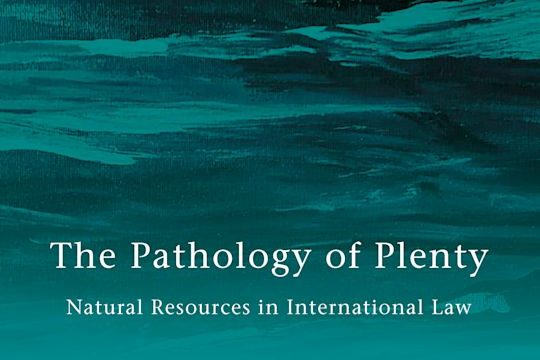
Lys Kulamadayil’s The Pathology of Plenty gives a critical account of the role of international law in governing natural resources, primarily those of the Global South. While readers might be familiar with various existing accounts of the issue of permanent sovereignty over natural resources, Kulamadayil’s book offers an original argument and contribution.
Kulamadayil takes as her starting point the mainstream account of the so-called “resource curse” or “paradox of plenty” whereby Global South countries with abundant natural resources often end up worse along common indicators of economic and human development. The book frames this central issue as a “puzzle,” in response to which it offers a multi-sited examination of what international law “has to say” about it. As we learn, international law has in fact had quite a bit to say, and is deeply implicated in both, the maldistributions of wealth associated with mineral resources as well as in hope for structural change. Each chapter grapples with this dilemma by detailing the “paradoxical” roles that international law plays by being both, constitutive of as well as responsive to the so-called “curse”.
The book puts a commonly held set of beliefs relating to development, linear progress, and resources under a critical legal lens, primarily informed by postcolonial theory and Third World Approaches to International Law (TWAIL). Kulamadayil recasts the resource curse/ paradox of plenty phenomenon as the “pathology of plenty.” The turn to ‘pathology’ indicates that analyses of the situation of natural resources must go beyond simplistic explanations of corruption or poor governance and rather must engage with the many dimensions (symptoms) through which the pathology orders the global economy. This three-dimensional (holistic) analysis necessitates excavating the implicit aims that shape anti-corruption and anti-money laundering regulations, the existence of international sanctions or other coercive measures which constrain Global South autonomy, and the imbalance of power in intergovernmental organizations when international law is formulated or treaties are negotiated, for example. All of these manifestations of the pathology shape how Global South sovereignty over natural resources is actually able to be exercised.
Flowing through the book is the question of how international law regarding natural resources was formulated to facilitate supply from former colonies to former empires, even after formal independence. The answers given are richly textured and differentiated. Throughout the book, she does not just tell us that supply was facilitated through law but rather how: what kinds of legal arrangements emerged through bilateral or multilateral negotiation or through U.N. General Assembly resolutions, or in international or domestic law articulated in various court cases and regulations.
The in-depth illustrations demonstrate that inquiries into the governance over natural resources must go further than whether a country has formal sovereignty over natural resources and rather examine more granularly the specific conditions under which sovereignty could be exercised. The book details a myriad of significant constraints on sovereignty, including international sanctions, imperially- engineered coups, unfair bargaining in international institutions and in trade and investment agreements, or conditional loans for infrastructure that require legal reforms which favor foreign investors, and so much more.
And yet, the book also provides us with an alternative story about the Global South. She shows us how Global South countries were, at times, able to shift legal norms around sovereignty over natural resources. This argument goes beyond common critiques or binaries of power/ powerless.
The various illustrations also demonstrate a rich differentiation of Global South countries. The Global South is not presented as a monolith, nor do Global South counties have easily definable set of interests. Two of her key examples here – Iran and Algeria – involve oil. With regard to Iran, she takes us through the legal framework of oil-related concessions with Britain, Iran’s nationalization of oil under Prime Minister Mossadegh and the ensuing US-engineered coup. She then examines the lease arrangements that followed, noting that, while the nationalization failed formally speaking, the shift of legal arrangements from concessions to production-sharing nevertheless, at least partially, led to the emergence of a sovereign regime. Algeria provides a contrasting example where, as she explains, France’s claim to Algerian oil was not a contractual one, but rather an imperial one. Therefore, the path to sovereign control was closely entwined with decolonization itself.
Through these examples and many more, the book engages with public international law, human rights, various domestic legal regimes, contract law, property law, tort law, and international economic law. Examining the intersection of these various fields of law problematizes what is sometimes cabined off as technical and economic – rather than political – and demonstrates how economic distributions and power differentials are etched into legal doctrine in seemingly neutral language. We are shown how economics are of course deeply political and through her engagement with political economy, we learn a more generalizable lesson about law, namely that it should not be divorced from its material contexts.
This conceptualization frames her discussion of anti-corruption and anti-money laundering regulation, where she argues convincingly that the purposes of these regimes have been to protect the global marketplace rather than its citizenry. The book therefore provides a powerful account of how legal norms are made, and how they shift with time and exercise power – whether through treaties or even by force.
It also shows us how the powers of private actors shape the public. The role of the state here is not completely separable from the role of corporations. While the book does not engage directly with corporate power, it is made clear that corporate and financial actors are not all powerful without the states that enable them and continue to design law in their interest.
The book constitutes a rare lawyer’s account of doctrine, distilled into a highly readable account suitable for a more general audience. The treatment of historical cases, treaties, and regulations prepare the reader to address a variety of broader questions regarding law.
In that sense, the book’s rich illustrations also prompt the reader to pursue a variety of further inquiries: what is the public? Is it international institutions, the state, particular governments, or the people? What happens when state governments change? What happens if the government change is not the result of exercised popular sovereignty but of a coup orchestrated by imperial powers? Do international institutions yield material power that shapes today’s world and how do they exercise such power? The book provides reference not just to the general system, but also to UN Conference on Trade and Development, the International Labor Organization, and other intergovernmental organizations, acknowledging different modes of participation by Global South countries in each of these institutions. These questions are all the more pressing in our current political environment with the withdrawal of participation or funding by the United States in many of these institutions.
In closing, the book demonstrates that the history of how public international law shaped sovereignty over natural resources is essential to understanding ongoing neo-imperialist and capitalist structures today. Its coverage of crucial historical moments and legal shifts gives readers the tools to deepen their understanding of many circumstances today: from oil-related legal arrangements in Venezuela, Israel’s encroachments on Palestinian territorial sovereignty, and the U.S.’ ambitions to annex Greenland to recent activities of asset manager BlackRock in rebuilding Ukraine.